



Financial markets underwent a substantial and aggressive hawkish reassessment of Federal Reserve policy, driving US Treasury yields sharply higher and pushing the Dollar Index to a fresh 2026 high. While non-yielding assets such as gold and Bitcoin suffered heavy losses due to tighter financial conditions, US equities advanced and market volatility declined, indicating that the dominant market driver was a recalibration of interest rate expectations rather than a broad, defensive flight from risk.
The scale of this policy adjustment proved striking across asset classes. Markets entered the week pricing roughly two additional quarter-point Federal Reserve rate hikes through September 2027, but ended the period anticipating nearly four. This significant shift was triggered primarily by Federal Reserve Governor Christopher Waller, who warned that larger interest rate increases might become necessary. His comments were closely followed by an October Consumer Price Index (CPI) report that met his explicit threshold for considering a 50-basis-point move. Although other central bank policymakers reinforced the overarching need for further monetary tightening, they offered diverging views regarding its ideal pace and provided no clear endorsement of the full path currently embedded in market prices.
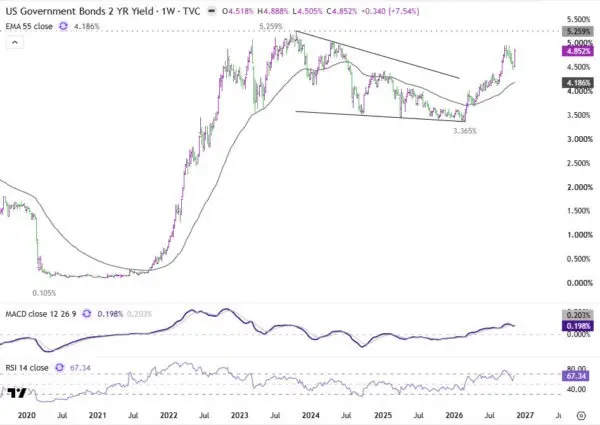
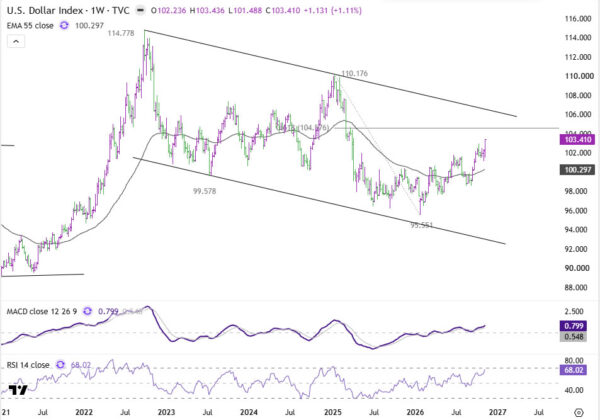
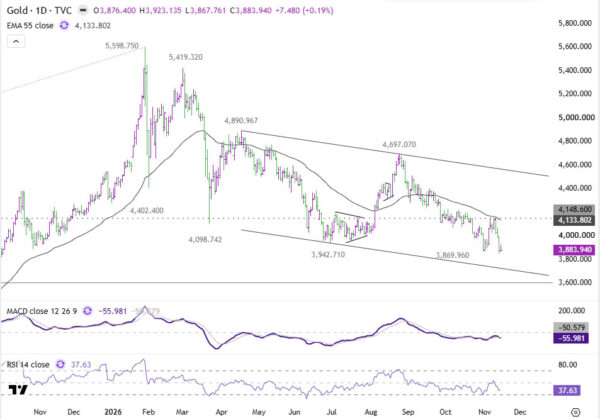
The central question facing traders and investors moving forward is whether economic data can justify the additional tightening already priced into financial instruments. The technical backdrop adds considerable urgency to this inquiry, as US two-year Treasury yields approach the key 5% psychological threshold, the Dollar Index breaks through significant overhead resistance, gold threatens a decisive breakdown below the 3,870 level, and Bitcoin breaches a major retracement milestone.

Fed Expectations Shift From Two Hikes to Nearly Four
The most consequential change in market sentiment centered not on the immediate expectation of another rate increase at the upcoming December Federal Open Market Committee meeting, but on the expected scale and timing of subsequent tightening. Prior to the week’s events, markets had already assigned a high probability to a December rate move, with additional modest tightening anticipated further out on the horizon.
At the close of the previous trading week, Fed funds futures pricing implied approximately 47 basis points of additional monetary tightening through September 2027, translating to just under two standard quarter-point hikes. By Friday of the following week, that aggregate expectation had climbed to around 90 basis points, representing approximately 3.6 quarter-point hikes. In essence, markets had nearly doubled the amount of forward tightening they expected the Federal Reserve to deliver over the cycle.
The probability of a December rate move shifted decisively, with CME FedWatch data assigning an overwhelming probability to a quarter-point adjustment, alongside a notable non-zero chance of a larger move. More importantly, the probability of cumulative tightening reaching at least 50 basis points by January jumped sharply. This repricing extended progressively further along the policy curve, with expected cumulative tightening increasing across multiple horizons.
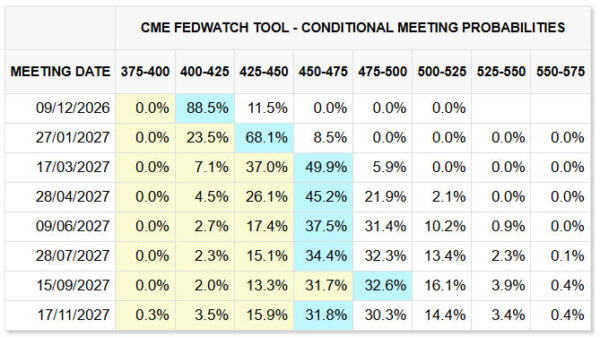
This distinction remains critical for market participants. The financial community was not simply betting on a larger adjustment at the next meeting; it was actively pricing a more sustained, prolonged tightening cycle and a significantly higher eventual terminal policy rate. Because the bulk of this adjustment occurred early in the week, subsequent economic releases served largely to test rather than dramatically alter this newly established baseline.
Waller’s Warning and October CPI Triggered the Repricing
The definitive turning point for global markets arrived when Federal Reserve Governor Christopher Waller raised the distinct possibility of accelerating the central bank’s monetary tightening campaign. Speaking at an international conference ahead of the domestic inflation figures, Waller indicated support for a standard 25-basis-point increase in December even if headline inflation readings showed improvement over September levels. However, he argued that a more aggressive 50-basis-point move ought to be actively considered if monthly core CPI figures reached approximately 0.3% or higher.
Waller cautioned that failing to act decisively would place central bank credibility at risk. His commentary extended beyond immediate inflation figures, highlighting a sophisticated feedback loop between actual policy actions and broader financial conditions. Because anticipated future rate increases had already tightened financial conditions independently, any failure by the Fed to deliver on those market expectations risked triggering a premature easing of interest rates, which could ultimately undermine the central bank’s mandate to restore price stability.
The subsequent release of the October Consumer Price Index report directly validated these concerns. Core consumer prices increased by 0.3% on a month-over-month basis for the third consecutive month, outstripping consensus forecasts of 0.2% and hitting Waller’s specified threshold. Headline CPI rose by 0.4%, also exceeding expectations, while internal metrics revealed persistent underlying price pressures within services components, particularly in areas excluding shelter.
Although a subsequent Producer Price Index (PPI) release offered a minor downside surprise on headline numbers, underlying producer inflation metrics remained uncomfortably elevated. This mixed producer data interrupted the immediate upward momentum in yields but failed to alter the broader inflation narrative that had dictated the week’s trading behavior.
Fed Officials Support More Tightening, but Differ Over Pace
While Waller’s remarks served as the primary catalyst for a more aggressive interpretation of the central bank’s reaction function, statements from other regional Federal Reserve presidents revealed a more nuanced internal debate regarding the appropriate path forward.
Dallas Fed President Lorie Logan voiced support for implementing at least two additional quarter-point increases, suggesting that a faster policy cadence might ultimately become necessary. Kansas City Fed President Jeff Schmid described current monetary policy as remaining fairly accommodative, reinforcing the view that borrowing costs had not yet reached a sufficiently restrictive plateau.
Conversely, other policymakers favored a more measured approach. Cleveland Fed President Beth Hammack advocated for smaller, more frequent rate adjustments, arguing that a gradual pace would grant households and businesses adequate time to adapt smoothly. She explicitly rejected the notion that the central bank had fallen significantly behind the economic curve. Similarly, San Francisco Fed President Mary Daly emphasized that rising Treasury yields were already performing the heavy lifting of tightening financial conditions, giving policymakers valuable breathing room for calibrated decision-making.
Other officials, including Austan Goolsbee of Chicago and John Williams of New York, acknowledged that inflation remained at a precarious juncture and supported further policy adjustments without committing to a specific timetable or magnitude. The emerging institutional consensus confirms that interest rates must continue to rise; the ongoing debate centers entirely on the required velocity and ultimate destination of those adjustments.
Treasury Yields Lead Dollar Higher While Equities Resist Risk-Off Pressure
The US Treasury market provided the most direct mathematical expression of this shifting monetary policy calculus. The two-year Treasury yield surged sharply over the course of the week, while intermediate and long-term yields experienced comparable upward pressure. The front-end outpaced the long end, resulting in a slight flattening of the yield curve that is characteristic of policy-driven repricing rather than a generalized deterioration in long-term economic outlooks.
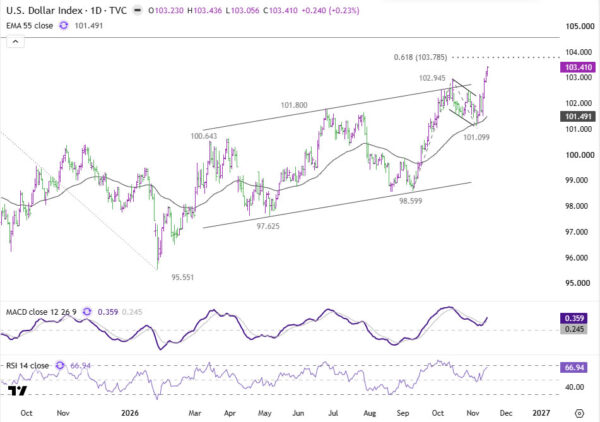
Sovereign bond yields climbed concurrently across major international economies, including the United Kingdom, Canada, and Japan, but US yield increases remained markedly larger. This divergence widened international yield differentials, providing a fundamental economic tailwind for the US Dollar. The Dollar Index climbed robustly, breaking cleanly above significant medium-term resistance and registering widespread gains against major global currencies.
Crucially, the nature of the currency rally pointed toward a yield-driven advance rather than a traditional safe-haven scramble. This distinction was underscored by developments in the equity markets, where major US stock indices mounted a recovery. The S&P 500, Nasdaq, and Dow Jones all posted solid weekly gains, while market volatility measures retreated sharply. Although higher interest rates continued to present valuation challenges for longer-duration growth and technology shares, the broader market demonstrated resilience rather than succumbing to a uniform withdrawal from risk.
Gold and Bitcoin Bear the Brunt of Tighter Financial Conditions
In stark contrast to equities, non-yielding and alternative assets bore the heaviest burden of higher real yields and a surging US Dollar. Gold suffered substantial losses over the week, driven down by the direct economic transmission mechanism where higher real interest rates elevate the opportunity cost of holding precious metals, while a stronger greenback creates an additional valuation headwind.
Bitcoin experienced even sharper downward volatility, breaking below key technical retracement levels. While cryptocurrency valuations are driven by a complex interplay of liquidity conditions, speculative positioning, and sector-specific catalysts, digital assets remain highly sensitive to broader macroeconomic tightening. The sharp increase in global borrowing costs reduced the relative attractiveness of alternative stores of value that generate no conventional income stream.
This divergence between advancing equities and declining alternative assets reinforces the conclusion that the week’s market movements were primarily a function of interest rate repricing rather than an indiscriminate panic across risk assets. Both gold and Bitcoin encountered intense technical pressure as the macroeconomic environment shifted decisively in favor of yield-bearing instruments.
Two-Year Yield Approaches 5%, Dollar Targets Further Gains
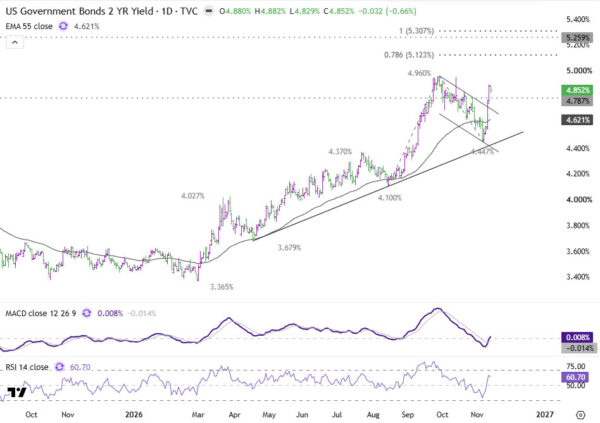
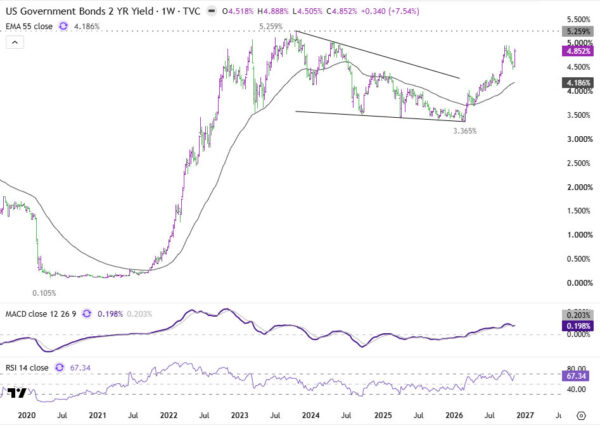
The technical structure of the US two-year Treasury yield reinforces the narrative that corrective pullbacks have completed and that upward momentum remains dominant. Having successfully defended key moving averages, the immediate technical focus centers on the upper resistance zone approaching the 5% mark. A decisive, sustained break above this threshold would confirm the resumption of the broader uptrend that originated earlier in the year, opening the door toward higher projected targets. On a multi-year horizon, market technicians are closely watching whether yields can overcome the longer-term peaks established in prior economic cycles.
Parallel technical developments are unfolding in the foreign exchange market. The Dollar Index’s decisive break above medium-term resistance and its channel boundaries signal an acceleration of upside momentum. Sustained trading above key moving averages suggests that the currency’s recovery structure remains intact, with further upside targets coming into view as yield differentials continue to favor the greenback.
Gold and Bitcoin Face Critical Technical Thresholds
Gold experienced a volatile week, briefly breaching vital multi-week support before staging a partial recovery ahead of the weekend close. Despite avoiding an immediate, catastrophic breakdown, the near-term technical bias for the precious metal remains fragile as long as overhead resistance caps recovery attempts. A confirmed, sustained close below key structural support would validate the initiation of a deeper correction from historic record highs, exposing lower retracement levels on the weekly charts.
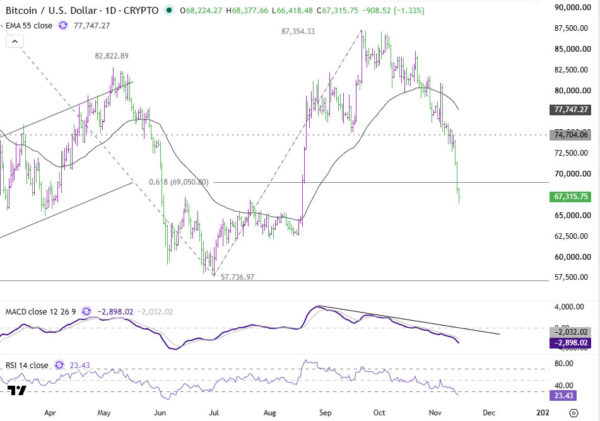
Meanwhile, Bitcoin’s technical deterioration is notably more advanced. The leading cryptocurrency broke sharply through major retracement thresholds, accelerating downward and testing critical support zones. While short-term momentum indicators reached oversold territory, signaling the potential for temporary technical bounces, the broader weekly structure indicates that the corrective phase remains in play. A decisive breach of foundational multi-month lows would expose significantly deeper downside projections, highlighting the severe impact of tighter global liquidity conditions on speculative asset classes.
The defining narrative of the financial markets remains the stark disconnect between aggressive market pricing and the measured guidance issued by central bankers. As investors await incoming economic reports on inflation, employment, and retail activity, the central question is whether incoming macroeconomic data will ultimately validate nearly four additional rate hikes or prompt a sharp reassessment. Until that clarity emerges, Treasury yields, foreign exchange markets, and alternative assets will remain highly sensitive to every incoming data point.