



Navigating the intricacies of government-supported financial planning in Canada can often feel like an uphill battle, but for one family, a recent milestone has highlighted the profound positive shifts built into the system. Two years after securing a lifelong renewal of the Disability Tax Credit (DTC), a Canadian parent has received their son’s 2026 Statement of Entitlement in the mail, revealing a dramatic and welcome change in how government grants and bonds are calculated now that the beneficiary has crossed a crucial age threshold.
The arrival of the 2026 statement marks a significant financial transition. Because the beneficiary is now over the age of 19, the calculation of his Registered Disability Savings Plan (RDSP) grants and bonds has shifted entirely. Rather than being evaluated against the parent’s household income—a hurdle that often restricts matching rates for middle-income families—the calculations are now based exclusively on the beneficiary’s personal income.
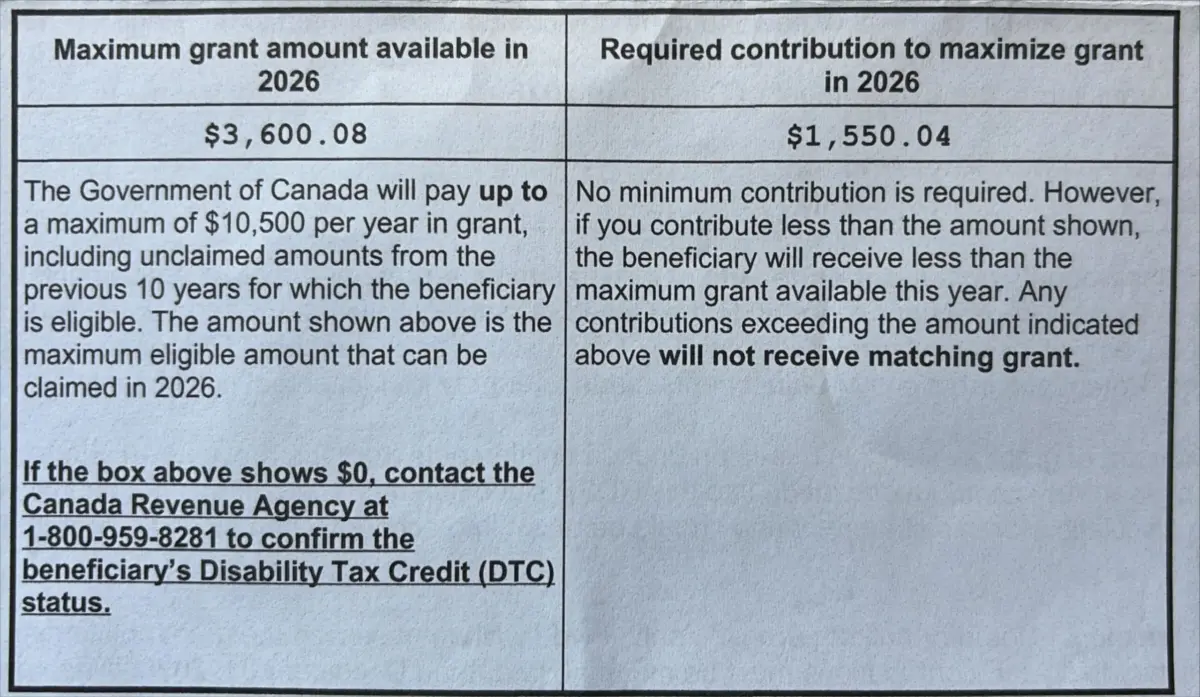
Because the young man remains a student, his independent income is nearly zero. The impact of this low-income assessment is clearly reflected in his latest Grant Statement, which shows notably higher matching numbers than in previous years. Furthermore, due to his diminished personal income, he also qualified for a federal Bond this year, adding another layer of support to his long-term financial security.
Reflecting on the proactive steps taken years earlier, the parent noted the foresight involved in setting up a Registered Education Savings Plan (RESP) for him, which supported his educational journey while keeping his current financial profile lean. All the incoming grant and bond money, along with the internal growth generated within the RDSP, will eventually be taxed in the beneficiary’s hands when he finally starts drawing from the account down the road.
To maximize the government’s support for the current year, an automatic deposit plan is being established to reach approximately $1,500, representing the maximum amount the federal government will match annually. Under current rules, contributors can deposit any amount of money into an RDSP at any time during the year, provided they remain mindful of the lifetime maximum contribution limit of $200,000. For each eligible contribution made within these parameters, the corresponding matching grant is automatically triggered within the plan.
Despite these mechanics, the broader financial community often overlooks the RDSP. It lacks the viral nature of trending social media topics and rarely commands mainstream financial headlines. Yet, financial analysts frequently point to it as one of the most generous government-supported savings vehicles available in Canada. The unique combination of Canada Disability Savings Grants (CDSG) and Canada Disability Savings Bonds (CDSB) can dramatically amplify even modest, consistent contributions over a long horizon, making it a cornerstone of disability financial planning.

The transition at age 19 represents a pivotal moment for many Canadian families managing an RDSP. When the assessment shifts from family income to the independent income of the beneficiary, families routinely see a dramatic increase in grant eligibility. For students and individuals with disabilities whose personal income remains minimal, this structural shift unlocks the highest possible matching tiers from Ottawa.
While the family does not expect the beneficiary to qualify for the Ontario Disability Support Program (ODSP) under current projections, that factor remains secondary to the long-term wealth-building capability secured through the RDSP framework. The primary focus remains on cultivating a resilient, very long-term savings plan designed to provide financial stability decades into the future.
DTC & RDSP FAQ
What happens to your RDSP if your DTC expires?
The account will no longer receive grants or bonds until the DTC is successfully renewed. Maintaining a valid DTC is a continuous requirement for active federal contributions.
When your DTC is renewed, how long will you receive a new statement of grant eligibility?
The processing window typically spans six to eight weeks, though timelines can vary depending on the workload of Employment and Social Development Canada and the Canada Revenue Agency. Beneficiaries or legal representatives who do not receive documentation after eight weeks are advised to follow up via phone.
My provider has locked my RDSP account so I can not put any money in, what can the HSDRC do about that?
Employment and Social Development Canada cannot intervene directly, as this typically stems from individual financial institutions enforcing their own administrative policies regarding RDSP accounts. Account holders must navigate these restrictions directly with their bank or credit union until standard deposit functions are restored.
Can an RDSP be included in a bankruptcy proceeding?
No. Legislative protections specifically exclude the RDSP from all bankruptcy actions, ensuring that accumulated long-term savings remain protected for the beneficiary’s future security.