




For many individuals pursuing financial independence, traditional investment portfolios consisting of stocks and bonds form the bedrock of their long-term strategy. However, a growing number of financial independence advocates treat accumulated travel miles and points as an entirely separate, highly lucrative asset class. By strategically maximizing credit card rewards and everyday spending, savvy travelers can generate thousands of dollars in annual value, effectively reducing the size of the core portfolio required to sustain early retirement.
Tracking the tangible value extracted from travel rewards over the years reveals a substantial financial impact. Historical tracking shows consistent returns from points and miles, with totals reaching $2,614 in 2019, $4,401 in 2020, $6,080 in 2021, and $6,192 in 2022. Following a modest dip to $648 in 2023, the value rebounded dramatically to $10,593 in 2024, followed by $4,253 in 2025 and $5,917 in 2026. Across these tracked years, the average annual value consistently exceeds $5,000.
Applying standard financial independence math to these figures demonstrates the profound weight of this secondary portfolio. Utilizing a traditional 4% safe withdrawal rate, generating $5,000 per year in travel rewards equates to having an additional $127,175 that does not need to be stored within the core investment portfolio. This realization shifts the perspective of credit card rewards from mere consumer perks to a legitimate, functional supplement to retirement planning.
Building and Simplifying the Secondary Portfolio
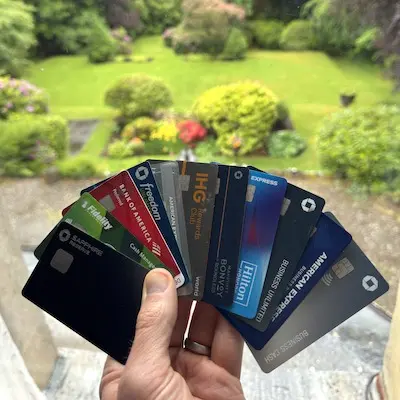
While portfolio management strategies for traditional investments are widely discussed, the composition of one’s wallet deserves equal strategic consideration. Over the years, the approach to managing these financial tools has shifted from intense optimization toward deliberate simplification. Rather than constantly chasing every new sign-up bonus or temporary promotion, settling on a curated lineup of reliable, high-performing cards creates a sustainable system that requires minimal ongoing maintenance while delivering maximum long-term value.
At the center of this wallet is the Chase Sapphire Reserve, which serves as the primary instrument for the vast majority of daily purchases. Acquired when it was first introduced in 2016, this card has remained the undisputed go-to option for over 95% of consumer spending. According to valuations by industry experts at The Points Guy, Chase Ultimate Rewards points carry a significant baseline value. When factoring in the robust point multipliers—such as four times the points on flights and hotels, and three times the points on dining—the effective cash-back equivalent climbs to over 8% on travel and 6% on dining, making them exceptionally lucrative for major lifestyle expense categories.
Beyond point accumulation, the card provides substantial auxiliary benefits that enhance the travel experience. Comprehensive airport lounge access delivers immediate financial and comfort benefits, saving approximately $100 every time travelers pass through airports lacking dedicated lounges while transforming stressful transit days into relaxed experiences. Furthermore, recent adjustments to the card’s annual fee structure introduced a fresh wave of perks that have yielded substantial monetary returns since their inception.
Essential Non-Points Cards and Everyday Spending Tools
While reward-earning cards capture much of the attention, certain non-reward cards remain indispensable components of a well-rounded financial toolkit. The Fidelity Cash Management Debit Card, for instance, earns no miles or points, yet it stands out as one of the most vital cards in the wallet for international and domestic utility alike.
When traveling abroad, the necessity of exchanging currency or acquiring traveler’s checks is eliminated entirely by withdrawing local currency directly from foreign ATMs upon arrival. The exchange rates provided through this mechanism consistently rival or beat traditional foreign exchange kiosks, offering both superior financial terms and unmatched convenience. Domestically, the card offers an equally compelling advantage through its complete reimbursement of all ATM fees. Cardholders can utilize any ATM nationwide without needing to locate a specific bank branch, secure in the knowledge that any incurred fees will be fully refunded by Fidelity, regardless of the amount. A traditional bank debit card is also maintained primarily for occasional cash withdrawals when in immediate proximity to a specific branch location.
For everyday spending within the United States that falls outside the realms of travel and dining, the Chase Freedom Unlimited card handles non-category purchases. Offering a baseline return of 1.5 points per dollar, and factoring in the elevated valuation of Chase points, the card functions effectively as a 3% cash-back vehicle on all general spending. Because it carries no annual fee, it remains a permanent fixture in the long-term financial strategy. Similarly, the Amex Everyday card is deployed specifically for supermarket spending to capture elevated rewards on grocery purchases.
Managing Hotel and Business Portfolios
A collection of specialized co-branded cards rounds out the portfolio to handle specific brand-loyal expenditures and business operations. Although the IHG Select card is no longer open to new applicants, cardholders have not been forced to upgrade, retaining the card largely because it delivers a complimentary annual hotel night in exchange for a modest $49 annual fee. Similarly, the Chase Marriott Bonvoy Boundless card is reserved strictly for Marriott purchases, justified by the delivery of an annual free night worth up to 50,000 points for a $95 annual fee. The Hilton Honors American Express card serves a comparable purpose for Hilton-specific bookings, kept active due to its lack of an annual fee.
On the commercial side, the Chase Ink Business Unlimited acts as the primary business card, offering 1.5 points per dollar on all business purchases with no annual fee. The Amex Business Blue provides an alternative avenue for building American Express point balances by earning two points per dollar on up to $50,000 of annual spending without an annual fee. The Chase Ink Business Cash is retained despite infrequent use, purely because its lack of an annual fee makes holding it cost-free.
Maximizing Modern Credit Card Perks
Recent structural changes to premium travel cards have introduced complex suites of statement credits and lifestyle benefits. While aggressive perk systems can occasionally encourage unnecessary consumer spending—functioning similarly to how gift cards prompt discretionary purchases—they also provide a valuable framework for individuals actively learning how to strategically allocate funds toward enjoyable experiences.
Recent utilization of these updated perks demonstrates significant monetary savings across various lifestyle categories. For example, a two-night stay at a downtown hotel generated a substantial statement credit, complemented by daily dining vouchers and property credits used for high-end culinary experiences. Additional statement credits successfully offset the costs of premium dinners, concert tickets, and sporting events. Furthermore, meeting high annual spending thresholds unlocked major travel credits and airline status, yielding direct savings on baggage fees and airfare.
When combining statement credits for hotels, dining, entertainment, and travel, the cumulative financial return from a single premium card easily exceeds thousands of dollars in annual value. This total does not even account for the intrinsic benefits of airport lounge access for cardholders and guests, or TSA PreCheck credits. For those who travel frequently and intentionally leverage these structured benefits, the math clearly demonstrates why premium travel cards remain powerful financial instruments.