



Financial markets found themselves navigating a complex web of high-stakes political developments, shifting geopolitical tensions, and surprising macroeconomic data releases. In what initially sounded almost too good to be true, news broke on the very day of the US midterm elections that the United States had approved a new draft Memorandum of Understanding (MoU) presented by the Qatari delegation.
So far, neither the United States nor Iran has officially confirmed the report, with both nations reportedly discussing plans to make a simultaneous announcement regarding the diplomatic breakthrough. While details remain exceptionally scarce and market participants have been urged to treat the reports with caution, the fresh MoU is said to contain mutual concessions centered on the sensitive nuclear topic and the status of frozen Iranian assets. This diplomatic initiative follows an earlier memorandum dating back to June 2026, which ultimately unraveled amid renewed military escalations and naval blockades in the region.
The latest diplomatic momentum follows reports that US President Donald Trump would favor returning to diplomatic engagement rather than pursuing new military strikes to bring an end to the protracted Middle East conflict. This sudden shift in sentiment triggered a sharp downward correction in energy markets. Brent crude prices plummeted from $118 on Friday—helped along by a contract-roll—to below $105 yesterday. The downward leg extended further toward the psychological $100 barrier today before Brent managed to pare some of its losses, stabilizing near $103.8 per barrel.
European natural gas prices experienced an even more dramatic slide, with Dutch TTF gas contracts collapsing to €86 perMWh before recovering to €92 perMWh. By comparison, these same contracts were trading comfortably around €104 perMWh at the end of last week. Across the fixed-income landscape, core bonds temporarily erased their earlier losses. US Treasuries returned to underperforming German Bunds, with yields adding 1 to 2 basis points across the curve, while German yields ticked up by 2 basis points within the 10-year to 30-year sector.
European stock markets and US stock futures initially bounced higher, though intraday price movements reflected a healthy dose of caution among investors wary of chasing unconfirmed, headline-driven risk-on rallies. For the EuroStoxx 50, the volatile session ultimately translated into flat trading rather than minor losses. Meanwhile, Wall Street entered the midterm election day with a mixed performance, as the Dow Jones Industrial Average fell 0.7%, while the tech-heavy Nasdaq Composite added 0.8%. In the currency markets, the euro once again attempted to breach the key EUR/USD 1.12 threshold, but the upward push lost momentum before gaining any real traction, leaving the US Dollar Index (DXY) little changed around 101.8.
US Midterm Elections Take Center Stage
Attention on trading floors shifted sharply to the United States as voters went to the polls for the crucial midterm elections. Democrats entered the day as favorites to capture the House of Representatives, while harboring ambitions of achieving a full legislative sweep by simultaneously flipping control of the Senate.
The Republicans’ razor-thin majority in the House is widely expected to transform into a comfortable majority for the Democrats, who require a net gain of just three seats to seize control. Securing the House would grant Democrats the powerful ability to block legislation backed by the US President and launch rigorous oversight investigations that could potentially pave the way for future impeachment proceedings.

In contrast, the path to victory in the Senate is considerably narrower, requiring Democrats to achieve a net gain of four seats. To accomplish this, they would need to capture traditional Republican strongholds such as Texas or Alaska. While the ultimate outcome of the House races could become clear relatively quickly, market analysts warn that it might take weeks to determine the final balance of power in the Senate. A closely contested toss-up state like Alaska, for instance, could take up to two weeks to officially call a winner.
Should Democrats manage to secure control of the Senate alongside the House, they will wield formidable veto power over high-level executive and judicial appointments. From a broader financial market perspective, a complete Democratic sweep could ultimately help lower US credit risk premia across a variety of asset classes by altering the legislative and regulatory outlook.
Swiss Inflation Surges in October
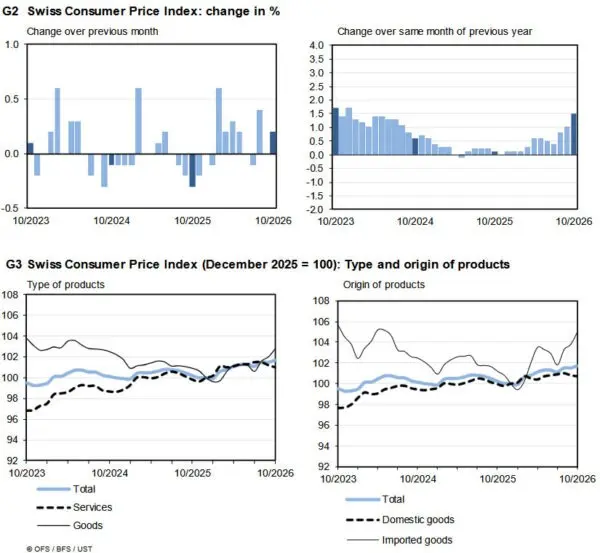
Away from the political drama in Washington, macroeconomic data out of Europe caught the attention of fixed income and currency traders. Swiss inflation rose significantly faster than anticipated in October, driven largely by imported pressures. A monthly consumer price increase of 0.2% lifted the year-on-year inflation rate from 1.0% to 1.5%, marking the fastest pace recorded since December 2023 and coming in well above the consensus economist estimate of 1.2%.
A deeper dive into the sub-components revealed that prices for imported products were the primary driver behind the acceleration, jumping 1.2% on a monthly basis and 3.7% compared to the same month last year. Energy remained the chief culprit, with the price of petroleum products surging 6.4% month-on-month and a staggering 40.3% year-on-year. Conversely, domestic prices offered some relief, falling 0.1% on the month to stand 0.8% higher over the year.
Core inflation—which strips out fresh and seasonal products, energy, and fuel—rose by a modest 0.2% on the month, bringing the annual core rate to 0.5%. Goods inflation registered at 0.8% monthly and 1.9% annually, while services inflation recorded a slight 0.2% monthly drop, leaving it up 1.2% over the year. Analysts noted that today’s soft core CPI reading keeps the prevailing narrative of an unchanged Swiss National Bank policy rate at 0% firmly intact. Meanwhile, the Swiss franc treaded water during the session following a strong month of October that had been fueled by rising eurozone credit risk premia and overall volatile or weak risk sentiment.
OECD Highlights Fiscal Challenges for Belgium
In other European economic news, the Organisation for Economic Co-operation and Development (OECD) published a comprehensive and sobering report on Belgium. Serving as an update to its previous Economic Surveys series released in September 2024, the report’s central message underscored that despite existing consolidation plans, high public debt and a persistent fiscal deficit are projected to continue rising. This trajectory highlights an urgent need for policymakers to strengthen structural fiscal sustainability.
The OECD emphasized that frontloading consolidation measures—primarily through containing public spending growth, improving tax efficiency, and reforming national and regional budgetary frameworks—will be essential to achieving fiscal stability. According to the organization’s updated projections, Belgium’s budget deficit is expected to remain above 5% of GDP for both the current year and the next. Furthermore, the country’s public debt-to-GDP ratio is forecasted to climb from 109% at the end of 2025 to 113% by the end of 2027. On the growth front, the OECD projects Belgian GDP to expand by 0.7% this year before picking up slightly to 1.0% in 2026.