



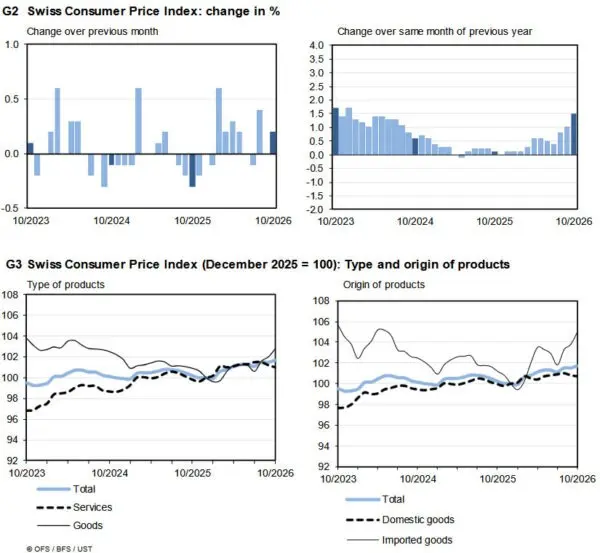
Swiss inflation accelerated at a faster pace than anticipated in October, driven largely by surging global energy costs, though underlying domestic price pressures remained remarkably subdued. According to data released by the Federal Statistical Office, the headline Consumer Price Index (CPI) climbed from 1.0% to 1.5% on a year-on-year basis, outpacing the median market expectations, which had pointed to a more modest rise of 1.3%. On a month-on-month basis, consumer prices advanced by 0.2%, reversing the flat 0.0% reading recorded in September and defying forecasts that had called for no change over the month.
Despite the notable jump in the headline figure, a closer examination of the underlying metrics reveals that broad-based inflationary momentum inside Switzerland remains contained. Core CPI, which strips out volatile components such as energy and fresh foods, held entirely steady at 0.5% compared to the same month last year and registered zero growth on a monthly basis. This clear divergence between the headline and core figures highlights that the October acceleration was highly concentrated in specific external components rather than signaling a widespread resurgence of domestic inflation.
Energy was by far the dominant driver behind October’s inflation uptick. Energy and fuel prices surged by 3.5% on a month-on-month basis, following a 2.3% increase in September. Petroleum products experienced a particularly sharp upward movement, gaining 6.4% over the course of the month. Within this category, heating oil prices jumped by an eye-catching 9.8%, diesel prices rose by 6.0%, and petrol climbed by 4.9%. On an annualized basis, the energy and fuels component expanded from 11.7% to 15.9%, exerting massive upward pressure on the broader consumer price basket.

To put the scale of the energy impact into perspective, the energy sub-component alone contributed approximately 0.197 percentage points to the overall monthly CPI increase of 0.206 percentage points, accounting for roughly 96% of the net monthly rise.
Imported products also played a major role in the month’s acceleration. Inflation for imported goods climbed sharply from 2.1% to 3.7% year-on-year, with prices advancing by 1.2% on a monthly basis. Imported items contributed a substantial 0.263 percentage points to the monthly CPI increase—an amount that actually exceeded the overall net increase in the consumer price index. This occurred because falling domestic prices acted as a partial offset, dampening the net impact of imported inflation on the headline index.
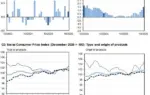
Swiss CPI and Component Performance
While external factors pushed headline figures higher, domestic and underlying price pressures showed virtually no evidence of a corresponding acceleration. Domestic product prices actually edged downward, falling 0.1% on a month-on-month basis following a 0.2% decline in September. On an annual basis, domestic inflation increased only marginally, moving from 0.7% to 0.8%.
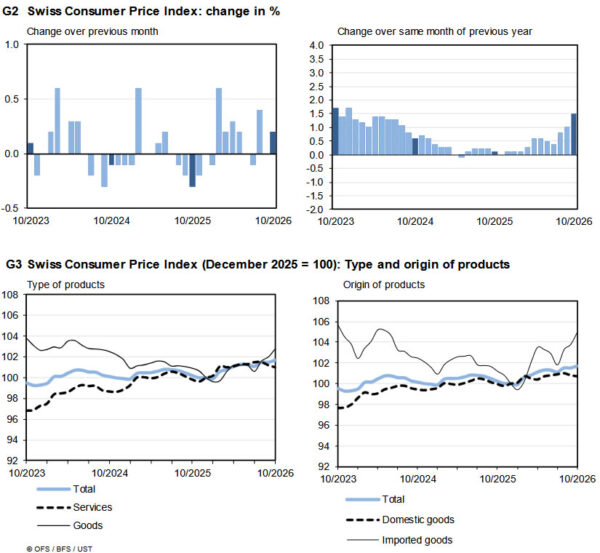
A breakdown of the broader goods and services categories further illustrates the stark contrast between imported and domestic pricing dynamics. While overall goods prices increased by 0.8% on the month, driven largely by imported components and seasonal shifts like a 3.7% jump in clothing and footwear, services prices actually declined by 0.2%. This downward pressure in the services sector was reinforced by lower costs in healthcare, hotels, and international package holidays, which helped keep broader consumer price pressures in check. Furthermore, the consumer price index calculated without petroleum products remained entirely unchanged on the month, reinforcing the narrative that domestic demand-pull inflation remains subdued.
Additional indicators released alongside the main CPI report painted a consistent picture. The Harmonized Index of Consumer Prices (HICP), which allows for standardized comparisons across European economies, ticked up from 1.2% to 1.6% on a year-on-year basis. Meanwhile, housing and energy costs saw a modest monthly increase of 0.4%, reflecting the steady percolation of utility and fuel adjustments into everyday household expenses, though not enough to trigger broader inflationary contagion across the domestic economy.
The October data leaves policymakers with a nuanced view of the economic landscape. The pronounced, energy-led increase in headline inflation pushes the year-on-year rate further away from the lower bounds of price stability, yet the steadfast stability of core inflation and the continued weakness in domestic services and goods prices suggest that broader, second-round inflationary pressures have not taken root. As global energy markets continue to exhibit volatility, the Swiss National Bank will likely look through these external supply-side shocks, focusing instead on the persistently benign core readings as an indicator of underlying domestic price stability.