



The financial markets have entered a tense phase for precious metals bulls as persistent selling pressure yields significant technical breakdowns. Two major industrial and precious metals, palladium and platinum, have officially slipped beneath key psychological price barriers, creating an increasingly uncomfortable environment for buyers and testing the limits of multi-week support zones that analysts have closely monitored.
Palladium has decisively fallen below the 1,000 threshold, venturing directly into territory previously identified as a vital potential support cluster over a week ago. Meanwhile, platinum has dropped under the 1,500 mark following a failed recovery attempt by buyers who were unable to translate earlier momentum into a convincing market reversal. These concurrent breakdowns across two major markets present high-stakes scenarios for the bulls, highlighting a broader struggle for control as sellers press their advantage.
Market observers note, however, that breaking below a designated support level during an active trading session is not automatically synonymous with a confirmed, lasting breakdown. The ultimate direction of these assets often hinges on how trading sessions conclude. In some instances, sellers manage to defend their newly won advantage all the way through the closing bell, thereby paving the way for further downside continuation. In other cases, buyers stage a late-session counteroffensive, transforming an apparent bearish victory into a failed breakdown that traps aggressive short-sellers.
As the daily price action unfolds, traders and analysts are closely examining whether these key psychological thresholds will trigger a robust defensive response from buyers or simply serve as stepping stones for the bears toward deeper downside objectives.
Platinum: The Recovery Falls Apart and the 1,446 Target Comes Into Focus
Platinum’s recent trajectory highlights the fragility of its recent recovery attempts. Earlier in the week, platinum buyers had a clear opportunity to build upon stabilization efforts near the critical 1,500 support level. Instead, the market ran into immediate trouble when an attempt to close Monday’s bearish gap within the 1,555 to 1,562 range sputtered and failed.
The subsequent retreat brought prices perilously close to the July low and Wednesday’s bullish opening gap, delivering an early warning that the developing bullish reversal scenario was rapidly losing credibility. Sellers wasted little time capitalizing on this weakness. Their aggressive push swept cleanly through Wednesday’s bullish gap between 1,537 and 1,546, carried platinum beneath the July low around 1,539, and ultimately breached the psychological 1,500 barrier.
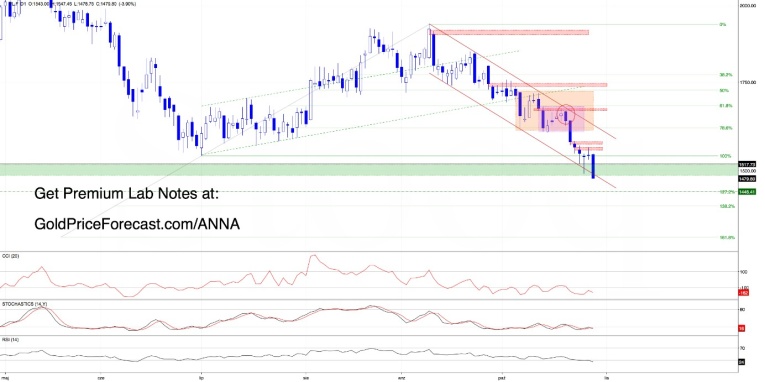
The downward momentum did not stop at the psychological threshold. The sell-off punched straight through the lower boundary of the prevailing red declining channel, driving platinum down to an intraday low of 1,478.75. This development marks a significant deterioration in the asset’s overall technical picture. The potential island-style reversal discussed earlier in the week never received the necessary confirmation, shifting market attention toward the next logical downside objectives.
Should sellers maintain their pressure and secure a daily close below both the 1,500 mark and the red channel’s lower boundary, the daily 127.2% Fibonacci extension, situated near 1446.41, stands out as the next major destination for the metal.
Conversely, a late-session recovery that pushes platinum back above 1,500 and reclaims the channel boundary prior to the daily close would invalidate the intraday breakdown. While such a move would blunt the immediate bearish argument, analysts emphasize that bulls would still need to recapture considerable technical ground before any genuine, long-term bullish reversal could be established. For now, the message from the trading floor is unequivocal: the bulls failed to protect their stabilization zone, and the closing price will dictate whether the bears can turn this failure into another sharp leg down.
Palladium: The 1,000 Support Zone Yields to Heavy Selling Pressure
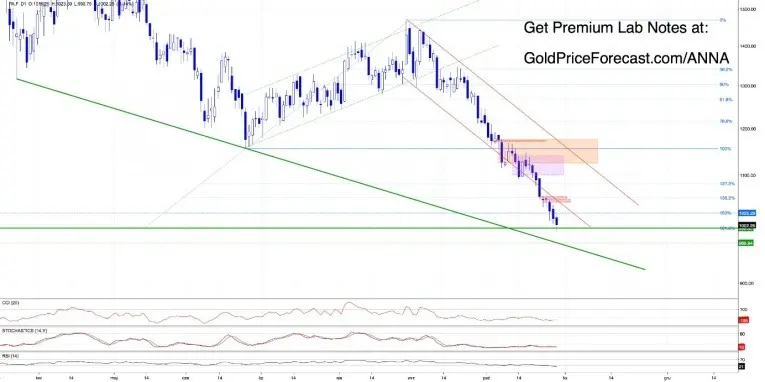
In the palladium market, recent developments validate technical projections outlined weeks in advance. In analytical notes published in late October, experts highlighted that prices were approaching the lower boundary of a weekly red declining channel. At the time, a confluence of technical factors—including a weekly 78.6% retracement near 1,010, the psychological 1,000 level, and a daily 161.8% extension at 996.80—formed a dense potential support cluster spanning the 997 to 1,010 range.
Rather than holding this well-documented zone, palladium sliced right through it. Sellers pushed prices down to an intraday low of 990.75, firmly establishing a presence beneath the psychological 1,000 barrier and the daily 161.8% Fibonacci extension. This move represents a direct continuation of the bearish roadmap that market analysts have tracked across multiple consecutive sessions.
Despite this breach, market participants remain focused on the pivotal question of how the session will conclude. Reaching or even temporarily penetrating a support zone does not automatically seal the market’s fate, making the daily closing price critically important.
If buyers manage to mount a late rally and reclaim the 1,000 level before the closing bell, the intraday breakdown beneath that psychological barrier will be invalidated. Such a recovery could spark a corrective rebound, drawing attention back toward the previously breached lower boundary of the red declining channel. While a corrective bounce would not erase the broader bearish trend, it would signal that buyers are finally mounting a credible defense.
Should the buyers fail, however, a confirmed daily close below 1,000 would cement the breakdown and significantly strengthen the bearish continuation scenario. In that event, the next major downside target would likely be the green declining support line located around 970, drawing on historical lows recorded in March and June. Such an outcome would present a considerably more challenging environment for market bulls.
Adding to the complexity, daily momentum indicators for palladium remain deeply oversold, with the Relative Strength Index hovering near 21 and the Stochastic indicator near 10. While these extreme readings suggest that a defensive reaction or technical consolidation around current prices is entirely plausible, previous rebound attempts in this market have repeatedly fizzled out before buyers could challenge meaningful overhead resistance.
Broader Precious Metals and Industrial Commodity Landscapes
The intense selling pressure observed in platinum and palladium is part of a broader, dynamic environment across related commodity markets.
The U.S. dollar continues to wrestle with a familiar resistance level, forcing currency traders to navigate a difficult decision-making process. Gold is currently undergoing a critical test to determine whether a recently recovered technical boundary can withstand a fresh wave of selling pressure. Silver has carved out another local low, bringing it progressively closer to downside objectives tracked in recent analyses. Meanwhile, copper has introduced an intriguing twist to the industrial metals complex: after successfully breaking through several notable resistance barriers, copper buyers have hit a technical wall near a crucial Fibonacci level.
These widespread setbacks raise pressing questions for the broader commodity complex. Market participants must weigh whether these localized reversals will morph into a synchronized wave of bearish continuation or if late-session developments will hand buyers the evidence needed to challenge the prevailing downward trend.
As trading desks monitor the closing prices across these various markets, the underlying lesson remains clear. Identifying and anticipating key price levels provides a necessary foundation for analysis, but the ultimate direction of the market is dictated by how participants react when those critical thresholds are put to the test. Observing the confirmation of price action remains the most reliable tool for deciphering the next chapter in these evolving market cycles.