
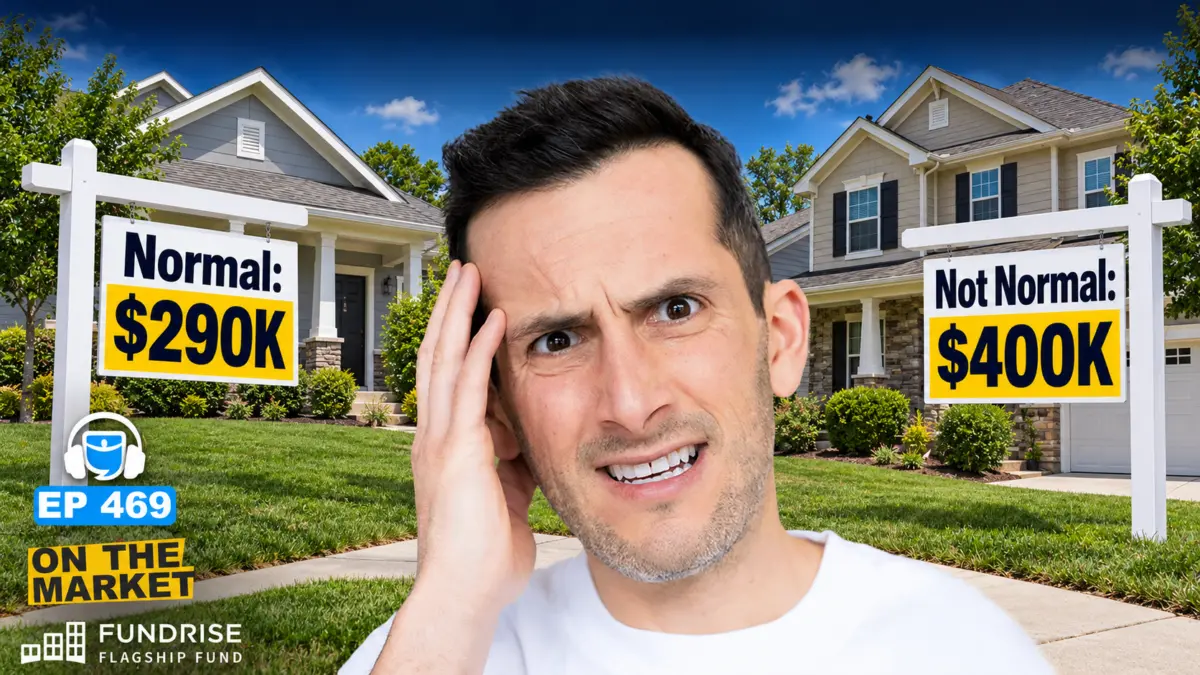
The U.S. housing market is trapped in a prolonged period of sluggishness, and according to new economic analyses, a return to "normal" conditions is much further away than many buyers, sellers, and industry professionals would like to believe. With mortgage rates hovering around 7.5% and median home prices sitting near $400,000 while employee compensation fails to keep pace, the fundamental pillars of housing affordability have broken down.
Dave Meyer, chief investment officer and housing analyst at BiggerPockets, recently broke down the hard numbers to determine what it will actually take for the housing market to recover. Addressing listeners on a recent episode of the On the Market podcast, Meyer explained that the single factor dictating the health of the current real estate market is housing affordability. Once affordability improves, transaction volume and market activity will follow. However, achieving that recovery is a complex mathematical puzzle that cannot be solved by wishful thinking or minor market adjustments.
To understand how far the market has drifted, analysts look at two distinct benchmarks: the long-term historical average running from 1989 through the present, and the conditions of 2019, the final full year before pandemic-fueled inflation upended the economy. In 2019, Americans spent roughly 15.5% of their gross income on monthly mortgage payments, creating a healthy and functional market. Over a broader historical average spanning nearly four decades, that payment-to-income ratio sat at 18.5%.
Today, that metric has skyrocketed to roughly 24.6% nationally, and climbs as high as 27% when factoring in peak borrowing costs. This stark disparity explains why the housing market feels persistently difficult for everyday consumers. Since 2019, average home prices have surged by 63%, while family incomes have grown by only 37%. Combined with elevated borrowing costs, monthly mortgage payments have more than doubled—surging by 116%—over the exact same timeframe.
Understanding how the market might eventually correct requires examining the three fundamental pillars of housing affordability: real wages, mortgage rates, and home prices. Evaluating these levers individually reveals why a quick fix is virtually impossible.
The first lever is wage growth. Ideally, affordability could be restored if everyone’s earnings simply rose significantly while prices and mortgage rates remained constant. However, historical data shows how unrealistic that outcome is. To return to the long-term affordability average of an 18.5% payment-to-income ratio through wages alone, real inflation-adjusted wages would need to jump by 33%. To get back to the 2019 affordability level of 15.5%, wages would need to surge by 57%.
Historical trends show that real median wage growth has averaged a mere 0.8% per year since 1968. At that historical pace, it would take roughly 40 years of wage growth to reach the long-term average, and nearly 60 years to match 2019 levels. Furthermore, real wage growth has recently turned negative as inflation outpaces typical pay raises, and the rise of automation and artificial intelligence threatens high-paying professional roles. Consequently, waiting for wage growth to single-handedly rescue housing affordability is not a viable strategy.
The second lever is mortgage rates, which have experienced extreme volatility in recent years. Many prospective buyers pin their hopes on the Federal Reserve cutting interest rates to make borrowing cheaper. However, the math behind mortgage rates presents another steep hurdle. To return to 2019 affordability levels through interest rates alone, mortgage rates would need to plummet to 2.7%—a scenario most financial analysts view as a statistical impossibility outside of unprecedented economic emergencies.
Even returning to the long-term affordability average would require mortgage rates to drop to 4%. While a 4% rate is theoretically possible, it would likely require severe economic turbulence and a significant victory over inflation, driving inflation rates down below the Federal Reserve’s traditional 2% target. With the bond market and 10-year U.S. Treasuries reflecting persistent inflationary pressures, expecting a return to ultra-low borrowing costs in the near future is unrealistic. At best, industry optimists hope for rates to settle into the mid-5% range over the coming years, which still falls short of restoring historical affordability metrics.
The third lever is home prices. To restore affordability through price reductions alone, the national median home price would need to experience a staggering correction. Getting back to 2019 affordability levels would require a national home price crash of roughly 36%, driving the median price down from its current perch near $446,000 to approximately $284,000. Returning to the long-term historical average would require a 25% price drop, bringing the median price down to roughly $335,000.
For context, the most severe home price crash in modern economic history occurred during the Great Financial Crisis of 2007–2008, when national home values declined by roughly 20% to 22%. That historic downturn was driven by a wave of subprime debt, negative home equity, and widespread financial distress. Today’s market fundamentals are vastly different.
The current market is heavily protected by what economists call the "lock-in effect." Approximately 80% of existing mortgages feature interest rates below 6%, 50% are below 4%, and 20% sit below 3%. This creates a massive disincentive for current homeowners to sell, as doing so would force them to trade a historically low mortgage rate for a much higher one on their next property. Because homeowners hold substantial equity and delinquency rates remain exceptionally low compared to historical norms, widespread financial distress and forced liquidations are largely absent from the current landscape.
While regional corrections are already underway in parts of the Sunbelt, Florida, and Texas—where nominal prices have slipped from their pandemic peaks—a sweeping national price crash of 25% to 35% remains highly improbable.
Because no single lever can fix the housing market in isolation, recovery will depend on a gradual combination of modest rate declines, flat or slowly correcting home prices, and incremental wage growth. Standard economic modeling suggests that even under an optimistic base case where mortgage rates drift down toward 6%, prices remain relatively flat, and real wages outpace inflation slightly, it will still take roughly five to seven years for the housing market to rebalance its affordability metrics.
For real estate agents, loan officers, and transactional businesses, this means transaction volumes will likely remain constrained until affordability meaningfully improves. For investors and prospective homeowners, the market demands a sober perspective and a disciplined approach. Rather than counting on rapid appreciation, market participants must focus on purchasing properties below current market value through aggressive negotiations or by executing value-add strategies. Navigating the years ahead will require patience, realistic expectations, and an acute awareness of the mathematical realities shaping the modern housing economy.