




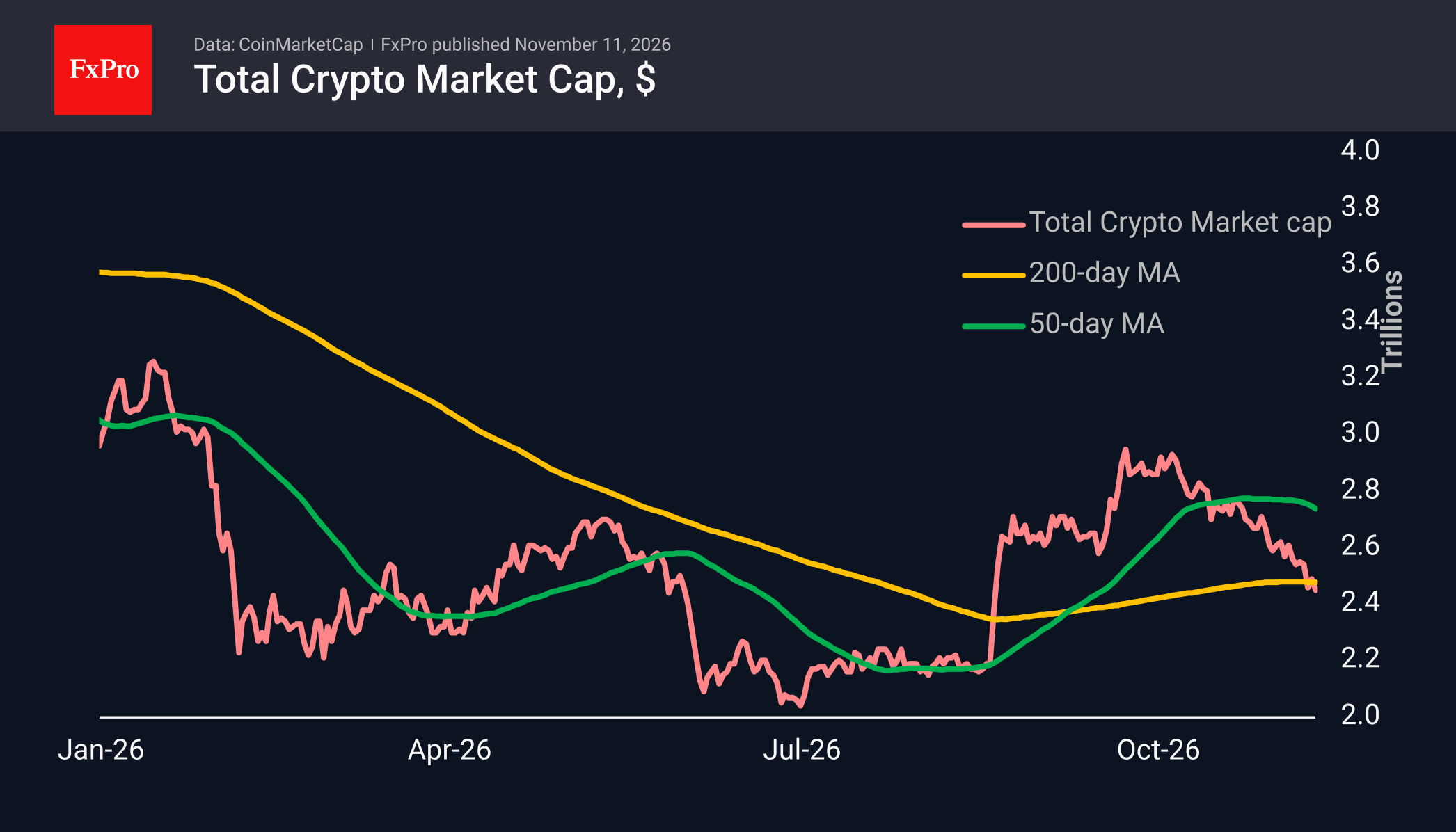
The global cryptocurrency market is facing a severe liquidity squeeze, with total market capitalization plunging by more than 1.5% over the past 24 hours to settle at $2.45 trillion—its lowest level since August. While traditional equity markets have continued to show resilience, digital assets have failed to keep pace, dragging significantly behind stocks as a confluence of macroeconomic headwinds, shifting investor capital toward artificial intelligence, and heavy institutional selling pressure take a toll on sentiment.
The divergence between equities and cryptocurrencies has become increasingly stark over recent sessions. Digital assets lagged behind stocks at the start of the week and faced renewed selling pressure as traders weighed a potent mix of economic indicators. Market analysts point to a familiar narrative playing out once again: surging investor interest in the artificial intelligence sector, particularly in the run-up to Anthropic’s anticipated initial public offering, is actively drawing risk capital away from the digital asset ecosystem, mimicking a similar capital flight observed between May and June.
At the same time, macroeconomic fundamentals in the United States have dealt a blow to non-yielding and speculative assets. Hotter-than-expected Consumer Price Index (CPI) data revealed accelerating inflationary pressures, which, combined with robust US employment figures and subsequent commentary from Federal Reserve officials like Waller, triggered a sharp rally in the US dollar. These robust economic indicators have opened the door wide to the possibility of a 50-basis-point interest rate hike by the Fed in December. Because this hawkish monetary policy outlook is underpinned by a fundamentally strong broader economy, it has not severely damaged equities; however, it has exerted immense downward pressure on cryptocurrencies and precious metals.
Amid this broader market downturn, activity among alternative cryptocurrencies has been heavily skewed toward losses, with the ratio of gainers to losers standing starkly at roughly one to six. Among the few bright spots in the top tier of traded altcoins over the past 24 hours were Internet Computer, which managed a 4.8% gain, Avalanche up 4.5%, and Cosmos advancing 2.6%. Conversely, the hardest-hit tokens suffered steep double-digit or near-double-digit corrections, led by Uniswap tumbling 7%, Dash dropping 4.3%, and Basic Attention Token falling 2.8%.
Bitcoin Tests Critical 200-Day Moving Average Amid Heavy Selling Pressure
The epicenter of the correction remains Bitcoin, which has slipped back below the $74,000 threshold to test its vital 200-day moving average. The modest, tentative rebound seen earlier in the week was easily overwhelmed by fresh waves of selling pressure, dragging the premier cryptocurrency down to price levels not witnessed since late summer. Back in August, bullish momentum was forcefully ignited by remarks from the US Treasury Secretary and the Fed, but as autumn progressed, fundamental macroeconomic data began to steadily erode buyer conviction. Investors have grown increasingly reactive to a firmly hawkish central bank stance in the ongoing fight to tame inflation.

From a technical analysis perspective, market watchers are laser-focused on Bitcoin’s ongoing test of the 200-day moving average. Analysts warn that a decisive break below this critical technical threshold could significantly accelerate and extend the current sell-off. At the same time, merely defending the current support level is seen as insufficient to trigger a genuine bullish reversal; market technicians emphasize that a strong, decisive upward impulse from this support zone will be required to restore confidence to the bulls.
Behind the Market News: Institutional Inflows to Exchanges and Corporate Liquidations
Underpinning the fragile technical landscape is a troubling shift in on-chain dynamics. Large-scale investors—frequently referred to as whales—are increasingly transferring their Bitcoin holdings directly to centralized cryptocurrency exchanges, a behavioral pattern that historically precedes and exacerbates selling pressure. While overall market leverage ratios have declined from their previous peaks, they still remain at elevated levels, leaving the market vulnerable to cascading liquidations should prices drop further. According to insights from XWIN Japan, for the current downward trend to halt and for Bitcoin to reestablish a trajectory of sustained growth, buyers must re-enter the spot market in meaningful numbers.
Further compounding the bearish sentiment, on-chain metrics are flashing warning signals reminiscent of previous major market downturns. Analyst Quinten François notes that Bitcoin has returned to a zone on the Market Value to Realized Value (MVRV) indicator that previously surfaced during the severe market corrections of 2020 and 2023. Additionally, analyst Mark Harvey points out that Bitcoin has slipped beneath the lower boundary of the power-law model, a mathematical framework used to describe the asset’s long-term price growth corridor. Historically, breaches of this structural boundary have coincided with monumental systemic shocks, most notably the collapse of the FTX exchange and the unprecedented market crash triggered by the onset of the COVID-19 pandemic.
Looking ahead, prominent figures in the crypto analytical community suggest the correction may still have room to run. Benjamin Cowen, founder of Into the Cryptoverse, opines that Bitcoin’s current correction is far from over, warning that the downward trajectory could persist over the coming weeks with a definitive market bottom potentially taking shape as late as December.
Adding to the supply-side headwinds, institutional balance sheets have also been active liquidators. According to data compiled by Lookonchain, 14 public companies have collectively offloaded approximately 108,247 Bitcoin—valued at an estimated $8.08 billion—since the beginning of 2026. More than half of this massive volume originated from just two corporate entities: MARA and Riot Platforms.
Real-World Adoption and Regulatory Shifts Continue to Evolve
Despite the bearish macro environment and intense selling pressure in the spot markets, underlying infrastructure development and enterprise adoption continue to press forward. In the traditional banking sector, US-based PNC Bank has partnered with Coinbase to launch testing for a new service enabling the acceptance of USDC stablecoin payments on the Ethereum network. This commercial solution is specifically engineered to streamline international settlements and drastically improve corporate access to liquidity and funds.
Simultaneously, traditional financial market infrastructure is deepening its integration with decentralized ledger technology. The New York Stock Exchange (NYSE) has announced plans to utilize the Avalanche network for clearing and settlement processes on its upcoming tokenized securities platform. To facilitate this institutional-grade operation, a dedicated, permissioned blockchain with controlled participant access will be established.
On the regulatory front, political headwinds are also forming. US Senator Elizabeth Warren is reportedly preparing to intensify congressional oversight of prediction markets and various cryptocurrency projects associated with the family of President Donald Trust, a move expected to materialize as she assumes the role of chair of the Senate Banking Committee in January.
The FxPro Analyst Team