




Markets
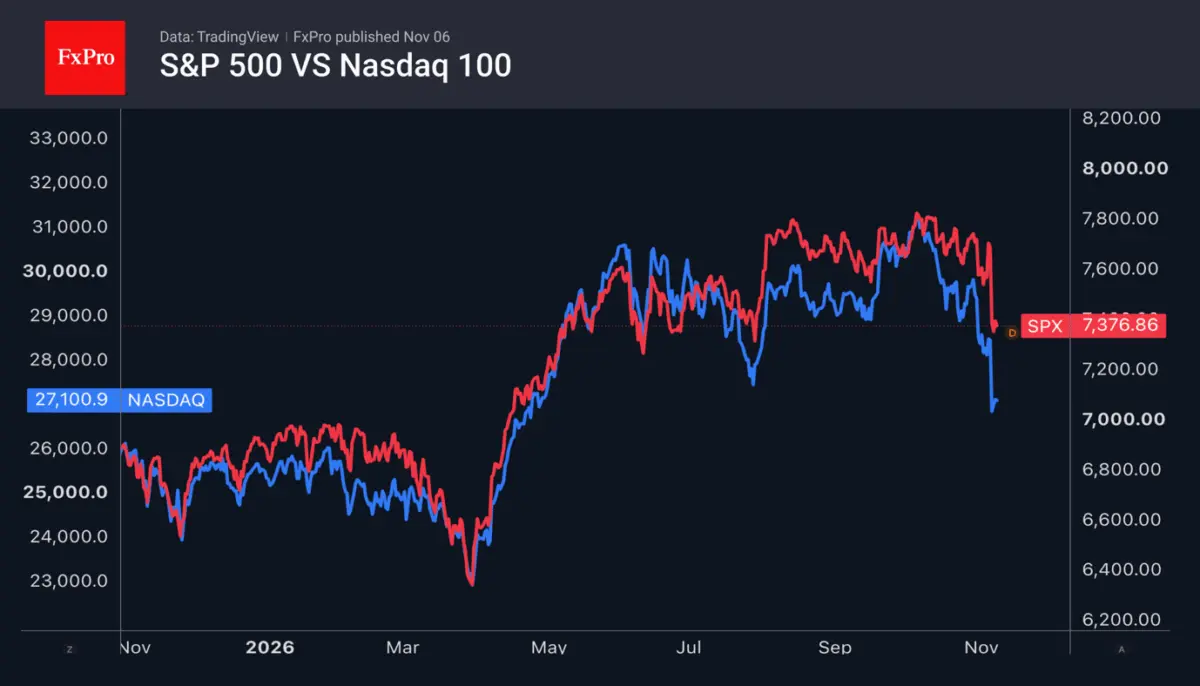
A broad-based and decisive equity rally lifted US stocks significantly to start a holiday-shortened trading week, with major indices posting strong gains ranging from 2.1% for the Dow Jones Industrial Average to 2.74% for the technology-heavy Nasdaq composite. Technology sectors showed notable resilience, as the SOX semiconductor index bounced nearly 7% higher while investors looked past ongoing legal and corporate headlines surrounding Nvidia. Unlike the tentative moves seen at the end of the previous week, this session’s stock market recovery offered a much broader and sturdier technical foundation for any further upward momentum to build upon.
Market breadth was exceptionally strong across the broader market, highlighted by the fact that 423 individual component companies within the S&P 500 finished the first trading day of the week in positive territory. This widespread participation signaled that the risk-on sentiment was not merely concentrated in a handful of mega-cap technology stocks, but rather extended deeply across multiple sectors of the economy. Meanwhile, European equities mirrored the positive global tone, with the EuroStoxx 50 surging nearly 2% in a dramatic and welcomed comeback from the heavy selling pressure that characterized the close of the previous week.
The primary catalyst breathing life back into the global risk-on mood was a sharp and unexpected decline in international energy prices. Brent crude oil tumbled to its lowest level since early September, with prices extending their downward trajectory further into the low-$90 barrier during the subsequent morning trading sessions. At the same time, European natural gas prices retreated significantly, testing the key €80/MWh threshold. Analysts noted that a substantial portion of this recent correction stemmed from a sudden evaporation of the geopolitical risk premium that had previously inflated energy valuations.
However, market strategists have urged caution regarding the durability of this energy price relief. A notable driver behind the recent drop in crude and natural gas valuations has been attributed to unconfirmed geopolitical reports—most notably claims that President Trump had reportedly agreed to an Iraqi proposal to end ongoing regional hostilities. Given the administration’s historical track record of utilizing verbal intervention to talk down commodity prices prior to resuming large-scale strategic operations, financial market participants remain deeply skeptical. The overarching verdict on the true trajectory of energy markets, therefore, remains very much undecided.
Despite this caution, the combination of lower global energy prices and a surging, cross-sector appetite for risk successfully outweighed rising US Treasury yields as the primary driver for foreign exchange markets. US government debt underperformed relative to German bunds ahead of crucial domestic inflation data releases, with US yields climbing by as much as 5 basis points across select maturities. Nevertheless, this yield advantage failed to protect the US dollar from facing broad-based selling pressure.
The greenback experienced a notable retreat, driving the DXY dollar index down from 102.24 to 101.65. This downward movement allowed the EUR/USD currency pair to successfully reverse Friday’s losses and reclaim ground north of the 1.12 handle. British Sterling traded with a more mixed profile, managing to eke out gains against the softening US dollar while slipping marginally against the resurgent euro.
Looking ahead, upcoming third-quarter Gross Domestic Product figures in the United Kingdom are expected to print strongly, providing Sterling with a potential tactical advantage as markets head toward an important upcoming diplomatic and economic summit between UK and European Union officials aimed at fostering improved trade relations. Emphasizing this potential for closer economic cooperation, Bank of England Governor Andrew Bailey endorsed the sentiment during a speech at an event in Zurich, stating that if opportunities arise to increase market openness and serve broader international regions—whether within the European Union, Switzerland, or elsewhere—other things being equal, policymakers should seize them.
On the data front, the US Bureau of Labor Statistics prepared to release its monthly Consumer Price Index (CPI) report, though traditional year-on-year headline figures were absent from the release due to missing baseline data stemming from a government shutdown in the previous year. Consensus expectations pointed to a 0.3% monthly rise in headline inflation and a 0.2% increase for the core index. When annualizing the three-month rolling average, these figures translate to yearly gauges of approximately 5.3% for headline and 3.25% for core metrics.

Following the robust non-farm payrolls employment report released at the end of the previous week, these inflation numbers were widely expected to reinforce the bottoming-out process observed at the front end of the US yield curve while lending localized support to the US dollar. In the fixed income space, a scheduled $42 billion US 10-year Treasury note auction commanded significant attention from investors gauging domestic borrowing demand. Additionally, a slate of high-profile central bank commentary featuring Federal Reserve Governor Michael Waller, European Central Bank Chief Economist Philip Lane, and Bank of England Chief Economist Huw Pill kept market participants on high alert for fresh monetary policy signals.
News & Views
Consumer sentiment regarding future economic conditions showed mixed signals in the latest economic releases. According to the New York Federal Reserve’s monthly Survey of Consumer Expectations for October, median inflation expectations remained entirely unchanged across all primary time horizons. Consumers continued to project an inflation rate of 3.9% over a one-year horizon, 3.3% over a three-year horizon, and 3.0% over a five-year horizon.
Beneath the headline inflation expectations, specific commodity outlooks within the survey shifted slightly. Median year-ahead expected price changes for gasoline dropped by 0.6 percentage points down to 4.2%, while expected price changes for food remained unchanged at 5.5%. Within the domestic labor market, median one-year-ahead earnings growth expectations held steady at 2.6%.
A deeper examination of the survey data revealed a growing divergence in economic confidence across demographic lines. Respondents without a college degree displayed an increasingly pessimistic outlook regarding their employment prospects over the coming year. Specifically, the mean perceived probability of an individual losing their job within the next 12 months ticked upward from 13.5% to 13.9%. Furthermore, the mean probability that the broader US unemployment rate would trend higher one year into the future surged by 1.4 percentage points to reach 45.3%, marking the highest reading recorded since April 2020.
Despite these labor market anxieties, consumer perceptions regarding their immediate personal financial situations showed a slight improvement. The net share of survey respondents reporting an enhanced financial standing compared to the same period a year prior registered a modest increase. At the same time, forward-looking expectations regarding households’ financial situations twelve months into the future remained largely unchanged.
Meanwhile, consumer spending trends in the United Kingdom reflected a period of domestic caution, according to the British Retail Consortium’s monthly UK Retail Sales Monitor. The data revealed that total same-store retail sales rose by 1.1% on a year-on-year basis, matching the modest growth pace of 1.0% recorded in September. A breakdown of the spending categories showed that food sales performed relatively well, rising 2.4% higher compared to October levels from the previous year, marking an acceleration from the 1.8% growth seen previously. Conversely, non-retail food sales experienced a minor contraction, falling 0.1% compared to a positive 0.3% growth rate in the prior survey.
British Retail Consortium Chief Executive Helen Dickinson characterized October as a distinctly subdued month for domestic retailers. She noted that many shoppers actively chose to delay discretionary spending in anticipation of upcoming promotional retail events such as Black Friday and the winter holiday shopping season. Persistent pressures from higher household utility costs, combined with widespread consumer caution ahead of the national budget announcement, also played a significant role in dampening retail activity. Looking further ahead toward the horizon, analysts warn that elevated energy costs, stubborn inflation rates, and higher borrowing costs will continue to create a highly challenging operational backdrop for the retail sector.