



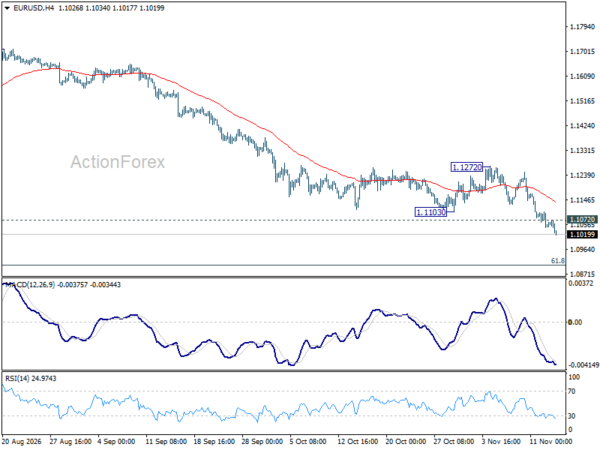
The EUR/USD currency pair has firmly extended its recent downward trajectory, breaking decisively through the critical 1.103 support level last week. This technical breach has reaffirmed the bearish sentiment dominating the foreign exchange market, setting the immediate sights of currency traders firmly on deeper retracement targets. As the new trading week begins, the near-term bias for the single currency remains skewed to the downside, with market participants closely monitoring upcoming support zones and pivotal moving averages that could dictate the pace of the decline.
Analyzing the immediate price action, the initial trading bias stays decidedly negative. The primary downside objective for sellers is located at the 1.0904 Fibonacci retracement level. This technical milestone represents a key threshold for the pair’s short-term trajectory. On the flip side, any attempts by euro bulls to stage a recovery will face immediate hurdles. A move above the minor resistance level at 1.072 would temporarily neutralize the current intraday downside bias, likely inviting a phase of technical consolidation. However, the broader technical outlook will remain firmly bearish as long as the more significant resistance ceiling at 1.1272 holds firm against any meaningful upward corrections.
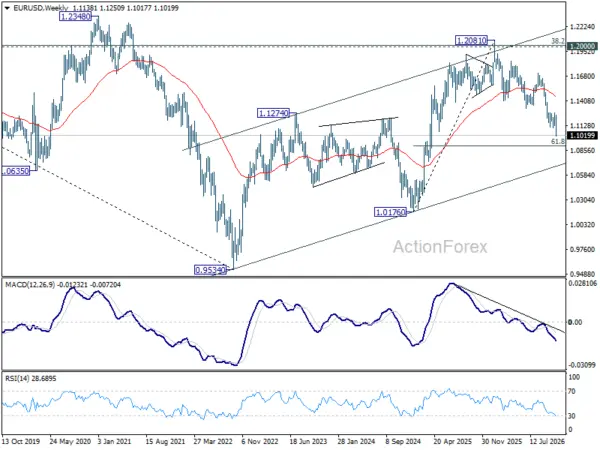
Expanding the analytical lens to a broader perspective, recent developments in the price structure suggest that the notable downward correction from the 1.2081 medium-term top may be actively reversing the preceding upward impulse. That earlier recovery originated from the 2025 low of 1.0176, and potentially stretches back even further to the foundational 2022 low at 0.9534. Because the medium-term corrective sequence has established a clear peak, market analysts anticipate that deeper losses are likely to unfold over the coming weeks and months.
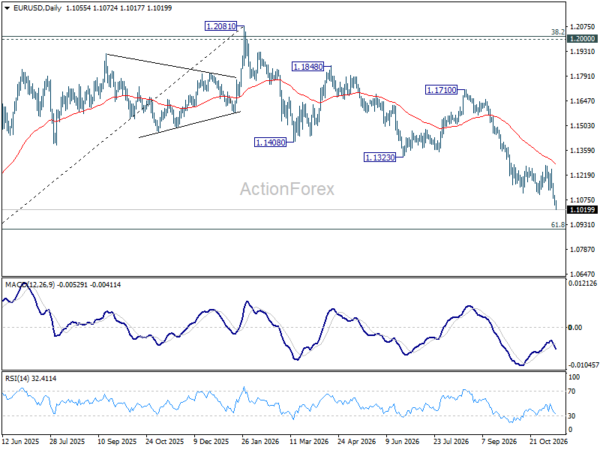
Following the breach of intermediate levels, the next major downside objective aligns with the 61.8% Fibonacci retracement of the entire bullish leg from 1.0176 to 1.2081, which converges precisely at the 1.0904 mark. If selling pressure intensifies and prompts a sustained, high-volume break beneath this vital retracement support, the currency pair could eventually set its sights on a deeper descent back toward the 2025 baseline low of 1.0176. For the time being, overall market risk remains heavily tilted toward the downside. This negative bias will persist as long as the former support level at 1.1323—which has now flipped to act as a formidable ceiling of resistance—remains unbroken during any potential relief rallies or technical rebounds.
Taking a step back to evaluate the grander long-term picture, the structural landscape of the EUR/USD pair reveals a profound shift in momentum. The firm and decisive break below the 55-month Exponential Moving Average, which currently stands at the 1.243 level, provides compelling technical evidence regarding the multi-year trajectory of the currency pair. This decisive moving average violation strongly argues that the significant advance originating from the 2022 low of 0.9534 has officially reached its conclusion.
Rather than signaling the beginning of a fresh secular bull market, that preceding recovery now appears to have been nothing more than a protracted three-wave corrective move that stalled out symmetrically at the 1.2081 peak. This cyclical top was heavily reinforced by a classic technical rejection occurring just beneath the 38.2% retracement of the monumental historical decline stretching from the 2008 high of 1.6039 down to the 0.9534 low, a zone that converged neatly near the major psychological round number of 1.2000.
Because the corrective wave failed to challenge higher resistance parameters and subsequently surrendered the crucial 55-month EMA, the overarching multi-year downtrend originating from the historic 2008 peak remains entirely intact. Consequently, technical projections indicate that a eventual breach of the multi-year 0.9534 low remains heavily favored from a macro perspective as the broader cyclical pressures reassert themselves across global foreign exchange markets.