




Hot inflation figures are traditionally interpreted as bearish news for precious metals. When consumer prices surge faster than anticipated, investors immediately begin pricing in more aggressive monetary policy tightening from central banks. Higher interest rates increase the opportunity cost of holding non-yielding assets like gold and silver, frequently placing heavy downward pressure on their market values.
However, during a recent broadcast of the Money Metals Midweek Memo, host Mike Maharrey argued that financial markets may be dangerously myopic, overlooking a far more significant structural crisis. The central question facing the global economy, according to Maharrey, is whether the Federal Reserve can realistically sustain a prolonged high-interest-rate environment when cumulative U.S. government debt has already surpassed the staggering threshold of $40 trillion.
Maharrey remains deeply skeptical. In his view, the Federal Reserve is trapped in an intractable policy bind, caught squarely between the dual mandates of fighting persistent inflation and protecting an excessively debt-laden financial system. This underlying macroeconomic tension, he contends, will eventually force the central bank to reverse course, abandon its tightening regime, implement rate cuts, and resume aggressive money creation—even as consumer price inflation remains stubbornly elevated.
Hot CPI Data Keeps Rate Hike Fears Alive
The latest Consumer Price Index (CPI) report released by the Bureau of Labor Statistics revealed that headline prices rose by 0.4% in October, coming in notably higher than the 0.3% increase forecasted by Wall Street economists. Meanwhile, core CPI—a closely watched metric that strips out volatile food and energy components—increased by 0.3%, likewise topping consensus expectations of a 0.2% gain. This marked the third consecutive month of 0.3% core monthly increases, a pace that annualizes to roughly 3.7%.
Notably, the Bureau of Labor Statistics did not publish a conventional year-over-year CPI comparison for this period because a federal government shutdown had previously prevented the agency from releasing its October report the prior year. Nevertheless, the monthly figures clearly demonstrated broad-based price pressures across multiple essential economic sectors.
Energy prices climbed 0.7% in October, building upon a dramatic 5.2% spike recorded in September. Gasoline prices advanced another 1%, following a staggering 9.3% surge the previous month. The cost of shelter rose by 0.3%, while overall food prices posted a 0.5% gain. Within the food category, beef prices increased 0.9%, snack foods climbed 1%, and the combined category for poultry, fish, and eggs moved up 0.5%. Transportation services experienced a 0.8% increase, and new vehicle prices ticked up 0.2%.
Maharrey noted that this robust inflation report helps explain why financial market participants are increasingly betting on additional interest rate hikes from the Federal Reserve, a sentiment that has recently placed considerable downward pressure on gold prices. At the same time, he cautioned that the Consumer Price Index captures only changes in retail consumer prices, failing to reflect the broader, more insidious picture of monetary inflation occurring beneath the surface of the economy.
Money Supply Growth Points to More Inflation
Shifting his focus to monetary aggregates, Maharrey emphasized the continuous expansion of the M2 money supply, defining true monetary inflation as an unbacked expansion in the circulating supply of money and credit. According to his analysis, between September 2025 and September 2026, the M2 money supply climbed from $22.15 trillion to $23.41 trillion, representing a substantial annualized growth rate of 5.7%.
The broader money supply expanded by an additional $13 billion during the month of September alone. Over the course of 2026, M2 has grown by an average of $136 billion per month, a staggering 89% faster than the average monthly expansion rate recorded throughout 2025. Maharrey warned that this relentless monetary accumulation will eventually manifest as higher consumer prices or drive excessive valuations in speculative asset classes, including public equities and real estate.
Further compounding these concerns, Maharrey pointed to the recent trajectory of the Federal Reserve’s balance sheet, which resumed an upward trend in December 2025. The balance sheet expanded by approximately $5 billion in October, standing roughly $212.4 billion above its cyclical low recorded on December 1. Maharrey characterized these ongoing Federal Reserve bond purchases as a de facto form of quantitative easing, arguing that such open-market operations inject fresh liquidity into the financial system while artificially suppressing government borrowing costs.
Additional corroboration for loose monetary conditions came from the Chicago Fed’s National Financial Conditions Index. For the week ending October 30, the index registered at negative 0.45, a reading that Maharrey highlighted as indicative of historically loose financial conditions. Remarkably, this index never entered positive territory throughout the entirety of the Federal Reserve’s aggressive monetary tightening cycle, having reached its tightening peak at a modest 0.09 back in October 2022.
The Fed’s Rate Hike Dilemma
The hotter-than-expected CPI data has immediately fueled market expectations regarding a potential interest rate hike at the upcoming December Federal Open Market Committee meeting, with several Wall Street analysts actively debating the possibility of a more aggressive 50-basis-point increase. However, Maharrey suggested that a standard 25-basis-point adjustment remains the more probable outcome, though he conceded that upcoming employment reports could easily sway policymakers toward a larger move if labor market resilience persists.
Despite these immediate policy expectations, Maharrey questioned whether incremental rate hikes can meaningfully subdue inflation while the broader money supply and the central bank’s balance sheet continue to expand unchecked. Furthermore, imposing higher interest rates places an unsustainable fiscal strain on both the federal government and the broader economy, particularly given the unprecedented scale of the national debt—now exceeding $40 trillion—and the rapidly escalating cost of servicing those obligations.
Maharrey described the central bank as trapped within a classic policy dilemma. While policymakers could theoretically continue raising interest rates to combat rising consumer prices, doing so dramatically increases the probability of triggering a severe economic recession or systemic financial instability. In the event that a severe financial crisis materializes as a result of tight policy, Maharrey anticipates that the Federal Reserve will quickly pivot, cutting interest rates and expanding its balance sheet once again to rescue the economy, regardless of the inflationary consequences.
He also expressed skepticism that any incoming Federal Reserve leadership would willingly permit a deep, prolonged economic downturn merely in pursuit of price stability. In his assessment, central bankers have consistently demonstrated a historical preference for monetary easing whenever severe financial stress threatens the stability of the broader economic structure.
Why Gold Is Falling and Why Maharrey Sees Opportunity
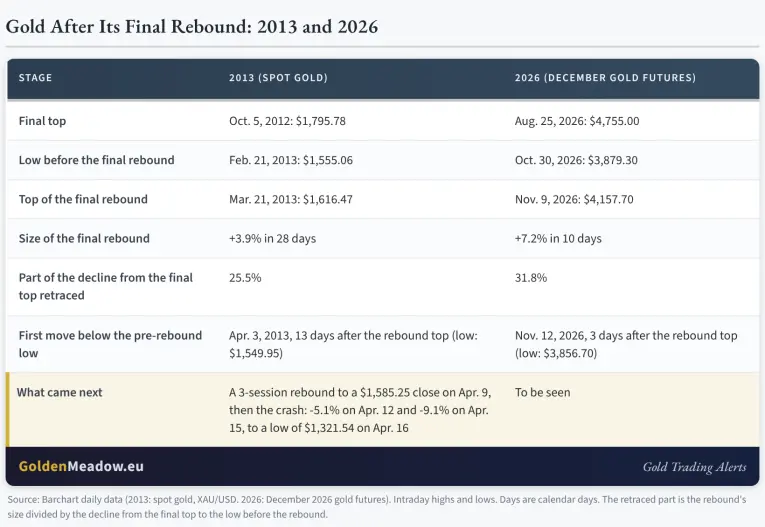
Prior to the recent midterm elections, gold prices had experienced significant volatility, tumbling below the crucial $4,000-per-ounce threshold before staging a recovery back above $4,100. As Maharrey prepared his latest commentary, gold had pulled back by roughly $120, drifting back toward the psychologically important $4,000 level. He noted that a temporary break below $4,000 would not come as a surprise given the current macro environment.
The immediate downward pressure on precious metals stems primarily from shifting market expectations regarding higher interest rates. Because gold and silver do not generate an explicit yield, rising interest rates increase their opportunity cost, making interest-bearing instruments temporarily more attractive to yield-seeking investors. Nevertheless, Maharrey argued that market participants are currently suffering from tunnel vision, focusing too intently on short-term rate forecasts and daily headlines while completely ignoring the long-term structural risks of unchecked money creation, sovereign debt expansion, and ongoing currency debasement.
Even in a hypothetical scenario where the Federal Reserve successfully manages to tame inflation without sparking a major financial crisis, Maharrey emphasized that fiat cash will continue to bleed purchasing power over time. Under a standard 2% annual inflation target, uninvested cash loses more than 10% of its real purchasing power over a five-year horizon. To counteract this relentless erosion, he presented physical gold and silver as proven, reliable long-term hedges against systemic currency devaluation.
The broadcast also drew attention to ongoing retail offerings from Money Metals, highlighting American Silver Eagles available at a competitive premium over melt value. Maharrey described the coins as .999 fine silver products whose weight and purity are backed directly by the U.S. government. To illustrate the growing importance of tangible wealth, he cited a recent international report indicating that approximately 60% of Paraguay’s population was temporarily locked out of accessing their bank accounts during a sudden domestic banking crisis, using the event to underscore how physical precious metals serve as a vital financial backup when electronic banking infrastructure fails.
Midterm Elections Add to Gold and Silver Uncertainty
Turning to the domestic political landscape, Maharrey noted that the midterm elections resulted in Democrats capturing control of both chambers of Congress, albeit with several individual races remaining too close to call at the time of publication. Current seat projections indicated a narrow 54–44 Democratic majority in the Senate alongside a 254–165 advantage in the House of Representatives. This setup points toward a divided government, leaving President Donald Trump with veto power while Congress retains the legislative leverage to constrain major components of his executive agenda.
Precious metals initially rallied in the immediate aftermath of the election results. Spot gold successfully reclaimed ground above the $4,000 mark, while silver advanced past $53 an ounce. However, Maharrey cautioned that these enthusiastic post-election market reactions could prove short-lived.
Citing analysis from the World Gold Council, he pointed out that the ultimate, lasting impact of the election on precious metals will depend heavily on whether subsequent policy implementations prove significant enough to overpower much larger, foundational global economic forces. He also referenced insights from Metals Focus, which characterized the electoral outcome as an introduction of fresh policy uncertainty into the precious metals sector.
A gridlocked Congress could theoretically limit additional large-scale fiscal stimulus, thereby dampening expectations for further aggressive interest rate hikes and potentially providing underlying support for gold. On the other hand, sustained high levels of government borrowing could keep long-term Treasury yields elevated, while any broader economic slowdown could weigh heavily on the industrial demand for silver and platinum-group metals.
Maharrey observed that meaningful deficit reduction remains politically improbable given existing federal spending commitments, rapidly ballooning interest payments on the national debt, and the profound difficulty of achieving bipartisan consensus on tax increases or significant spending cuts. Additionally, he discussed the ongoing military conflict between the United States and Iran, noting that the ultimate trajectory of the war could heavily influence global inflation expectations, interest rates, and commodity pricing. A significant escalation would likely intensify inflationary fears and rate pressures, whereas a lasting diplomatic resolution could remove key headwinds currently facing the gold and silver markets.
Maharrey’s Gold and Silver Outlook
Summarizing his near-term outlook, Maharrey characterized himself as short-term and midterm bearish on both gold and silver. He explained that the precious metals sector could remain trapped under downward price pressure until the geopolitical trajectory of the ongoing conflict becomes clearer or until broader financial markets finally recognize that the Federal Reserve may ultimately be forced to abandon its interest rate hiking campaign. Nevertheless, he views these periodic price pullbacks as attractive accumulation opportunities for patient, long-term investors.
His overarching thesis remains firmly rooted in the belief that persistent inflationary pressures are virtually guaranteed to continue, driven by underlying structural realities such as relentless money supply growth, compounding government debt, and the predictable central bank response to future financial stress. Consequently, Maharrey views physical gold and silver as essential, time-tested hedges against systemic currency debasement and prudent components of a diversified investment portfolio, while consistently advising against concentrating one’s entire net worth into a single asset class.