




I may have stumbled upon the worst financial retirement plan ever conceived. It is actually worse than my own savings plan as a young man—which, looking back with a mixture of amusement and regret, was no plan at all.
Allow me to make a brief confession. Historically speaking, I am not a natural saver. Over the years, I have worked hard on changing those habits, and I am definitely in a better financial position than I was when I was younger. Back then, my overarching retirement strategy could best be described as "hope and pray." While I do have an actual financial plan today, having a plan does not automatically make the process easy. Like millions of people across the country, I am currently feeling the heavy squeeze of persistent inflation.
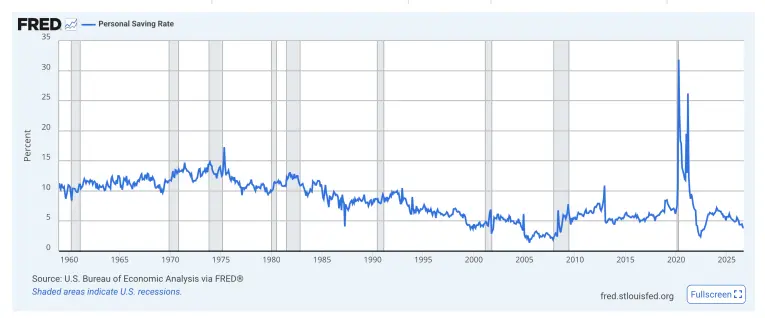
At the very least, I know I am not alone in this struggle. Economic data indicates that the vast majority of Americans are finding it remarkably difficult to set money aside for the future. According to recent federal economic reports, the personal savings rate dropped down to 3.8 percent. With the single exception of a brief, post-pandemic dip recorded in 2022, this represents the lowest level of personal savings seen in the United States since the financial crisis of 2008.
Compounding the problem is the reality that even when individuals manage to throw a few pennies into the proverbial penny bank, inflation actively works to steal those accumulated savings. Even during relatively stable economic times, government monetary policy explicitly targets an annual inflation rate of 2 percent. While a 2 percent depreciation might not sound like an alarming figure at first glance, the mathematics of compounding interest work relentlessly against the consumer. Every five years, that steady erosion strips away a little more than 10 percent of an individual’s purchasing power. And that is merely the official, stated target of the economic planners; the real-world impact on everyday households is often far worse.
Looking back through history, a family could once take a small pouch of gold coins, set them aside, and discover that those exact same coins could purchase roughly the same basket of goods and services twenty years later. Today, however, the modern saver is forced onto a relentless treadmill, constantly chasing yield simply to keep pace with the relentless march of inflation.
This environment aggressively incentivizes financial risk. Naturally, a saver could choose to place their hard-earned cash into a traditional savings account, earning a small, nominal percentage of interest. Yet under current economic conditions, an individual would be remarkably lucky just to maintain their baseline purchasing power, let alone grow their wealth in any meaningful way. To achieve genuine growth, everyday people are essentially pushed out of safe havens and into much riskier investments. As inflation continues to climb higher, investors are forced to take on escalating levels of risk simply to generate adequate returns for their futures.
Of course, taking on excessive financial risk is inherently dangerous. And looking at current trends, that risk-seeking behavior has arguably gotten entirely out of hand, particularly among the youngest generation of adults.
In a startling shift from historical norms, young people are now increasingly treating gambling as a legitimate retirement strategy. When discussing this phenomenon, I do not mean the figurative gambling that takes place through complex trades in the volatile stock market. I mean literal, brick-and-mortar or digital gambling—specifically, sports betting.
According to a recent survey focusing on retail investors, an astonishing 52 percent of Gen Z respondents admitted that they took money they had originally set aside for investing and used it for sports betting instead. Perhaps even more alarming is a related statistic from the same survey: a full quarter of those Gen Z investors stated that they actively consider sports betting to be a foundational part of their long-term financial strategy.
If your immediate reaction to that revelation is the thought that "that will not end well," you are entirely correct.
Data compiled by the Bank of America Institute illustrates the harsh mathematical reality of the gambling industry. On average, sports bettors get back roughly 75 cents for every single dollar they wager. This outcome should not come as a shock to anyone; the glittering entertainment destination of Las Vegas exists precisely because the house ultimately wins over the long run.
The broader economic consequences of this trend are becoming increasingly visible in macroeconomic data. Economists have observed a direct correlation between the legalization of sports betting in various states and a noticeable drop in local household savings rates.
When a person gambles and loses, they are sacrificing far more than just the face value of a single lost wager. Consider a practical scenario: suppose I lose a modest fifty dollars betting on my beloved Tampa Bay Buccaneers. If, instead of handing that money over to a sportsbook, I had invested that exact fifty bucks at age 25 into a diversified portfolio earning a historical 7-percent annual return, that single sum would grow to approximately $750 by the time I reached retirement age at 65.
It is not difficult to understand the fundamental appeal of gambling. There is always the intoxicating possibility that you might hit it big and walk away with a massive windfall. But the mathematical reality is that you probably won’t. The cold odds dictate that the average participant will not even manage to break even over time. The entire multi-billion-dollar sports betting and casino industry depends entirely on that mathematical certainty.
Regardless of the avenues people choose, the reality remains that saving money is inherently difficult. Yet it is entirely possible, provided an individual is willing to establish a concrete financial plan and execute it with discipline.
An investment planner recently offered some pragmatic advice, noting that a bad financial plan is ultimately better than having no plan at all. Fortunately, there are sound alternatives available for those looking to protect their purchasing power from the steady erosion of currency debasement.
Programs designed to help individuals accumulate precious metals over time offer a compelling alternative to traditional fiat savings vehicles. Rather than funneling discretionary funds into digital sports betting accounts or speculative applications, savers can allocate those same funds toward acquiring physical gold and silver.
Through structured monthly purchasing programs, an individual can begin building a dedicated portfolio of precious metals with modest contributions, sometimes starting with as little as $100 per month. While this approach will not deliver the overnight riches promised by a longshot sports parlay, it offers a different kind of return: the peace of mind that comes from knowing you are saving in sound, tangible money that cannot be devalued by government decree.