


At 53 years old, a financial writer who had spent a lifetime making practical compromises finally allowed himself to purchase a car purely for the joy of it. What began as a routine maintenance appointment at a local dealership unexpectedly morphed into an extraordinary financial transaction, illustrating the shifting dynamics of the post-pandemic used-car market and challenging a lifetime of ingrained thrift.
The unexpected journey began during the height of the COVID-19 pandemic in early July 2020. At that time, he paid $35,990 for a used 2019 Mini Countryman SE All4. Though he affectionately referred to the compact crossover as a “Maxi Cooper,” he regretted the acquisition almost immediately. His original intention had been to replace an aging 2004 Mini Cooper with a newer iteration of the same nimble model, but he allowed himself to be nudged toward an SUV alternative.
For two years, he drove the Maxi Cooper and tolerated it. While acknowledging that it was not a bad car objectively, it proved to be the wrong car for his personal preferences. Identifying firmly as a small-car enthusiast rather than an SUV driver, the vehicle remained a daily mismatch for his lifestyle.
The turning point arrived last month when he brought the Maxi Cooper in for an oil change. While waiting in the showroom, a dealer representative approached him with an unexpected proposition: the dealership wanted to buy the vehicle back.
A Wild Used-Car Market
As anyone following the U.S. automotive landscape knows, the used-car market experienced unprecedented volatility over the preceding couple of years. According to data from the U.S. Federal Reserve, prices for used vehicles surged by a dramatic 55% between July 2000 and the peak of the market anomalies. While new vehicle prices also rose during that timeframe, the increase was a much more modest 18%.
As someone who frequently writes about personal finance, he was well aware that used-car valuations were sitting at historic highs. However, he had never seriously considered capitalizing on the trend by selling a vehicle he had purchased only two years prior. As a consumer who typically buys a car and holds onto it for a decade or more, the thought of flipping a relatively recent purchase had not crossed his mind. But when the dealership offered to write a check for $33,000 for a car he had bought 26 months earlier, he found himself thoroughly intrigued.
Seeking professional perspective, he reached out to an acquaintance and former car salesman named Jeremy. Presenting the figures, he asked what he might be missing in what appeared to be an unusually favorable proposition.
Jeremy’s response was emphatic. He described the offer not merely as a good deal, but as a financial miracle. Breaking down the numbers, he pointed out that holding the car for over two years while only losing roughly $3,000 in depreciation amounted to leasing the vehicle for about $115 per month. Jeremy strongly advised taking the offer immediately before the dealership changed its mind.
The situation mirrored broader economic shifts highlighted by financial commentators across the industry. During normal economic periods, used cars depreciated at a much slower and more predictable rate than new cars, which traditionally suffered steep, immediate drops in value the moment they were driven off the lot. However, a combination of global supply chain disruptions, a severe shortage of computer chips, and broader inflationary pressures upended those historical norms, turning used cars into surprisingly resilient assets rather than immediate bargains.
Unprepared to Purchase
Armed with the realization that he could divest from the Mini Countryman with minimal financial penalty, he immersed himself in automotive research. Along the way, he made a pivotal personal commitment: for the first time in his life, he was going to buy a vehicle he genuinely wanted without making compromises.
Reflecting on his automotive history, every car he had ever owned involved some degree of sacrifice. In his younger years, the compromise was strictly financial; constrained by a limited budget, his options were narrow. In more recent years, compromises took the form of buying used instead of new, or settling for a compact SUV when what he really wanted was a sports car. This time, he wanted to bypass compromise entirely and secure the exact vehicle he desired.
The challenge was that he had not planned on parting ways with the Maxi Cooper, meaning he had done zero preliminary thinking about a replacement. While most consumers carefully select a new vehicle before selling their current one, he was operating in reverse, applying a self-centered shopping strategy directly to his automotive search.
For a brief period, he even considered forgoing a replacement vehicle altogether. He still owned a rugged, albeit aesthetically challenged, 1993 Toyota pickup truck that got the job done. Furthermore, living in Corvallis, Oregon—a small city with robust infrastructure for alternative transportation—meant he already walked upwards of 20 miles per week through town and frequently used a bicycle for longer errands during the summer months. Transitioning to a car-free lifestyle was a genuine option, as was simply tracking down another vintage 2004 Mini Cooper. Ultimately, however, he decided to seize the moment to upgrade to a new vehicle that fit his specific driving ethos.
His automotive preferences remained rooted in the spirit of the 2004 Mini Cooper, provided it came equipped with modern technological updates suited for the contemporary era. Unfortunately, manufacturers no longer produced a vehicle matching that precise description; modern Minis had grown larger, and consumer satisfaction scores for the brand had drifted downward. While he also admired the Audi A1, that model was not available for purchase in the United States.
A Very Short Search
His formal vehicle search was remarkably intense and concise, lasting roughly 24 hours. As he read through automotive journalism and buyer guides, he compiled a strict list of criteria based on his long-standing preferences.
Early in the research process, he utilized the Consumer Reports car finder tool, a subscriber-based quiz designed to match drivers with vehicles suited to their profiles. The tool generated a shortlist of five recommendations: the Kia Niro Electric, the Ford Mustang Mach-E, the Mazda Miata, the Tesla Model 3, and the Hyundai Ioniq 5.
He systematically filtered out the options. The Tesla Model 3 was dismissed because it exceeded his target price range and had received only mediocre reliability marks. The Kia and Hyundai electric vehicles were ruled out due to less-than-stellar owner satisfaction ratings. Meanwhile, the electric Ford Mustang Mach-E proved to be an SUV rather than a traditional sedan—a dealbreaker given his aversion to larger utility vehicles.
That process of elimination left a single standout contender: the Mazda MX-5 Miata.
He had always harbored a quiet admiration for Miatas. They boasted an appealing aesthetic, consistently high marks from both professional reviewers and everyday owners, and checked the exact boxes that drew him to small, engaging cars in the first place. The Miata quickly soared to the top of his very short list, alongside his lingering affection for the Mini Cooper and the notoriously practical Subaru Outback, which serves as a ubiquitous sight across Oregon.
Reviewing technical and performance comparisons from automotive authorities like Consumer Reports and Kelley Blue Book, the Miata’s merits became increasingly clear. The vehicle’s only notable drawback in professional evaluations was a middling road-test score, which reviewers attributed to cabin road noise and a distinct lack of interior cargo space. However, as he read through the detailed road-test report, he realized that those specific trade-offs did not bother him in the least.
Reviewers frequently highlighted the MX-5 as an unapologetically impractical machine. It accommodated two passengers tightly, offered virtually no room for major grocery hauls, and let considerable road noise into the cabin. Yet, automotive critics remained thoroughly charmed by its plucky ragtop design, praising it as one of the best fun-per-dollar performance vehicles on the market. They emphasized that the Miata offered an intimate, connected driving experience where the driver felt like a natural extension of the machine, responding with nimble handling and predictable agility even when pushed to the limits of its tires.
YouTube video reviews echoed the sentiments found in print, with automotive enthusiasts noting that the car was guaranteed to bring genuine joy to the driver’s heart every time it hit the road. Unable to find a compelling reason to cross the Miata off his list, his search effectively came to an end.
Buying My Miata
Known for his cautious, deliberate approach to major financial decisions—preferring to ruminate and analyze every angle over extended periods—he moved with unusual swiftness. On a Thursday in late August, he drove to Salem to visit the nearest Mazda dealership.
Having coordinated with a salesman in advance, a test vehicle was already waiting. Within the first fifty feet of the test drive, before even leaving the dealership parking lot, he knew he was going to buy a Miata, provided he could secure the $33,000 trade-in valuation for his Maxi Cooper. To maintain appearances, he completed a five-mile loop around Salem while chatting with the salesman, explaining the unexpected chain of events that led him to the showroom.
When they returned, he handed over the paperwork for the Mini Countryman, including the written purchase offer he had secured the day before. The salesman took the documents to his manager and returned ten minutes later with confirmation that they would match the competitor’s offer.
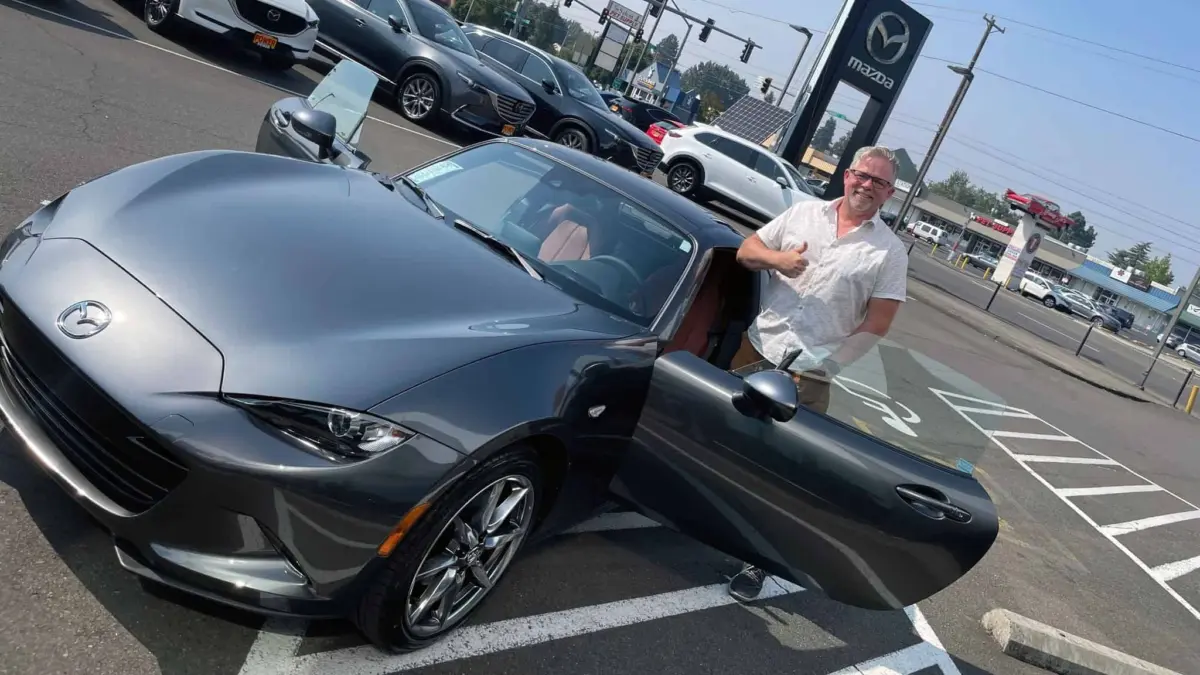
With the trade-out resolved, he produced a printout from the dealership’s website detailing the exact car he wanted: a gray hardtop model. However, the online listing indicated that the vehicle was currently in transit.
The salesman briefly attempted traditional closing techniques, asking what it would take to send him home with a car that very day from the existing inventory on the lot. The lot featured five Miatas, but none matched his preferred configuration, as they were either red, equipped with automatic transmissions, or featured soft-tops. He remained steadfast in wanting a gray exterior, manual transmission, and hardtop roof.
The salesman accommodated the request, noting that while the dealership could not discount the $39,245 listed price—which included a mandatory market adjustment markup of $1,995—they would lock in the trade-in deal and hold the incoming vehicle. They shook hands on a tentative agreement without signing final paperwork, awaiting the delivery of the car.
Driving home, he weighed the financial reality of spending roughly $40,000 on a car. Even in an era of inflated vehicle costs, it represented a significant expenditure. He briefly questioned whether a more utilitarian vehicle, like a Chevy Spark, would be more financially sensible, but quickly dismissed the thought. For his entire life, he had compromised on automobiles; this single instance was meant to be an intentional indulgence.
He framed the decision around a fundamental question: Would he rather keep the 2019 Maxi Cooper and an extra $7,000, or own a brand-new 2022 Mazda Miata? Framed that way, the choice was entirely clear.
To ensure his decision was not purely driven by impulsive emotion, he sought the counsel of trusted friends. His acquaintance Jeff, known online as The Happy Philosopher, enthusiastically encouraged him to make the purchase. When he consulted his girlfriend, Kim, she voiced no objections whatsoever, firmly validating the plan.
On the final day of August, the Mazda salesman called to report that the vehicle had arrived that morning. He immediately drove back to Salem to finalize the acquisition.
The new Miata was delivered with just five miles on the odometer. The finance professional handling the paperwork remarked that in thirty years in the automotive industry, it was the lowest odometer reading he had ever encountered on a new vehicle delivery.
He took the long way home to Corvallis, steering along winding riverside roads and rolling farm hills with the top down. The warm late-summer sun, a cool breeze, and music playing on the stereo created an experience that delivered the exact emotional resonance he had sought.
Reflecting on his upbringing—having grown up in financial hardship that often left lingering guilt over purchasing non-essential items—he recognized the Miata as an undeniably nice possession. Yet, looking back on the choice, he felt no guilt. Embracing the philosophy that financial resources should be deployed intentionally to construct a fulfilling life, the new car became a meaningful chapter in his personal story.