



The global financial markets are standing at a critical juncture following a turbulent week that saw aggressive selling pressure spread rapidly from technology equities into the corporate credit markets, precious metals, and cryptocurrencies. Friday’s steep declines—highlighted by a 2.86% plunge in the Nasdaq Composite and an 8.24% rout in the iShares Semiconductor ETF—have effectively extended a punishing two-week, AI-driven market correction. What initially began as a routine valuation reassessment for high-flying technology names is now morphing into a broader test of investor confidence, raising fundamental questions about the sustainability of massive artificial intelligence infrastructure spending and its potential ripple effects across the wider economy.
With traditionally safe-haven assets like gold, silver, and Bitcoin all moving lower alongside risk assets even as US Treasury yields retreat, market participants are laser-focused on a few pivotal technical levels. The Nasdaq holding near 25,036.33, the S&P 500 testing 7,507.77, and the 10-year Treasury yield hovering around 4.815% are now the definitive lines in the sand determining whether this pullback remains an orderly correction or transforms into a more severe, systemic market downturn.
Why This Matters
The ongoing liquidation in artificial intelligence and technology-related stocks is becoming increasingly difficult for Wall Street to dismiss as a mere temporary setback. Over the past fortnight, market sentiment has been steadily eroded by three distinct waves of selling, culminating in Friday’s sharp equity retreat. More importantly, however, growing skepticism regarding the financial returns and monetization timelines of unprecedented AI capital expenditure is no longer confined to equity valuations. These anxieties have officially breached the barrier of corporate credit assessments.
This deterioration is now vividly apparent across multiple asset classes. While Treasury yields have dropped significantly as traders price in a more cautious Federal Reserve, commodities and cryptocurrencies have faced relentless selling pressure. Yet, amid this widespread turbulence, the US Dollar has managed to maintain its bullish consolidation pattern, and the broader S&P 500 has thus far avoided the severe technical breakdowns experienced by the tech-heavy Nasdaq.

The overarching risk of a deeper, more persistent market correction has undeniably escalated, though a generalized systemic breakdown is far from confirmed. The upcoming week promises heightened volatility, with the US midterm elections and simmering geopolitical tensions in the Middle East injecting an extra layer of uncertainty into markets that are already grappling with the economic viability of the AI investment boom.
AI Concerns Move Beyond Valuations Into Credit
The narrative driving market anxiety has decisively shifted over the past week. Investors are no longer merely asking whether AI-related stocks are overvalued; they are demanding to know whether companies can realistically generate sufficient cash flows and financial returns to justify their astronomical capital commitments.
This tension was thrust into the spotlight following Alphabet’s dramatic 12.64% plunge. Despite reporting robust cloud revenue growth, the tech giant posted a negative quarterly free cash flow of $9.07 billion as capital expenditures swelled to a staggering $51.4 billion. Amazon subsequently compounded these fears by releasing disappointing earnings alongside continued heavy spending projections, while weak forward guidance from Intel sent shockwaves across the entire semiconductor landscape.
The broader takeaway from the technology sector is that institutional investors are rapidly losing their appetite for absorbing the immense financial costs of aggressive AI expansion, regardless of how constructive the underlying long-term demand outlook might appear.
However, the most significant development in this saga arrived from the credit markets. S&P Global Ratings took the decisive step of revising Meta’s credit outlook from stable to negative, directly citing heightened uncertainty surrounding the company’s bloated capital expenditures and future cash generation capabilities. With Meta projecting a massive $135 billion to $145 billion in capital spending for 2026 alongside a $2.12 billion quarterly free cash flow deficit, analysts and rating agencies are placing intense scrutiny on how these tech monoliths plan to finance and monetize their ambitious AI strategies.
Although S&P did not issue an outright credit downgrade—and Meta formally disputed the rating agency’s assessment—the outlook revision marks a profound psychological turning point. Concerns regarding AI spending are no longer restricted to stock prices; they are actively influencing professional judgments regarding corporate financial health. This distinction is vital because any further degradation in credit conditions could trigger consequences that extend far beyond a standard valuation correction in richly priced technology shares.
Despite these mounting pressures, notable macroeconomic counterweights remain present. The US economy expanded at a robust 3.4% annualized rate in the third quarter, and cloud computing giants like Microsoft Azure and Google Cloud continue to post impressive, substantive revenue gains. Defensive sectors also demonstrated notable resilience during Friday’s trading session, keeping the S&P 500 relatively close to its historical highs despite the Nasdaq’s steep retreat. Consequently, the available evidence does not suggest that the overarching AI investment cycle is collapsing. Instead, the market is aggressively interrogating whether the current funding structures and projected financial returns can genuinely support the unprecedented scale of capital already deployed.
Treasury Rally Reflects a More Cautious Fed Outlook
The steep sell-off in technology equities has occurred in tandem with a dramatic reassessment of US interest rate expectations. Earlier in the week, the Federal Reserve maintained its benchmark policy rate in the 3.75% to 4.00% range, though the decision featured two dissenting policymakers who advocated for an immediate rate increase. Federal Reserve Chair Kevin Warsh notably refrained from committing the central bank to a predetermined tightening path, leaving market participants to recalculate how much further monetary authorities might push rates if financial conditions continue to tighten.
This monetary policy repricing has been both substantial and consistent. While a future rate increase remains part of the market’s baseline scenario, overall conviction has noticeably softened. Part of this recalibration stems from growing anxiety that sustained weakness in the technology sector could inadvertently tighten financial conditions to a degree that weighs heavily on the broader macroeconomic expansion. Although September headline PCE inflation came in slightly softer than anticipated at 3.6%, inflation remains stubbornly elevated, and resilient GDP figures underscore an otherwise healthy economy.
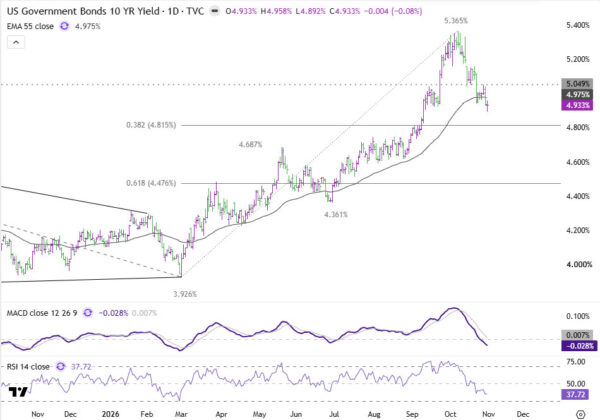
US Treasury yields have adjusted sharply to these shifting dynamics. The 2-year Treasury yield closed near 4.594%, extending a steady decline from its earlier peak of 4.960%, while the 10-year yield finished the week around 4.933%, well below its October high of 5.365%.
Yet this robust Treasury rally poses a deeper question for investors. Falling yields may simply represent the market adjusting to a less aggressive Federal Reserve policy path, but they may also signal that institutional investors are actively seeking safe-haven protection against a potential deterioration in equities, credit conditions, and overall economic growth. An orderly downward adjustment in yields is entirely consistent with a recalibration of Fed expectations. However, a much sharper decline—particularly if accompanied by worsening equity and credit metrics—would strongly suggest that market participants are bracing for more acute financial stress.
Dollar Holds Firm as Selling Spreads Across Risk Assets
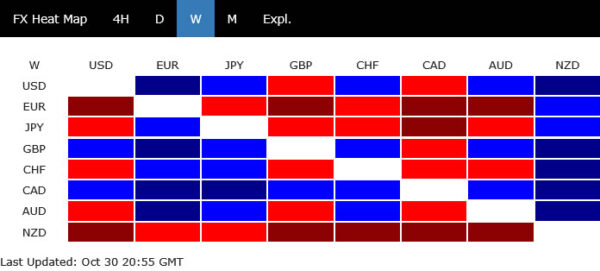
The resilience of the US Dollar throughout the week encapsulates the conflicting forces currently dominating global markets. The US Dollar Index recovered from early session weakness on Friday to close at 101.963, booking a modest 0.11% gain for the day and a roughly 0.39% advance over the week. Foreign exchange performance maps indicated that the Canadian dollar and British pound held their ground as some of the stronger major currencies, while the New Zealand dollar and the euro lagged behind.
Declining Treasury yields and reduced expectations for aggressive Fed tightening naturally weigh on the dollar’s traditional interest-rate advantage. Simultaneously, however, deteriorating market risk appetite provides underlying support to the greenback through safe-haven demand and general liquidity preferences. With neither of these opposing forces decisively overpowering the other, the dollar has remained remarkably range-bound despite intense volatility across other asset classes.
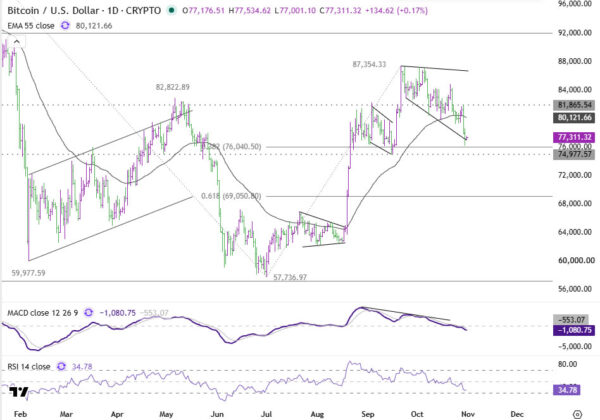
In contrast, the weakness observed in alternative investment categories has been considerably more pronounced. Precious metals experienced sharp pullbacks alongside cryptocurrencies, reflecting a broader trend of investors aggressively trimming their exposure to historically volatile asset classes. While this simultaneous retreat across technology stocks, gold, and digital assets points to a generalized risk-off sentiment, current data does not confirm forced systemic liquidations or automated cross-market selling mechanisms.
For the time being, the most critical takeaway is that selling pressure has successfully broken containment outside of AI-related equities, even if the broader financial system has yet to display signs of a widespread structural breakdown.
Midterms and Geopolitical Risks Add Uncertainty for Next Week
Looking ahead, financial markets face an influx of fresh catalysts and potential risks stemming from the upcoming US midterm elections and the lingering threat of escalating military tensions involving Iran.
Investor sentiment surveys leading up to the midterms have largely priced in expectations of a political shift in the House of Representatives, suggesting that such an outcome is already partially baked into current asset prices. However, unexpected election results in the Senate or prolonged uncertainty surrounding the final vote tally could easily disrupt market stability.
The geopolitical landscape introduces an entirely different category of risk. Recent reports indicating that Washington has discussed potential military contingencies regarding Iran following the elections have stoked fears of a major regional escalation. While no definitive operational decisions have been finalized, the mere possibility has already driven sharp upward spikes in global crude oil and European natural gas prices. A renewed energy price shock could easily exacerbate domestic inflation pressures at the exact moment financial markets are growing increasingly anxious about economic growth.
This dynamic creates two distinct, competing risk-off scenarios for the days ahead. If AI-related financial stress remains the dominant market driver, investors are likely to scale back their Fed tightening expectations even further, pushing Treasury yields down and applying downward pressure on the dollar as its yield advantage narrows. Conversely, if energy-driven inflation risks take center stage, Treasury yields could experience renewed upward momentum, while the dollar would likely draw support from both inflation-hedging rate expectations and defensive safe-haven flows.
Nasdaq Leads the Correction, S&P 500 Faces Confirmation Test
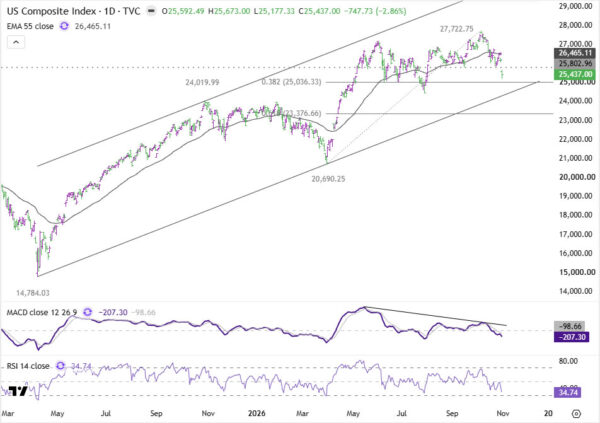
From a technical perspective, the damage sustained by the Nasdaq Composite is considerably more pronounced than it was at the outset of the week. The decisive break below the 25,802.96 support level—following an earlier rejection near the 55-day exponential moving average—confirms that the downward leg from the 27,722.75 high is actively correcting the broader advance that began at 20,690.25.
Market attention is now firmly fixed on the 38.2% retracement level at 25,036.33. A sustained break beneath this threshold would expose the next major structural support near 24,019.99, raising fundamental questions about whether the Nasdaq is carving out a much deeper correction within its multi-year uptrend. For now, the near-term path of least resistance remains tilted to the downside as long as the 55-day EMA—currently sitting around 26,465.11—caps any attempted relief rallies.
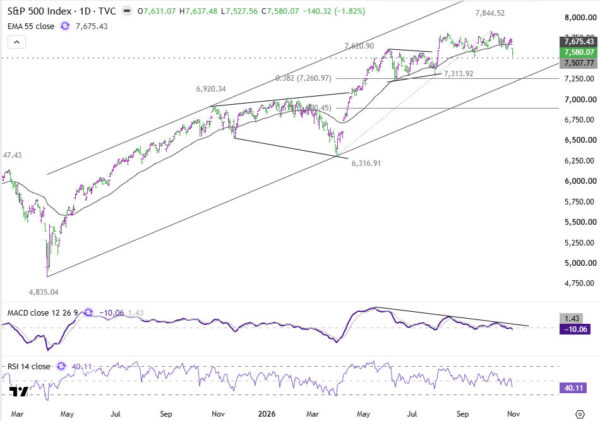
Meanwhile, the broader S&P 500 has yet to fully confirm the same technical breakdown seen in its tech-heavy counterpart. Immediate focus rests on the 7,507.77 support level, which mirrors a structural threshold that the Nasdaq has already breached. A confirmed break below this mark would synchronize the technical outlooks of both major US indices, signaling that the pullback from 7,844.52 is correcting the rally from 6,316.91 and training sights on the 38.2% retracement at 7,260.97.
The divergence between these two indices remains a crucial market feature. The Nasdaq has already confirmed a correction of its recent gains, whereas the S&P 500 is currently approaching the tipping point that could validate a much broader equity market downturn.
Treasury Yields Approach Levels That Could Signal Greater Stress
The US government bond market offers another essential lens through which to evaluate the depth and severity of the current correction. The 2-year Treasury yield extended its downward slide from 4.960% to settle near 4.594%. While this move can still be categorized as a retracement of the prior advance from 4.100%, a decisive break above resistance at 4.787% would signal that the pullback has officially run its course.
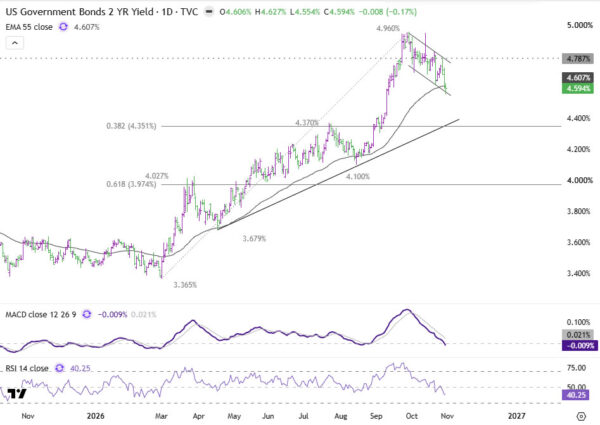
However, a sustained breach below the 55-day EMA near 4.607%, combined with a break of the prevailing channel floor, would suggest that the yield is correcting the entire upward move originating from 3.365%. Such a development would quickly draw attention to the 4.351% to 4.370% support zone, which houses the 38.2% retracement level.
The 10-year Treasury yield has already slipped below its 55-day EMA, indicating that the decline from 5.365% is actively correcting the broader structural rise from 3.926%. Further downside is anticipated as long as resistance at 5.049% remains intact, with the 38.2% retracement at 4.815% serving as the next major test of buying interest. A decisive break beneath 4.815% would pave the way for a deeper descent toward the 61.8% retracement at 4.476%. Should this occur alongside compounding equity losses and deteriorating credit conditions, it would strongly imply that the surge in Treasury demand stems from genuine financial stress rather than simple monetary policy adjustments.
Dollar Index Retains Its Bullish Structure
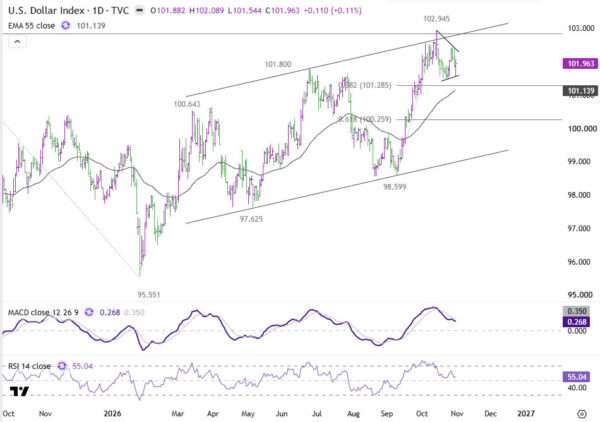
Despite enduring considerable intra-week volatility, the US Dollar Index continues to hold comfortably within its established near-term consolidation channel. The 38.2% retracement of the move from 98.59 to 102.94, located at 101.28, alongside the rising 55-day EMA near 101.13, remains intact, preserving the broader bullish market structure.
A successful push above resistance at 102.49 would provide the initial signal that the consolidation phase off the 102.94 high has concluded, putting a retest of that peak back on the table. A subsequent break above 102.94 would effectively resume the larger uptrend extending from the 95.55 low.
While another leg lower within the current consolidation range cannot be completely ruled out, the overarching bullish technical thesis remains valid as long as the 101.13 to 101.28 support zone successfully defends against sellers. Conversely, a sustained and decisive break beneath this vital area would warn of a near-term bearish reversal targeting the 61.8% retracement at 100.25. The dollar’s notable tenacity in preserving its structural integrity despite falling bond yields underscores the importance of parsing the underlying divergence between rate repricing and defensive currency demand.
Next Week Could Determine Whether the Correction Broadens
The ongoing sell-off across artificial intelligence equities has officially evolved past a routine reassessment of technology sector valuations. As questions surrounding investment returns infiltrate corporate credit ratings and selling pressure broadens into semiconductors, precious metals, and digital assets, the stakes for the broader financial system have risen appreciably.
Nevertheless, significant pockets of structural resilience remain visible. The broader S&P 500 has so far resisted the deeper technical deterioration seen in the Nasdaq, the Federal Reserve’s tightening cycle is being recalibrated rather than abruptly reversed, and the US dollar maintains a firm bullish footing.
The coming days will test crucial market thresholds: the Nasdaq’s hold at 25,036.33, the S&P 500’s defense of 7,507.77, and the 10-year Treasury yield’s test of 4.815%. A decisive breakdown below these key technical levels, particularly if paired with further credit market stress, would substantially increase the probability of a deeper, more persistent market correction. Conversely, successful defenses at these levels would allow the recent wave of liquidation to stabilize without inflicting lasting damage on the broader financial architecture.
With upcoming midterm elections and geopolitical flashpoints threatening to pull bond yields and currency valuations in opposing directions, market participants face a delicate balancing act. The central question facing investors is no longer whether the high-flying AI trade can engineer a swift rebound, but whether the financial pressure accumulating around the sector can remain safely contained before it spills over into the wider economy.