



Corporate taxation in the United States remains a complex, multi-layered system that significantly influences where businesses choose to operate, invest, and expand. At the center of this framework is the federal corporate income tax, which is levied at a flat rate of 21 percent. However, the true tax burden borne by American corporations extends far beyond Washington, D.C. Forty-four states and the District of Columbia also impose their own taxes on corporate income, creating a diverse mosaic of state-level policies, brackets, and alternative levies that heavily shape the nation’s economic landscape.
The variation among state policies is striking. Top marginal corporate income tax rates across the country range from a modest 2.0 percent in North Carolina to a high of 11.5 percent in New Jersey. To administer these levies, states take different structural approaches. Thirteen states utilize graduated corporate income tax rates, where the tax percentage increases as a company’s profits grow. Meanwhile, a larger share—31 states and the District of Columbia—opt for a flat tax rate applied uniformly to corporate income, regardless of the scale of the enterprise.
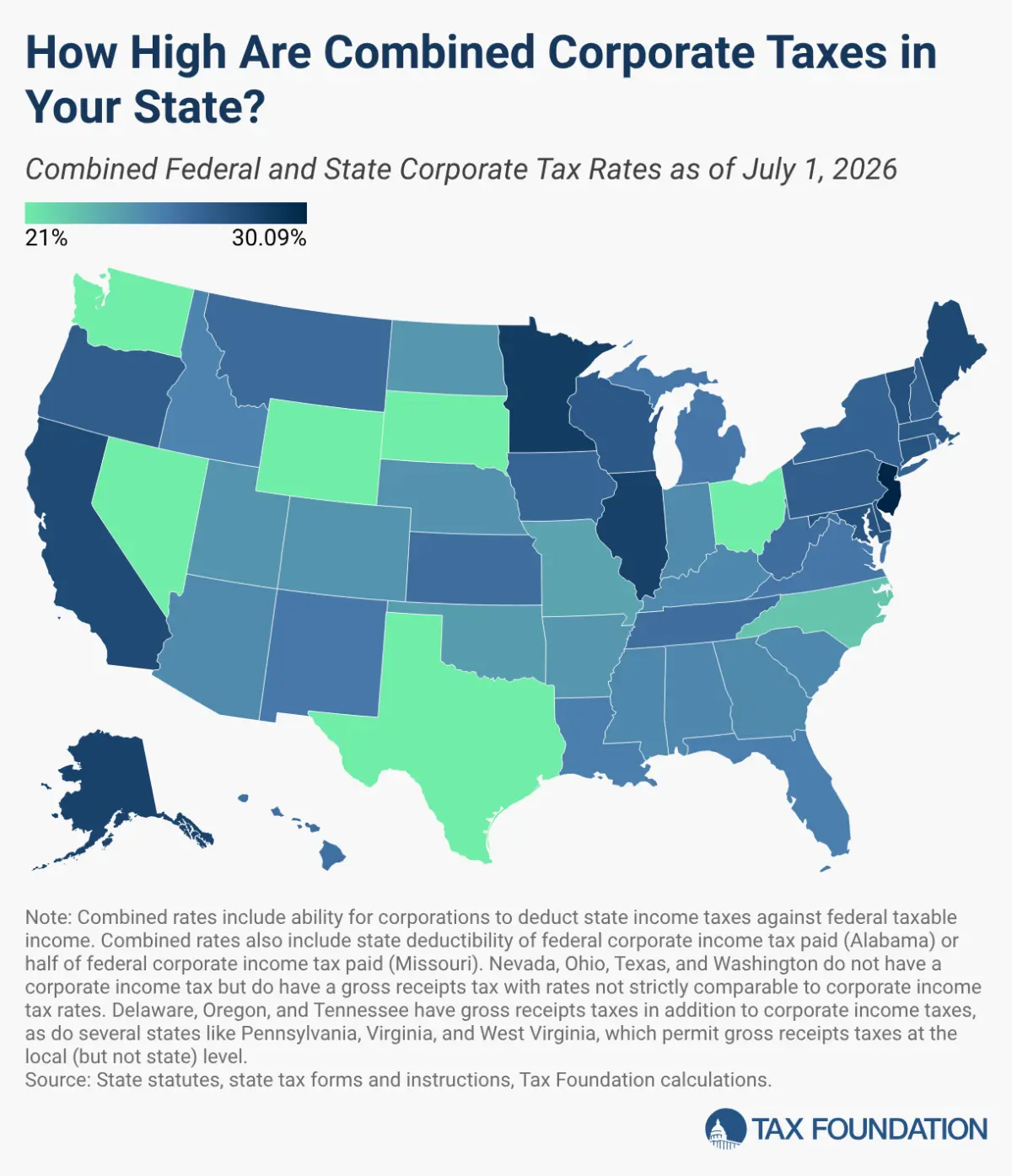
For many businesses, the traditional corporate income tax is only part of the equation. In Nevada, Ohio, Texas, and Washington, corporations are subject to gross receipts taxes instead of traditional corporate income taxes. Unlike standard corporate income taxes that apply to net profits after accounting for business deductions, gross receipts taxes are assessed directly on a company’s total gross sales. Crucially, these taxes provide no deductions for standard business expenses such as employee compensation, the cost of goods sold, or overhead costs. Furthermore, while a typical sales tax applies only at the final point of retail purchase, a gross receipts tax is assessed on transactions at every stage of the production process. This compounding effect, known as tax pyramiding, can significantly increase the total tax burden on goods and services as they move through the supply chain from raw material to final consumer.
The intersection of state tax policies creates even more intricate compliance environments for multi-state operators. Delaware, Oregon, and Tennessee take a dual approach, imposing both a traditional tax on corporate income and a separate levy on gross receipts. Meanwhile, Pennsylvania, Virginia, and West Virginia do not levy gross receipts taxes at the state level, but they permit local jurisdictions to impose them. At the opposite end of the spectrum, two states—South Dakota and Wyoming—maintain exceptionally business-friendly environments by levying neither a corporate income tax nor a statewide gross receipts tax.
When combining federal and state obligations, the total tax pressure on corporations varies dramatically depending on geography. The state with the highest combined corporate income tax rate in the nation is New Jersey, where businesses face an aggregate rate of 30.1 percent when factoring in federal and state components. Other states also maintain notably high combined burdens; in Alaska, Illinois, Maine, and Minnesota, corporations face combined corporate income tax rates at or above 28 percent. Conversely, the six states that levy no state corporate income tax—Ohio, Nevada, South Dakota, Texas, Washington, and Wyoming—face only the federal baseline rate of 21 percent, though it is worth noting that four of these states compensate by levying statewide gross receipts taxes instead.
Complicating these calculations further are intergovernmental tax deductibility rules, which can alter the effective rates that corporations ultimately pay. Under current tax rules, corporations generally may deduct state corporate income tax payments against their federal taxable income. This deduction effectively lowers the net federal corporate income tax burden. For instance, a corporation operating in Rhode Island is subject to the state’s 7 percent flat corporate income tax. Because that state tax payment can be deducted against the 21 percent federal corporate income tax, the company’s effective federal rate is reduced to 19.53 percent. When combined with the state levy, the resulting overall tax rate for that corporation in Rhode Island comes out to 26.53 percent.
In a twist on this mechanism, a select few states allow corporations to perform the reverse calculation, deducting federal corporate income tax liability against a portion of their state corporate income tax obligations. Alabama stands out by allowing full deductibility of federal corporate income tax liability against state tax liability. Similarly, Missouri permits corporations to deduct 50 percent of their federal corporate income tax liability. These rare provisions serve to further lower the effective corporate income tax rates faced by businesses operating within those jurisdictions.
When factoring in all jurisdictions across the country—including the states that choose to impose no corporate income taxes whatsoever—the average combined state and federal corporate tax rate in the United States stands at 25.5 percent. This national average reflects a post-tax-reform environment that is markedly different from historical norms, yet the competitive dynamics between individual states continue to draw intense scrutiny from economists and policymakers alike.
Analyzing the total tax burden on businesses requires looking carefully at both federal and state components, as corporate taxes are widely regarded by economic analysts as among the most economically damaging ways for governments to raise revenue. Because corporate levies can discourage capital investment, depress wage growth, and slow productivity, tax policy experts frequently point to corporate tax reform as a promising avenue for individual states seeking to increase their economic competitiveness. By modernizing their tax codes and lowering these burdens, states can foster an environment more conducive to long-term economic growth, ultimately benefiting both growing enterprises and the workforce they employ.