



The United Kingdom economy expanded by 0.1% month-on-month in August, successfully defying market consensus expectations which had forecasted a 0.1% contraction. While the latest reading marks a sharp deceleration from the more robust 0.4% growth rate recorded in July, the figures released by the Office for National Statistics reveal an economy that continues to find pockets of notable resilience. The expansion for the month was driven entirely by the production sector, even as services stagnated and the construction industry extended a persistent downward trend.
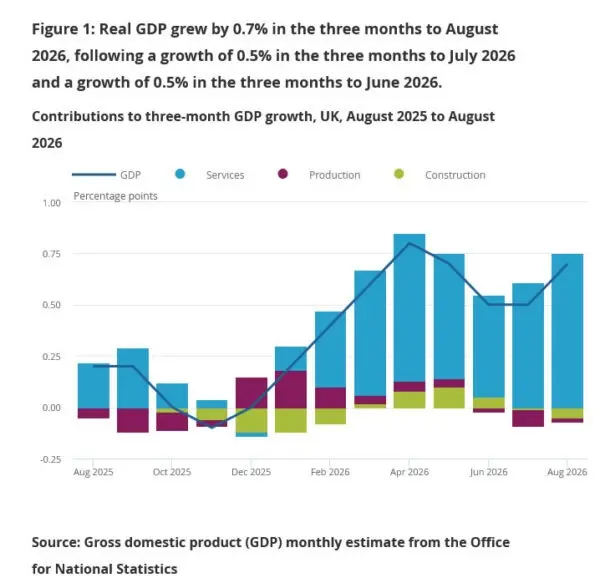
Despite the month-on-month slowdown in August, the broader macroeconomic picture spanning a three-month horizon remains encouraging. According to the Office for National Statistics, gross domestic product growth accelerated to 0.7% in the three months leading up to August, climbing from the 0.5% rate registered previously. This marks the eighth consecutive period of positive three-month growth for the UK economy. Furthermore, services output across the broader three-month window increased by 0.9%, up from 0.7% in the preceding period, indicating that the lack of momentum witnessed strictly in August has not undermined the underlying expansion trajectory of the broader economy.
Manufacturing Provided the Main Support to August’s Growth

A detailed look at the sectoral breakdown reveals that manufacturing served as the primary engine behind August’s positive headline GDP figure. Production output accelerated significantly from a 0.3% increase in July to 0.8% in August, comfortably outperforming consensus forecasts that had anticipated a 0.1% decline. Within this category, manufacturing production strengthened remarkably from 1.0% to 1.2%, completely eclipsing the modest 0.1% growth expected by analysts. This robust performance was broad-based, with nine out of thirteen subsectors recording positive growth over the course of the month.
The manufacturing surge was spearheaded by pharmaceutical manufacturing, which jumped 5.1% in August following a solid 3.4% increase in July. Additionally, transport equipment output staged a welcome rebound, rising 1.8% and helping offset areas of weakness elsewhere in the industrial landscape.
In sharp contrast to the buoyant manufacturing sector, services output completely stalled at 0.0% in August, coming to a dead stop after expanding by a healthy 0.5% in July. The breadth of growth within services was notably narrow, with only four out of fourteen subsectors managing to record positive numbers. Consumer-facing services proved particularly sluggish, contracting by 0.3% during the month. This weakness was heavily influenced by a sharp 2.7% decline in food and beverage activities, highlighting underlying vulnerability and fatigue in parts of domestic consumer demand despite the strong rebound seen on the manufacturing side.
Construction Sector Struggles and Broader Economic Implications
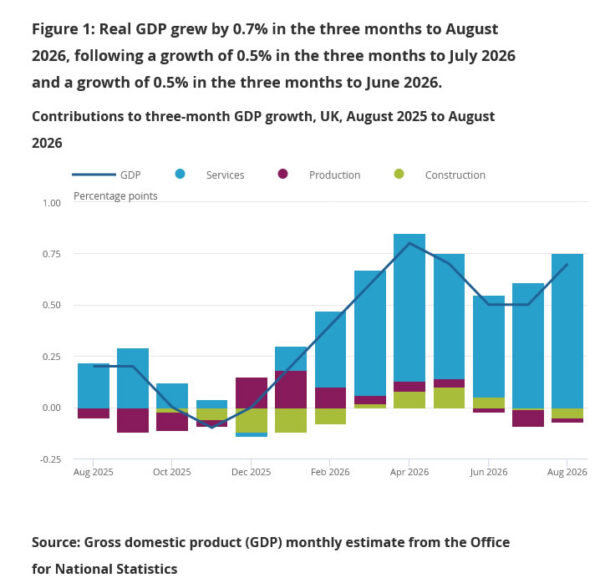
The construction industry continued to act as a drag on overall economic performance, contracting by 0.2% month-on-month in August and extending its current downturn to a fourth consecutive month. Moreover, the official data for July was revised sharply downward, moving from a previously reported 0.1% increase to a deeper 0.5% contraction.
A closer inspection of the construction figures shows that new construction work fell by 0.7% in August, weighed down heavily by a 1.9% decline in private housing activity. Looking at the broader trend, total construction output dropped by a notable 1.0% over the three months to August. These figures collectively point toward an increasingly uneven economic expansion, where strong manufacturing activity successfully supports monthly GDP while services and construction demonstrate softer momentum.
Nevertheless, the combination of stronger three-month growth figures, particularly the resilient performance in the services sector over the medium term, suggests that the wider UK economy remains relatively robust and capable of absorbing isolated monthly slowdowns as it navigates the final quarters of the year.