



The US dollar has demonstrated remarkable resilience over the past week, holding its ground firmly despite a disappointing US employment report released on October 2. The weaker-than-expected labor market data immediately dialed back market expectations for a consecutive interest rate increase by the Federal Reserve at its upcoming policy gathering on October 28.
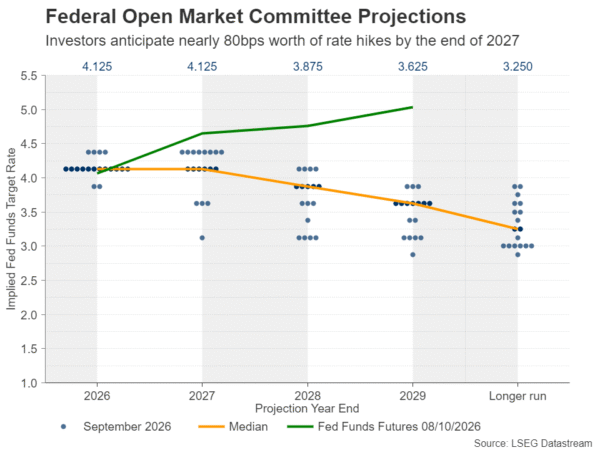
Just weeks earlier, the narrative surrounding US monetary policy was defined by aggressive tightening expectations. Following a Federal Open Market Committee meeting where officials opted for a 25-basis-point interest rate hike, policymakers delivered a sufficiently hawkish message. That tone initially aligned with market pricing that anticipated roughly 100 basis points worth of additional rate increases through the end of 2027, sending the probability of an October rate hike surging to a strong 70% to 75%.
However, the landscape shifted dramatically following subsequent commentary from influential Federal Reserve officials. Fed Vice Chair Jefferson and New York Fed President Williams both cautioned that the committee should avoid rushing into another immediate rate hike. Combined with the softer labor market metrics, these remarks quickly drove the probability of an October rate increase down to approximately 20%.
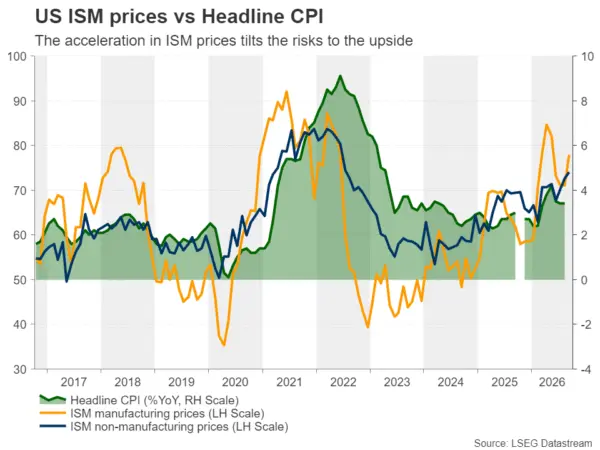
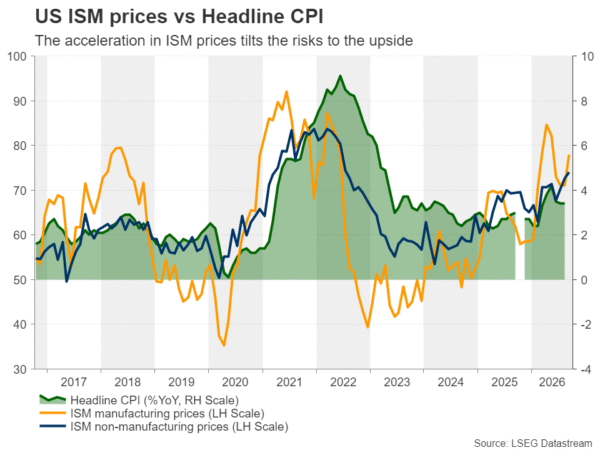
Despite the diminishing odds for October, market pricing remains aggressive further out on the curve. A quarter-point rate increase is still fully baked into expectations for December, while a cumulative 80 basis points worth of rate hikes remain priced in by the conclusion of 2027. Investors appear convinced that the central bank will ultimately be forced to maintain its tightening cycle, even if an October move has largely fallen off the table. This underlying conviction is supported by broader economic data, such as the ISM services PMI for September. Although that index showed some slowing in overall growth, it remained comfortably inside expansionary territory. More importantly, the survey revealed that the prices-paid component accelerated to its highest level since July 2022, signaling persistent underlying inflationary pressures.

US CPI Inflation Could Reshape Fed Rate Expectations
With inflationary pressures proving stubborn, market participants are training their focus on the upcoming US Consumer Price Index (CPI) report for September. Another round of sticky inflation figures has the potential to quickly revive market speculation regarding faster and more aggressive rate hikes from the Federal Reserve.
The path toward next week’s CPI release has already been mapped by a series of auxiliary economic indicators that point toward upside risks for consumer prices. Alongside the ISM services PMI, the flash S&P Global PMIs for September highlighted rising input-cost inflation, which climbed to its highest level since October 2022. Adding to these concerns, consumer sentiment surveys conducted by the University of Michigan showed that one-year inflation expectations accelerated notably, rising to 4.6% from the previous reading of 4.0%.
Even if the likelihood of an October rate adjustment remains subdued, persistent price pressures could easily prompt traders to price in additional basis points of tightening for the coming year. Such a shift would likely provide fresh momentum for the US dollar, potentially pushing long-dated Treasury yields toward new multi-decade highs.
The economic calendar for the remainder of the week offers further tests for the dollar, with the release of September producer price index (PPI) numbers and retail sales data scheduled for Thursday, followed by US industrial production figures on Friday. If these reports continue to point toward hot inflation alongside a resilient economy, the narrative favoring further Federal Reserve rate hikes through 2027 will only solidify.
Euro at the Mercy of French Politics
Traders navigating the euro-dollar exchange rate face a turbulent week, caught between upcoming US inflation metrics and mounting political uncertainty within France.
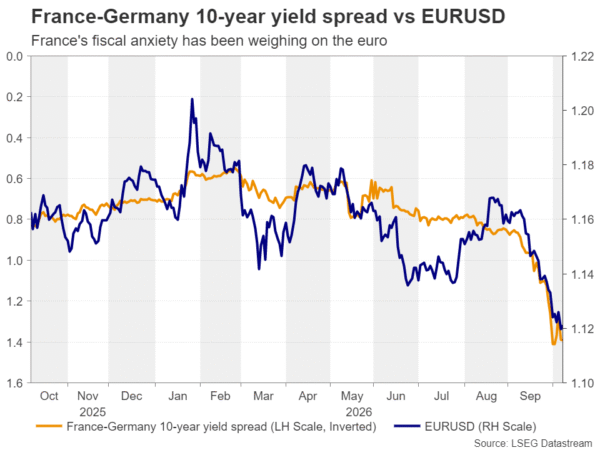
Prime Minister Sébastien Lecornu’s minority government recently presented its 2027 budget bill to parliament, proposing roughly 43 billion euros in new savings. The fiscal package is designed to narrow the country’s budget deficit from 5.4% of gross domestic product in 2026 down to 5.0% in 2027. However, the proposal faces formidable political hurdles. Opposition parties have signaled they may demand substantial concessions or resort to a motion of no confidence, setting the stage for a contentious debate in the National Assembly.
As investors increasingly doubt whether the fiscal package can successfully clear parliament, French government bond yields have extended their sharp rally. The yield spread between 10-year French and German sovereign debt briefly surpassed 140 basis points, marking its widest differential since the height of the Eurozone debt crisis in 2012. Concurrently, French credit default swaps have surged, reflecting broader trader anxieties regarding potential fiscal contagion spreading across other Eurozone economies.
This dynamic leaves the European Central Bank in a precarious position. On one side, policymakers must contend with persistently sticky inflation that demands higher interest rates. On the other side, aggressive monetary tightening risks stifling regional economic growth and driving up the borrowing costs required to finance France’s substantial national debt. Reflecting these competing pressures, Eurozone money markets have scaled back their expectations, currently factoring in roughly 70 basis points of additional ECB rate hikes through the end of 2027, down from 100 basis points just days prior.
While market discussions frequently turn to potential intervention by the central bank via its Transmission Protection Instrument, most analysts view such a step as unlikely in the near term. Bank of France Governor Emmanuel Moulin emphasized on October 7 that France does not currently require central bank assistance, arguing instead that internal fiscal consolidation and a credible budget remain the appropriate remedies.
AU and UK Data to Test RBA and BoE Rate Hike Bets
Beyond the United States and the Eurozone, incoming economic data from Australia and the United Kingdom will serve as critical tests for future monetary policy decisions by the Reserve Bank of Australia and the Bank of England.
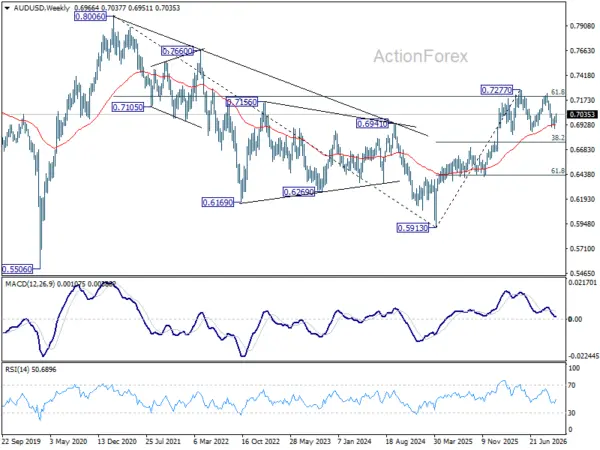
In Australia, the release of the minutes from the latest RBA policy meeting on Tuesday, followed by the national employment report on Thursday, will help determine whether policymakers pursue another rate hike before the end of the year. Following the central bank’s fourth rate increase of 2026 on September 29, investors currently assign a 50% probability to a fifth hike before the calendar turns. Should these upcoming data releases reinforce expectations for further tightening, the Australian dollar could find renewed support. Additionally, traders will closely monitor Chinese CPI and PPI data for September, slated for release on Wednesday, given China’s status as Australia’s primary trading partner.
In the United Kingdom, the Office for National Statistics is set to release monthly GDP figures for August, alongside industrial production and international trade data. During its most recent policy meeting, the Bank of England opted to keep interest rates unchanged, though three dissenting members voted in favor of an immediate increase. The central bank maintained an overall hawkish tone, largely driven by persistently high energy prices. Consequently, financial markets are currently pricing in an 85% probability of a rate hike at the upcoming November 5 gathering. Although global oil prices have retreated somewhat from their mid-September levels, favorable domestic economic data could cement the case for an imminent policy move, even as officials maintain their stance of evaluating incoming data on a meeting-by-meeting basis.
IMF-World Bank Meetings and Q3 Earnings Also on Tap
The broader financial markets will also digest major developments from the annual meetings of the International Monetary Fund and the World Bank, which are underway in Bangkok for the duration of the week. The most anticipated events of the summit are scheduled for Tuesday, when the IMF publishes its flagship World Economic Outlook and Global Financial Stability Report, accompanied by high-profile press briefings.
Tuesday also marks the official commencement of the third-quarter corporate earnings season, with Wall Street’s major financial institutions taking center stage. Industry giants including JPMorgan Chase, Goldman Sachs, Citigroup, and Wells Fargo are scheduled to report their financial results on Tuesday, with Bank of America and Morgan Stanley following on Wednesday. A central question for market observers scrutinizing these bank earnings will be the extent to which tightening financial conditions and rising yields have begun to weigh heavily on overall credit demand.