



For individuals pursuing financial independence (FI), building wealth is rarely limited to traditional index funds and retirement accounts. Travel miles and points can function much like an alternative portfolio, serving as a powerful supplement to a primary FI portfolio by significantly reducing out-of-pocket living and travel expenses over time. Tracking the actual monetary value extracted from travel rewards over the years reveals a substantial financial impact, consistently generating thousands of dollars in value annually and effectively reducing the size of the nest egg needed to achieve long-term freedom.
An analysis of annual reward totals demonstrates the compounding effect of an optimized points strategy. Tracking the returns over an eight-year period reveals yields of $2,614 in 2019; $4,401 in 2020; $6,080 in 2021; and $6,192 in 2022. Although 2023 saw a temporary dip to $648, the returns rebounded dramatically to $10,593 in 2024, followed by $4,253 in 2025 and $5,917 projected or realized into 2026. Across this multi-year window, the average annual value exceeds $5,000. Applying standard financial independence mathematics, specifically a traditional 4% safe withdrawal rate, generating $5,000 a year in travel savings equates to removing the need for roughly $127,175 in a traditional investment portfolio.
How I Build Up My Other Portfolio
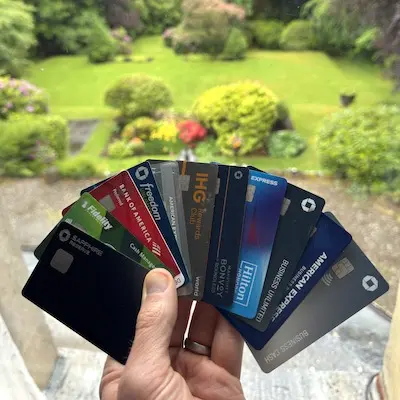
While seasoned investors frequently detail the exact contents and management strategies of their core investment portfolios, far less attention is often paid to the everyday wallet contents that generate these auxiliary savings. For many practitioners of financial minimalism, the goal shifts over time from constant optimization to radical simplification. When a reward ecosystem performs exceptionally well and meets every practical need, the necessity to chase new offers or constantly churn plastic diminishes. Instead, a core group of reliable financial products remains firmly established in daily use.
Chase Sapphire Reserve
Among the vast landscape of rewards cards, the Chase Sapphire Reserve has maintained its status as a premier choice, utilized for the vast majority of daily and travel purchases. Acquired when it first launched in 2016, the card has remained a primary financial instrument for nearly a decade. According to valuations by industry experts at The Points Guy, Chase Ultimate Rewards points carry an estimated value of approximately 2.05 cents each. This valuation transforms the card’s accelerated earning structure into a massive return on everyday spending, translating to substantial cash-equivalent returns on major categories like travel, lodging, and dining.
Beyond the raw accumulation of points, the tangible lifestyle benefits yield immediate financial relief. Airport lounge access, for instance, routinely saves travelers significant sums per airport visit—particularly when navigating terminals lacking dedicated airline spaces—while transforming potentially stressful travel days into relaxed experiences. Recent adjustments to the card’s annual fee structure were accompanied by the introduction of substantial new perks, generating thousands of dollars in added value through targeted statement credits, luxury hotel stays, dining experiences, and live entertainment bookings.
Fidelity Cash Management Debit Card
While travel points dominate the conversation around alternative portfolios, cash management products remain essential for international and domestic mobility. The Fidelity Cash Management Debit Card, while not earning travel miles or reward points, serves as an indispensable tool for global travelers. Two primary features drive its utility: the complete absence of foreign transaction fees and the blanket reimbursement of all domestic and international ATM fees, regardless of how high they may be.
When traveling abroad, this structure eliminates the need to visit currency exchange counters or acquire traveler’s checks. Travelers can simply withdraw local currency directly from an ATM upon landing in a foreign country, securing an exchange rate that consistently beats commercial exchange booths. Furthermore, the fee-reimbursement policy provides immense convenience domestically, removing the need to hunt down a specific bank’s ATM network and ensuring that any fee charged by an independent machine is fully refunded by the institution. Although some traditional banking debit cards are retained for localized cash access near physical bank branches, the cash management card remains the primary vehicle for liquidity.
Chase Freedom Unlimited and Everyday Spending
For everyday domestic purchases outside of travel and dining, cards featuring flat-rate cash or point structures provide reliable, low-effort accumulation. The Chase Freedom Unlimited serves as a primary vehicle for non-category spending within the United States, earning a baseline of points per dollar that, when paired with high point valuations, equates to a strong return on miscellaneous purchases. Because the card carries no annual fee, it remains a permanent fixture in the rotation. Similarly, targeted spending at supermarkets is directed toward cards that maximize grocery rewards, such as specialized American Express products tailored to US supermarket purchases.
Hotel and Business Credit Cards
Brand loyalty programs often provide outsized value through annual retention perks that far outweigh their nominal costs. Mid-tier hotel cards, such as legacy IHG products, Marriott Bonvoy cards, and basic Hilton Honors options, are strategically kept active to capture annual free night awards. Even when accounting for modest annual fees, the market value of a complimentary hotel night frequently exceeds the yearly cost of holding the card, making these products valuable long-term holds for frequent travelers.
In the small business sector, flat-rate rewards cards provide a streamlined way to accumulate points on operational expenses without managing complex category rotations. Business cards offering strong baseline returns per dollar on all purchases, paired with zero annual fees, allow entrepreneurs to build up substantial point balances across different issuer ecosystems. While certain older business cards may see diminished direct use following the acquisition of more streamlined options, they are frequently kept open to preserve average account age and maintain overall credit health without incurring ongoing costs.
Maximizing Modern Card Perks
Recent structural changes to premium travel cards have introduced a complex web of lifestyle credits, statement rebates, and milestone bonuses. While traditional personal finance dogma often warns against letting card perks dictate spending habits—cautioning that credits can mimic gift cards and induce unnecessary purchases—these features can also serve as a welcome catalyst for individuals intentionally learning how to allocate discretionary funds toward memorable experiences.
Recent utilization of these expanded benefits highlights how statement credits can effectively subsidize luxury and leisure. Multi-night stays at boutique downtown hotels, paired with generous daily dining vouchers and property credits, allow cardholders to experience high-end hospitality with minimal out-of-pocket costs. Similar statement credits successfully offset premium dining experiences at upscale steakhouses and ticket purchases for major hockey games, concerts, and live performances through entertainment booking platforms. Furthermore, crossing high annual spending thresholds unlocks substantial airline fee credits and elite status upgrades, generating further savings on baggage fees and domestic airfare.
When summing these targeted redemptions—spanning luxury hotel nights, fine dining, entertainment, and travel credits—the total annual value extracted from a single premium card can easily surpass three thousand dollars, even before factoring in baseline airport lounge access, expedited security screening credits, and general point earnings. This layered approach illustrates why carefully curated credit card strategies continue to serve as a cornerstone of modern financial optimization.