



For many individuals pursuing financial independence (FI), investment portfolios built on stocks, bonds, and real estate are the foundational pillars of early retirement. However, a growing cohort of practitioners argues that alternative assets—specifically travel miles and credit card reward points—can function as a secondary, highly lucrative portfolio capable of meaningfully supplementing traditional retirement funds.
Tracking the tangible financial value generated by travel rewards over an eight-year period reveals substantial annual returns. Documented earnings show $2,614 in value for 2019, scaling upward to $4,401 in 2020, $6,080 in 2021, and peaking at $6,192 in 2022. Following a modest dip to $648 in 2023, the returns rebounded significantly, reaching $10,593 in 2024, $4,253 in 2025, and $5,917 in 2026. Across this multi-year tracking period, the average annual value consistently surpassed $5,000.
Evaluated through standard financial independence mathematics—specifically applying a 4% safe withdrawal rate—generating over $5,000 annually in travel rewards is equivalent to needing an additional $127,175 parked within a traditional income-generating investment portfolio. By substituting out-of-pocket cash expenses for points and miles, retirees and near-retirees can reduce their annual portfolio withdrawal requirements, effectively extending the lifespan of their core nest egg.
Building and Simplifying the Secondary Portfolio
While extensive literature exists detailing how to structure and manage a core FI stock and bond portfolio, far fewer resources examine the operational side of managing a rewards wallet over the long term. Over recent years, the strategy has shifted away from aggressive optimization and complex churning toward a philosophy of simplification. Maintaining a stable, unchanging lineup of financial products eliminates the cognitive fatigue of constantly hunting for new sign-up bonuses, ensuring that the selected cards consistently deliver high value with minimal administrative friction.
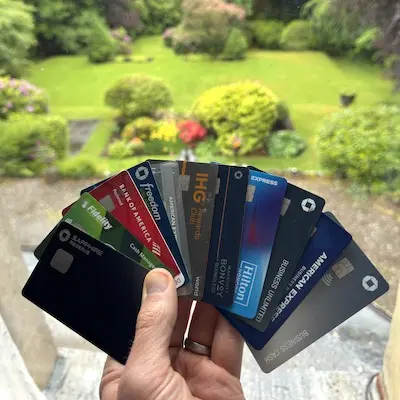
At the center of this wallet is the Chase Sapphire Reserve, a premium travel card that commands the vast majority of daily spending. Acquired shortly after its market introduction in 2016, the card has remained the primary instrument for more than 95% of all consumer purchases. Industry valuation experts, such as The Points Guy, frequently value these transferable points at approximately 2.05 cents each. Consequently, earning 4x points on flights and hotels alongside 3x points on dining translates to an effective return of over 8% and 6% respectively on two of the largest typical household expense categories.
Beyond point accumulation, the card offers structural lifestyle benefits that translate directly into financial savings. Airport lounge access routinely saves approximately $100 per transit for traveling parties, bypassing the inflated costs of terminal food and beverage while transforming stressful travel days into more relaxed experiences. Recent adjustments to the card’s annual fee structure also introduced a suite of updated perks and statement credits. Since these changes took effect, cardholders have captured thousands of dollars in added value, proving that premium annual fees can sometimes yield a net-positive return for frequent travelers.
Essential Banking and Supplemental Cards
Complementing the primary rewards card are a select few financial instruments chosen for specific utility rather than point accumulation. The Fidelity Cash Management Debit Card stands out as an indispensable tool for international and domestic travel, despite earning zero rewards points. The card provides two vital features for frequent travelers: zero foreign transaction fees and complete worldwide ATM fee reimbursements.
When traveling abroad, this eliminates the need to visit currency exchange kiosks or purchase traveler’s checks. Cardholders can simply withdraw local currency directly from an ATM upon landing, securing an exchange rate superior to typical commercial exchange bureaus. Domestically, the universal ATM fee reimbursement means cardholders never need to hunt for a specific bank’s network, as any domestic ATM fee is fully refunded by the institution regardless of the amount. A traditional bank debit card is also retained purely for convenient cash access when physically adjacent to a local branch.
For everyday domestic spending outside of travel and dining, the Chase Freedom Unlimited serves as the standard non-fee card. Earning 1.5 points per dollar on all purchases, which can be valued at over 3 cents per dollar equivalent when paired with premium travel redemption options, it functions effectively as a strong cash-back equivalent on miscellaneous spending. Similarly, the Amex Everyday card is utilized specifically for supermarket purchases in the United States, capturing 2 points per dollar on grocery spending.
Hotel-branded credit cards occupy a permanent place in the wallet due to a straightforward economic calculation: low annual fees offset by guaranteed annual rewards. The IHG Select card, though no longer open to new applicants, is kept active because its modest $49 annual fee yields a complimentary hotel night each year. Similarly, the Chase Marriott Bonvoy Boundless card is utilized exclusively for Marriott property spending, justified by an annual free night award worth up to 50,000 points in exchange for a $95 annual fee. The Hilton Honors American Express card rounds out the hotel portfolio, maintained primarily because its lack of an annual fee allows it to sit indefinitely in reserve for brand-specific stays.
Business Credit Card Strategy
For professional and entrepreneurial expenses, business credit cards provide an additional layer of rewards without adding personal liability burdens or annual costs. The Chase Ink Business Unlimited serves as the primary business card, offering 1.5 points per dollar on all business expenditures with no annual fee. The Amex Business Blue card is deployed selectively to build up American Express Membership Rewards balances, earning 2 points per dollar on the first $50,000 of annual spending without an annual fee. Meanwhile, the Chase Ink Business Cash card is retained despite low utilization, preserving an older, no-fee line of credit.
Evaluating Premium Perks and Spending Behavior
Recent structural enhancements to premium travel cards have introduced a complex psychological dynamic into personal finance: perks that intentionally encourage increased spending. While traditional personal finance dogma strictly discourages spending money simply because a discount or gift card is available, individuals who have mastered the art of intentional spending view these credits differently. For those actively learning how to reallocate accumulated capital toward lifestyle enrichment during or after the accumulation phase of financial independence, targeted statement credits provide a welcome nudge to enjoy experiences that might otherwise be bypassed.
Recent utilization of these expanded benefits highlights significant tangible savings. A two-night stay at a downtown hotel generated a $250 statement credit, supplemented by daily breakfast vouchers and property-wide food and beverage credits. Dining out at high-end establishments, such as specialized steakhouses, yielded additional statement credits that subsidized meals otherwise considered outside normal budgetary parameters. Entertainment credits successfully offset the ticket costs for professional hockey games and major live music concerts. Furthermore, clearing high-tier annual spending thresholds unlocked substantial airline credits and complimentary airline status, which eliminated domestic baggage fees.
Accumulating these statement credits, hotel certificates, and promotional perks across a single calendar year results in thousands of dollars in direct savings. This total captures a blend of routine expenditures that would have occurred regardless, alongside discretionary splurges that enriched overall lifestyle quality. Unused credits remaining in reserve—including shopping stipends, curated hotel booking credits, and biannual dining allowances—point toward even greater cumulative value.
Ultimately, when factoring in complimentary airport lounge access, TSA PreCheck credits, and flexible point redemptions, a well-curated travel rewards portfolio functions as far more than a collection of plastic cards. For practitioners of financial independence, it operates as a sophisticated, resilient secondary portfolio that actively defrays the cost of living and traveling well.