



The EURGBP currency pair continued its aggressive downward trajectory on Wednesday, piercing through key technical thresholds to touch its weakest level since late May. The single currency found itself under immense, multi-pronged pressure as macroeconomic headwinds intensified across the Eurozone, most notably underscored by surging French sovereign bond yields and a widening yield spread with Germany. Meanwhile, across the English Channel, the British Pound received a powerful tailwind from domestic data revealing hotter-than-expected inflation, further widening the monetary policy divergence narrative between the European Central Bank and the Bank of England.
The fundamental weakness plaguing the Euro has been heavily compounded by mounting fiscal and political anxieties originating in France. On Wednesday, French 10-year bond yields climbed to their highest levels in over four years, alarming fixed-income investors and sending ripples of risk aversion across European currency markets. This sharp upward movement in French borrowing costs notably stretched the yield spread between French and German sovereign debt—a closely watched barometer of fragmentation risk and economic stress within the Eurozone. As investors demand a higher premium to hold French debt amid persistent budget concerns, the shared currency has borne the brunt of the sentiment deterioration, leaving the euro vulnerable against major peers, and particularly exposed to a resilient British Pound.

Conversely, the Sterling narrative was bolstered by domestic economic readings that showed UK inflation running hotter than anticipated by consensus forecasts. This persistent inflationary pressure complicates the policy outlook for the Bank of England, forcing market participants to recalibrate their expectations regarding potential interest rate cuts and pricing in a more cautious approach from central bankers in London. The contrast between stubborn UK price growth and a more fragile economic backdrop on the continent created a fertile environment for EURGBP bears, driving the currency pair steadily lower during European trading hours.
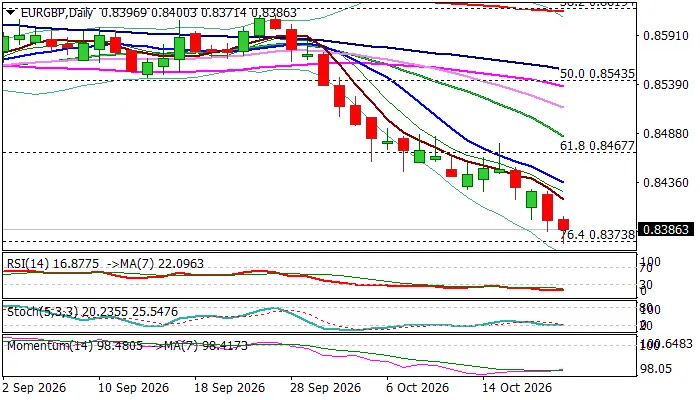
From a technical perspective, firmly bearish daily studies continue to heavily dominate the macroeconomic outlook, signaling that the broader downward trend remains intact. However, the intensity of the recent sell-off has left the Relative Strength Index (RSI) deeply oversold. This technical extreme suggests that the dominant bearish momentum may soon pause to catch its breath, particularly after finding a temporary foothold at the 0.8373 Fibonacci support level. This crucial floor marks the 76.4% retracement of the broader upward wave that developed between December and November, serving as a critical line in the sand for market participants evaluating the depth of the current correction.
Near-term price action demonstrated a slight technical reaction, bouncing modestly from an intraday low of 0.8371. Despite this minor recovery bounce, the exchange rate continues to trade suppressed below the initial psychological barrier at the 0.8400 round figure. Market analysts note that any extended near-term upticks should ideally be capped by the falling 10-day moving average, currently situated around the 0.8436 mark, as well as the former swing low from July 15 near 0.8454. A failure to breach these overhead resistance levels would confirm a healthy corrective bounce within a larger bearish structure, ultimately allowing sellers to regain full control of the directional momentum.
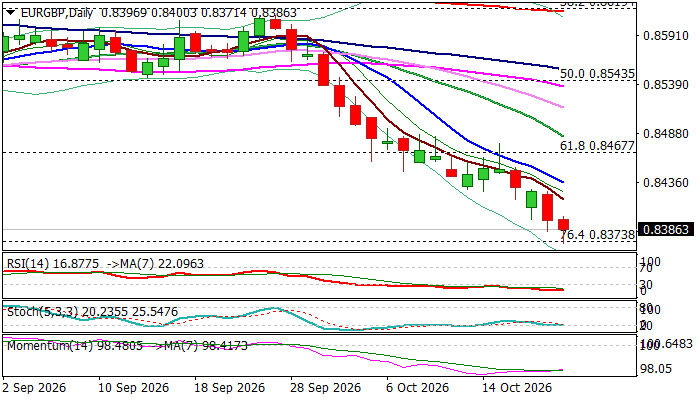
Looking ahead at the pivotal technical landscape, immediate resistance levels are stacked at 0.8400, followed by the 10-day moving average at 0.8436, the July 15 low at 0.8454, and a higher ceiling at 0.8465. On the downside, immediate support rests at the 0.8373 Fibonacci level, with subsequent floors identified at 0.8355, 0.8315, and the psychological 0.8300 threshold. Market participants will continue to monitor European bond markets and incoming UK economic indicators closely to determine whether the current technical consolidation will spark a deeper corrective pullback or give way to a resumption of the primary downward trend.