


Central bank gold acquisition reached a powerful crescendo in September, driving third-quarter purchases significantly above the five-year quarterly average as monetary authorities worldwide continue to bolster their sovereign reserves against a backdrop of global economic and geopolitical uncertainty.
According to comprehensive figures released for the third quarter, central banks globally expanded their official and estimated gold reserves by an impressive 321.2 tonnes. This total represents a striking 42 percent year-on-year increase compared to the same period in the previous year, demonstrating that institutional appetite for the precious metal remains robust despite historically elevated market prices.
While publicly reported central bank gold buying totaled 120 tonnes for the third quarter, data compiled by the World Gold Council highlights a massive volume of unacknowledged accumulation. The organization estimates that additional, unreported central bank purchases reached a substantial 201 tonnes during the same three-month window.
Market analysts note that this shadow accumulation continues a pronounced trend that has reshaped the global gold market since 2022. Unreported activity accounted for roughly 63 percent of the quarter’s total demand, underscoring the reality that disclosed country-level purchases provide only a partial and incomplete picture of the true underlying sources of sovereign demand.
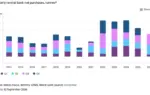
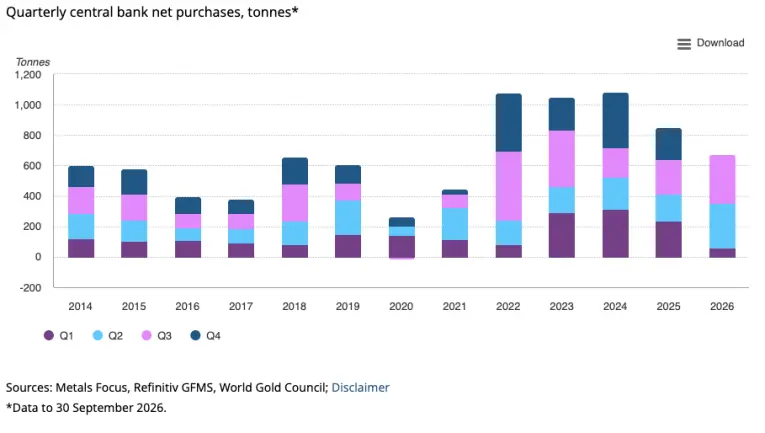
When factoring in these unacknowledged acquisitions alongside officially reported figures, total central bank gold accumulation through the first three quarters of the year rises to an estimated 675 tonnes. This aggregate figure marks a 7 percent increase over the same nine-month period last year, proving that sovereign stacking of the yellow metal has not slowed down on a macro level, even if monthly participation fluctuates based on localized pricing and liquidity conditions.
Central Bank Gold Accumulation Accelerated in September
The upward trajectory of sovereign gold demand became particularly pronounced as the third quarter drew to a close. Central banks globally increased their net gold reserves by 61 tonnes in September alone, marking the highest monthly accumulation rate observed throughout the entire year.
Among the most active participants in this global buying spree is the National Bank of Poland, which currently ranks as the top institutional gold buyer of the year. The Polish central bank expanded its reserves by another 25 tonnes in September, bringing its total year-to-date acquisitions to 123 tonnes. With these consistent additions, Poland now holds a formidable 673 tonnes of monetary gold in its vaults.
This aggressive accumulation aligns with a strategic announcement made by Polish central bank leadership late last year. The National Bank of Poland previously outlined explicit plans to acquire up to 150 additional tonnes of gold over time, with the ultimate goal of raising total national holdings to a maximum of 700 tonnes.
Governor Adam Glapiński emphasized the strategic prestige associated with this policy, noting that the expanded gold reserves would elevate Poland into an elite tier of sovereign holders. In public remarks, he highlighted that the initiative will firmly place Poland among the elite ten countries with the largest gold reserves anywhere in the world.
The scale of Poland’s current monetary reserves places it well ahead of several established Western European institutions; notably, the Polish central bank already holds more gold than the European Central Bank itself. This modern accumulation represents a dramatic shift from historical baselines, contrasting sharply with the fact that the National Bank of Poland held a mere 14 tonnes of gold as recently as 1996.
Meanwhile, the People’s Bank of China maintained an accelerating pace of gold acquisition throughout September, reporting official purchases totaling 23 tonnes. This milestone marked the twenty-third consecutive month of officially reported gold buying by Beijing, lifting official Chinese reserves to a reported 2,410 tonnes. This massive cache now accounts for approximately 9 percent of the country’s total official international reserves. Year-to-date, the People’s Bank of China has officially reported the addition of 80 tonnes to its sovereign holdings.
However, market observers emphasize the critical distinction between officially reported figures and actual physical accumulation. China is widely recognized by independent researchers as one of several major central banks holding significantly more gold than it chooses to publicly disclose, meaning Beijing likely accounted for a substantial portion of the unreported buying detected by the World Gold Council.

Independent researchers, such as prominent energy and metals analyst Jan Nieuwenhuijs, have documented evidence suggesting that the People’s Bank of China is quietly acquiring vast amounts of gold off the books. Data parsed from trade flows and domestic production indicates that the Chinese central bank may currently sit on more than 5,000 tonnes of monetary gold securely housed in Beijing—more than double the quantity that Chinese officials officially admit to holding.
Financial institutions in the mainstream market are increasingly acknowledging these discrepancies. Major investment institutions have begun factoring undisclosed sovereign accumulation into their long-term forecasts. Earlier this summer, analysts at Goldman Sachs published notes highlighting China’s ongoing secret gold reserve expansion, while BMO Capital analysts released projections estimating that Chinese gold reserves could realistically surpass those of the United States within the span of five years.
Other sovereign actors also adjusted their reserve profiles during the late third quarter. After temporarily pausing its accumulation to sell one tonne of gold in July, the Central Bank of Uzbekistan pivoted back to a buying posture in August by adding 8 tonnes to its reserves. This was followed by an additional 7-tonne purchase in September, bringing its net gold accumulation to 57 tonnes for the year.
Uzbekistan’s monetary policy maintains a heavy reliance on the precious metal, with gold accounting for roughly 90 percent of the country’s total international reserves. Such fluctuations are characteristic of central banks that rely heavily on domestic mining and refining output, leading them to periodically balance domestic liquidity needs against sovereign accumulation strategies.
Similarly, the National Bank of Kazakhstan reported a 5-tonne increase in its gold reserves in September, pushing its total expansion to just under 44 tonnes for the year. Like Uzbekistan, Kazakhstan frequently balances local production with strategic reserve management.
In Europe, the Czech Republic continues to distinguish itself as one of the most consistent and methodical gold buyers in the region. The Czech National Bank maintained its disciplined strategy in September with another steady 2-tonne purchase, continuing a streak of monthly acquisitions that has now lasted for 43 consecutive months. After adding 20 tonnes to its reserves last year, the Czech Republic currently holds 88 tonnes of gold, with official institutional policy targeting a total of 100 tonnes by the year 2028.
Additional, smaller-scale sovereign participation in September included reported purchases from Jordan, which added 4 tonnes to its holdings, and Bolivia, which registered a 1-tonne increase.
On the opposing side of the ledger, the Central Bank of the Russian Federation remained the most notable seller of official gold reserves. Russia reduced its gold holdings by another 6 tonnes in August, bringing its year-to-date sales total to 72 tonnes and leaving its official reserves standing at 2,265 tonnes. Economic analysts point out that Moscow is actively tapping its substantial sovereign gold reserves to navigate ongoing international economic sanctions and finance the demands of a wartime economy.
The Big Picture
Stepping back to view the broader multi-year trajectory, central bank gold buying experienced a mild moderation in 2025 following record-breaking historical highs, yet it remained remarkably elevated compared to long-term historical norms. Official net full-year buying for the previous year reached 863.3 tonnes. While this represented a 21 percent decline year-on-year—marking the lowest annual total since 2021—it stayed well above the pre-2022 historical average of 473 tonnes per year recorded between 2010 and 2021.
In historical context, the accumulation seen in recent years ranks as the fourth-largest expansion of sovereign gold reserves on record. The all-time high was established in 2022, when global central banks added a staggering 1,136 tonnes to their vaults. That milestone marked the highest level of net institutional purchases recorded since 1950, encompassing the historic eras both before and after the 1971 suspension of dollar convertibility into gold.
Market strategists indicate that the persistently high price of gold likely tempered the pace of central bank accumulation during certain stretches of the current year. The World Gold Council noted in market commentary that elevated prices prompted a more cautious and tactical approach among institutional buyers early on, though purchasing activity reliably rebounded whenever market prices dipped during the second and third quarters.
Despite intermittent price volatility, analysts emphasize that short-term price fluctuations are secondary to larger structural motivations. Longer-term strategic considerations, such as asset diversification, geopolitical risk management, and de-dollarization initiatives, remain the primary and enduring drivers of sovereign demand.
Recent sentiment surveys conducted by the World Gold Council underline this institutional outlook. Central bankers overwhelmingly report that they expect global sovereign gold reserves to continue expanding over the coming twelve months. Rather than retreating from the market due to higher valuations, monetary authorities appear to be actively utilizing market corrections to accelerate their accumulation programs, confirming that gold remains a foundational pillar of modern central bank reserve management.