



At 53 years old, the author had spent a lifetime making compromises. Growing up with a background of financial scarcity can leave a lasting psychological imprint, often making the purchase of pure luxury or indulgence feel like an unwarranted guilt trip. For decades, every vehicle purchase was carefully calculated around constraints—tight budgets in youth, practical used cars in middle age, and eventually, a pragmatic compact SUV rather than a true sports car. But a convergence of post-pandemic economic anomalies, a routine maintenance trip, and a sudden stroke of automotive serendipity completely upended a lifetime of automotive restraint, resulting in a surprising and joyous splurge.
During the peak of the pandemic in early July 2020, the author paid $35,990 for a used 2019 Mini Countryman SE All4. Affectionately dubbed the “Maxi Cooper,” the compact crossover was not a terrible vehicle by objective standards, but it was fundamentally the wrong vehicle for its owner. Having intended to replace an older 2004 Mini Cooper with a modern equivalent of the same nimble model, the buyer had allowed himself to be nudged toward a more utilitarian compact SUV. For two years, he drove the Maxi Cooper out of a sense of obligation rather than affection. As a self-proclaimed "small-car guy" rather than an SUV enthusiast, the mismatch grated on him daily, though he resigned himself to keeping it for a decade, as was his usual practice.
Everything changed last month during a routine trip to the dealership for an oil change. While waiting for the service to be completed, a representative unexpectedly offered to buy the vehicle back. Unbeknownst to the owner at the time, this inquiry was happening against the backdrop of an unprecedented used-car market in the United States. According to data from the U.S. Federal Reserve, prices for used vehicles had surged an extraordinary 55 percent since July 2020, driven heavily by supply chain bottlenecks, microchip shortages, and broader macroeconomic inflation. While new vehicle prices had also risen over the same period, the increase was a much more modest 18 percent.
As someone who writes about personal finance, the author was well aware that used-car valuations were historically inflated, yet he had never seriously considered capitalizing on the trend with his own daily driver. However, when the dealership casually tossed out a purchase offer of $33,000 for a car he had bought 26 months prior, curiosity took over. He reached out to a trusted acquaintance, a former car salesman named Jeremy, to evaluate the proposition.
Jeremy’s response was immediate and enthusiastic. He pointed out that recouping $33,000 on a vehicle purchased 26 months earlier effectively meant the owner had leased the car for a staggering low cost of roughly $115 per month. Urging him to lock in the deal immediately before the dealership changed its mind, Jeremy’s advice aligned with broader automotive economic commentary at the time. Industry observers noted that historical norms—where used cars depreciated predictably while new cars suffered steep, immediate value drops—had been completely inverted. Supply constraints meant used cars were no longer bargains, making sudden high-value trade-in offers too lucrative to ignore.
Unprepared to Purchase
Faced with the unexpected prospect of shedding his vehicle, the author made a firm psychological commitment: for the first time in his life, he was going to purchase a car based entirely on desire rather than compromise. Past vehicle acquisitions had always required concessions—whether financial limitations when young, opting for used models later on, or settling for a family-friendly crossover instead of a spirited roadster. This time, he decided to bypass compromise altogether.
Because the sale of the Maxi Cooper was entirely unplanned, he found himself doing things in reverse. Most consumers determine their vehicular needs and preferences before parting with their current ride; the author, however, was suddenly car shopping from scratch. He briefly weighed the possibility of going car-free entirely. He already owned a utilitarian 1993 Toyota pickup—undeniably aged and unsightly, but functional. Furthermore, living in Corvallis, Oregon, presented an ideal environment for alternative transportation, featuring robust infrastructure that supported walking dozens of miles a week and biking for routine errands. He also entertained the thought of hunting down another vintage 2004 Mini Cooper, his perennial automotive ideal.
Modern Mini models had grown noticeably larger over the years while drawing declining customer satisfaction scores, and preferred international models like the Audi A1 were unavailable in the United States. Ultimately, he decided that this unique window presented the ideal opportunity to acquire something entirely new that would truly bring him happiness.
A Very Short Search
An intense, accelerated 24-hour research phase commenced. Turning to structured tools to narrow down his options, he utilized the Consumer Reports car finder, a proprietary matching questionnaire. The algorithm generated a shortlist consisting of the Kia Niro Electric, the Ford Mustang Mach-E, the Mazda MX-5 Miata, the Tesla Model 3, and the Hyundai Ioniq 5.
Immediate filtering eliminated several contenders. The Tesla Model 3 was discarded due to its high price point and mediocre reliability history. The Kia and Hyundai electric offerings were passed over because they failed to secure top-tier owner satisfaction marks. Meanwhile, the electric Ford Mustang Mach-E was disqualified simply by virtue of being an SUV rather than a sedan—a categorization error by the recommendation tool, given the buyer’s explicit anti-SUV stance.
That left a single remaining vehicle: the Mazda Miata.
The Miata had long held a quiet appeal for the author. It consistently earned stellar praise from both automotive critics and everyday owners while embodying the compact, engaging driving dynamics he loved about his older Mini Coopers. Although comparative data from Consumer Reports and Kelley Blue Book highlighted typical drawbacks such as limited cabin space, minimal cargo utility, and noticeable road noise, these factors held zero weight for someone seeking a pure driving experience.
Professional assessments reinforced his growing conviction. Test track reviews celebrated the MX-5 as an exceptionally nimble, highly efficient, and unmatched fun-per-dollar performance car that offered an intimate connection to the road. Video reviews echoed the sentiment, with automotive enthusiasts emphasizing its singular ability to generate genuine driving joy. Unable to find any logical or emotional reason to reject the vehicle, the search effectively ended.
Buying My Miata
Known for deliberation and careful rumination, the author acted uncharacteristically fast. On a Thursday afternoon in late August, he drove to the nearest Mazda dealership in Salem, Oregon, having phoned ahead to arrange a test drive. The decision was essentially sealed within the first fifty feet of leaving the dealership lot.
During a brief five-mile test drive through local streets, he broached the subject of a trade-in with the salesman, presenting the written $33,000 offer he had received from the Mini dealership just the day before. After consulting with the sales manager, the dealership agreed to match the competing offer dollar-for-dollar.
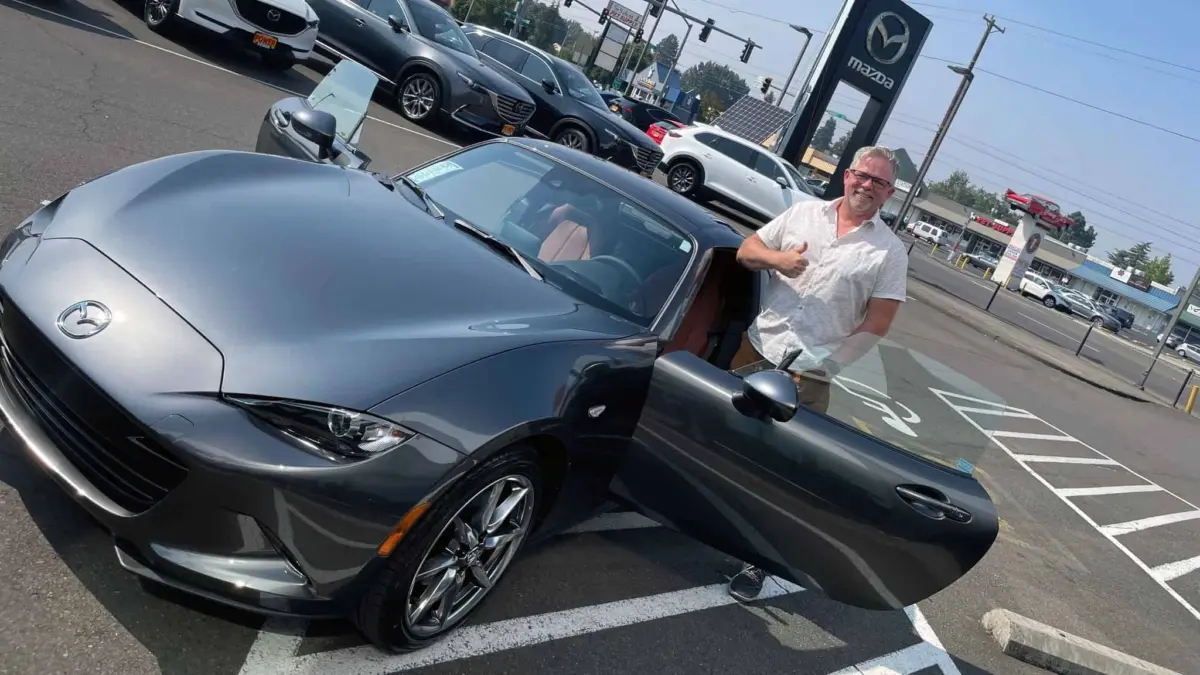
Finding the exact configuration proved slightly more challenging. The lot featured several Miatas, but none matched his precise specifications: a gray exterior, manual transmission, and a hardtop roof. Pointing to a listing for a car currently in transit on the dealership’s website, the author made his preference clear. While the dealership attempted standard sales tactics to push an immediate purchase from current inventory, they ultimately respected his stance. A tentative agreement was struck at the listed price of $39,245—which included a mandatory $1,995 market adjustment fee common during the era’s supply crunch—with the understanding that the salesman would call the moment the requested vehicle arrived.
Reflecting on the financial outlay during the drive home, the psychological hurdle of spending roughly $40,000 on a personal vehicle was softened by framing the choice clearly: would he rather keep the 2019 Maxi Cooper alongside $7,000 in cash, or own a brand-new 2022 Mazda Miata? The answer was unequivocally the latter. Seeking validation from trusted confidants, including a fellow financial writer and his supportive girlfriend, both offered an immediate endorsement.
On the final day of August, the phone call arrived. The Miata had been delivered. Dropping his current schedule, the buyer drove straight to Salem to finalize the paperwork. The vehicle was so fresh off the transport truck that its odometer read a mere five miles—a figure the veteran finance manager remarked was the lowest he had seen in three decades of processing car sales.
The drive home served as the ultimate confirmation of his choice. Taking a scenic, winding route along riverside roads and rolling farmland with the top lowered, the warm sun and rushing wind accompanied music playing softly from the stereo. Decades of financial conditioning from growing up with limited means had often fostered guilt around purchasing luxury items, but this acquisition brought no such regret. True to the philosophies of intentional spending championed by modern financial educators, the car had become a deliberate, joyful addition to a well-lived life.