



Navigating the intricacies of government-supported savings programs for individuals with disabilities can often feel like an exercise in patience and bureaucratic navigation. However, for one Canadian parent, the system recently delivered a welcome milestone. Reflecting on the financial journey of raising a child with disabilities, the parent shared the positive news that their son’s Disability Tax Credit (DTC) was successfully renewed for life two years ago in 2024, providing long-term security. While public administrative systems do not always run smoothly, this particular milestone provided a crucial foundation for the family’s broader financial planning, culminating in the arrival of the 2026 statement of entitlement in the mail.
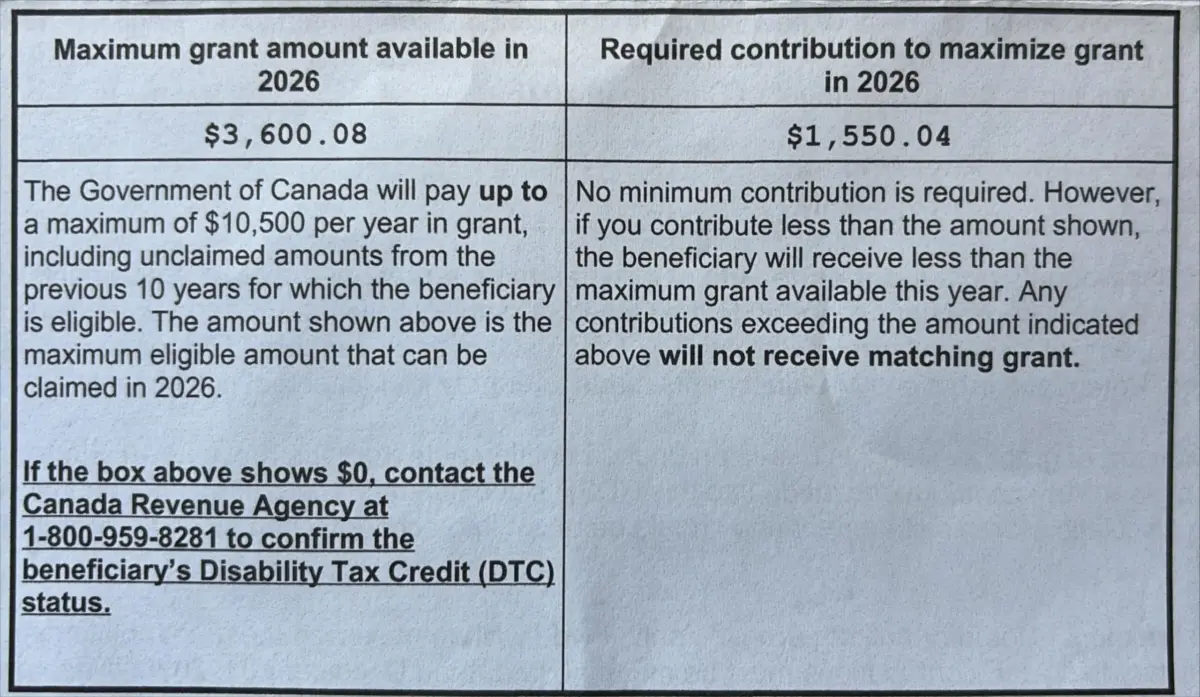
With the beneficiary now past the age of 19, a significant structural shift has taken place regarding how his Registered Disability Savings Plan (RDSP) grants and bonds are calculated. Up until this age milestone, government contributions were tied to family income. Now, however, the calculations are based entirely on the beneficiary’s personal income. Because the young adult is still actively pursuing his education—a trajectory that the family also supported by establishing a Registered Education Savings Plan (RESP) years prior—his personal income remains close to zero. As clearly outlined in his latest Grant Statement for 2026, this independent income assessment has resulted in noticeably higher government matching numbers.
The Impact of Low Personal Income on RDSP Contributions
Because of his minimal income status as a student, the beneficiary also qualified to receive a federal Bond this year, supplementing the matching grants. All of these government contributions, along with the investment growth accumulated inside the account, will ultimately be subject to tax only when the beneficiary begins drawing funds from the RDSP in the future. To maximize the current year’s entitlements, the account holder plans to set up an automatic monthly deposit. This strategy will accumulate to approximately $1,500, hitting the exact threshold required to capture the maximum matching funds provided by the federal government.
Contributors are permitted to deposit any amount of money into an RDSP at any time during the calendar year, provided they remain mindful of the lifetime maximum contribution limit of $200,000. For each eligible dollar contributed up to the matching thresholds, the government injects the corresponding grant directly into the plan. As financial planners and experienced parents frequently emphasize, the RDSP is designed fundamentally as a very long-term savings plan, requiring patience and sustained commitment over decades to realize its full compounding potential.
Although the family anticipates that the beneficiary will most likely not qualify for the Ontario Disability Support Program (ODSP) down the road, that specific outcome is not the primary focus of their current financial strategy. Instead, the immediate reality is that the income shift at age 19 represents a monumental development for families navigating the disability savings landscape. Many households experience a dramatic and beneficial increase in grant eligibility once the beneficiary’s independent income is assessed. When that personal income is low—a common scenario for students and individuals navigating significant disabilities—the government matching rate can scale up significantly, turning modest personal savings into a powerful long-term asset.

Understanding the Role of the RDSP
Despite its immense financial power, the RDSP remains a relatively quiet financial instrument. It is rarely a trending topic on social media and lacks the mainstream flashiness of other retail investment products. Yet, it stands firmly as one of the most generous government-supported savings vehicles available anywhere in Canada. The unique structural combination of Canada Disability Savings Grants and Canada Disability Savings Bonds can dramatically amplify modest, regular contributions over a long horizon, offering financial security that grows steadily behind the scenes.
DTC & RDSP FAQ
What happens to your RDSP if your DTC expires? The account will temporarily cease to receive any new grants or bonds until the Disability Tax Credit is officially renewed.
When your DTC is renewed, how long will you receive a new statement of grant eligibility? Processing times typically range between six to eight weeks, depending on the current workload of the Employment and Social Development Canada and the Canada Revenue Agency. If no documentation arrives after eight weeks, a follow-up inquiry is recommended.
My provider has locked my RDSP account so I can not put any money in, what can the department do about that? The federal administration has no direct authority over this; individual financial institutions occasionally implement unique internal policies regarding RDSP accounts. Account holders generally must wait until the specific bank lifts its internal restrictions to resume deposits.
Can an RDSP be included in a bankruptcy proceeding? No, legislative protections enacted in 2019 explicitly exclude the RDSP from all bankruptcy and insolvency actions, safeguarding the long-term security of the beneficiary.