



The precious metals sector is experiencing a turbulent start to the week, characterized by a sharp divergence between gold prices and junior mining equities. At the time of writing, the VanEck Junior Gold Miners ETF (GDXJ) is trading near $111.70, hovering just below an intraday peak of $112.81. Meanwhile, December gold futures are holding near $4,125 per ounce. This robust performance among mining stocks marks their second consecutive strong session, unfolding even as broader macroeconomic pressures weigh heavily on bullion.
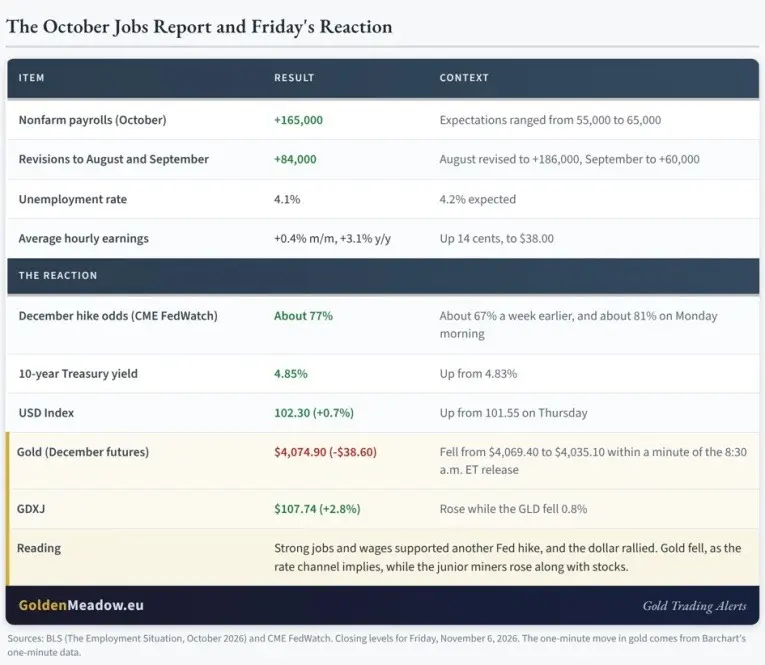
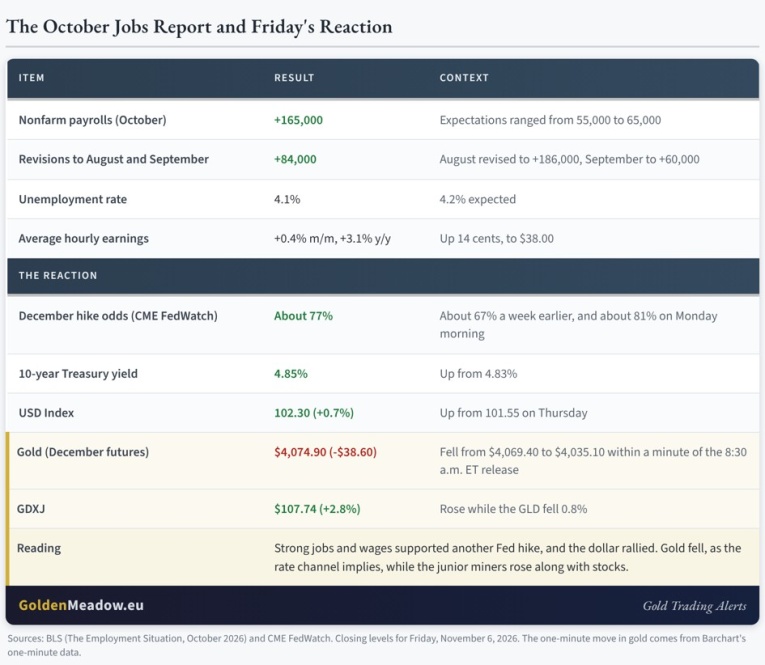
The resilience of the mining sector was first put to the test on the previous Friday. On that day, gold tumbled by $38.60 following the release of a surprisingly robust employment report. Despite the sharp pullback in the underlying metal, the junior miners’ index managed to post a 2.8 percent gain.
In a recent market forecast for November 2026, analysts pegged $3,500 as the broader downside target for gold. While Friday’s trading session did little to alter that fundamental outlook, the mining stocks behaved in a manner that market observers had flagged as critical. In a late-October market note, analysts cautioned that until junior miners began showing strength on days when gold dropped—or at least resisted downward pressure better than the metal itself—the correction in the sector would likely have further room to run. Following that warning, the GDXJ slipped from a close of $99.94 down to $93.50 within a span of four days, illustrating the vulnerability that preceded the current bounce.
The Jobs Report Hit Gold, but Not the Miners
Friday’s trading session appeared, at first glance, to provide the exact bullish divergence that market bulls had been waiting for, driven primarily by the October nonfarm payrolls data.
The U.S. labor market report blew past consensus expectations, showing an addition of 165,000 nonfarm payroll jobs compared to economists’ forecasts ranging between 55,000 and 65,000. Additionally, the national unemployment rate ticked down to 4.1 percent, while average hourly earnings registered a solid 0.4 percent increase. In the wake of this data, market pricing shifted rapidly. According to the CME FedWatch tool, the implied probability of a Federal Reserve interest rate hike at the December meeting jumped to approximately 77 percent, up from roughly 67 percent just a week prior.
Because gold is a non-yielding asset, higher interest rates increase the opportunity cost of holding the precious metal, making it significantly less attractive to institutional investors. Gold reacted predictably to this monetary policy shift, with December futures sliding to $4,074.90 and the SPDR Gold Shares (GLD) ETF falling 0.8 percent.
In sharp contrast, the GDXJ climbed 2.8 percent to close at $107.74, rebounding firmly after opening near its daily low and finishing close to the session high. While this superficial strength might suggest a classic bullish decoupling where miners lead the metal higher, market veterans note that there are two entirely distinct underlying mechanisms that can cause mining stocks to rally while gold moves in the opposite direction.
Two Reasons Why Miners Rise While Gold Falls
Understanding the dual nature of these market movements is essential for navigating the current trend. The first reason stems from broader equity market correlations. The GDXJ is composed of small- and mid-capitalization mining companies, which often trade in tandem with the broader stock market rather than strictly following bullion. When general equity markets stage a relief rally, junior mining shares frequently get swept upward in the risk-on sentiment, regardless of what gold is doing on that particular day. On Friday, this dynamic was clearly visible as the Nasdaq Composite rose 1.1 percent and the Russell 2000 small-cap index gained 0.9 percent.
The second reason reflects genuine, fundamental strength within the mining sector itself. Because the operating margins and profit growth of mining companies tend to expand at a much faster pace than the spot price of gold during certain market cycles, investors anticipating a higher long-term gold price will often rotate into mining equities ahead of the metal. At true market bottoms, miners historically lead gold higher as smart money positions early.
However, on any single trading day, both phenomena can look identical. Distinguishing between a stock-market-driven bounce and true fundamental accumulation requires observing how miners perform on days when both gold and the broader stock market decline. If junior mining stocks can hold their ground and retain their gains through the closing bell on a day when equities sell off, it signals genuine sector strength. Because Friday’s rally was accompanied by rising equity markets, it failed to provide this definitive test. Today’s session, which features both gold and stocks moving higher, similarly leaves the question unanswered, cementing the broader stock market as the primary driver and indicator for the near-term fate of mining shares.
Why the Stock Market Matters Now
The equity market rebound that supported miners on Friday followed a period of sharp liquidation. Although the S&P 500 managed a modest 0.3 percent gain to close at 7,376.86 on Friday, the index finished the week down 2.7 percent. Earlier in the week, S&P 500 futures broke decisively below their mid-2026 highs and their rising medium-term support line, marking a significant technical breakdown. Stocks have since attempted to extend their rebound, with the S&P 500 trading near the 7,500 level and futures pushing back toward the zones they recently breached.
Market analysis suggests that this equity market recovery is merely corrective in nature, a dynamic that implies mining stocks could soon face severe downward pressure once the temporary stock bounce exhausts itself. This intermarket linkage operates just as powerfully on the downside. On October 30, when the S&P 500 suffered a 1.8 percent drop, the GDXJ plunged by 5.9 percent. For historical context, during the broader financial panic of 2008, the GDX plummeted 53.5 percent between September 19 and October 27, while the S&P 500 declined 32.4 percent over the same period, illustrating just how vulnerable high-beta mining equities are when broader liquidity dries up.
Gold itself has participated in the latest rebound, driven by specific macroeconomic catalysts that point toward similar underlying trends.
Gold Rebounds, and Silver’s Lead Fades
Gold found a fundamental catalyst for its morning bounce following comments from political leaders. Crude oil prices slid after statements indicated that renewed military conflicts in the Middle East were considered unlikely if ongoing diplomatic discussions with Tehran made headway. The resulting drop in energy prices helped ease immediate inflation expectations, providing temporary relief to gold through the interest rate transmission channel.
Despite this bounce, gold remains below its recent high of $4,155.80 established on Thursday, and early signs of outperformance in silver have already begun to evaporate. Shortly after global markets opened, the gold-to-silver ratio dipped to 77.41, signaling initial relative strength in silver. However, that lead quickly faded, pushing the ratio back up near 78.5, slightly higher than Friday’s close of 78.45.
Market strategists note a historical precedent regarding these silver-led recoveries. When silver leads a bounce in the precious metals complex, the move is frequently corrective rather than the inception of a new, sustainable bull run. Previous short-lived rebounds that displayed this characteristic quickly faded within 48 hours, matching the behavior of the current recovery.
The next major test for the market arrives with the release of the October Consumer Price Index (CPI) report. A hotter-than-expected inflation reading would instantly reinforce expectations for a December Federal Reserve rate hike, heaping renewed pressure onto bullion prices. Prior to the opening bell, advisory notes to subscribers highlighted that while junior miners might soar during the session, the advance was viewed as likely temporary, with the GDXJ having already surpassed initial upside price targets.
Where This Leaves Us
The recent price action reveals a complex environment where junior miners have managed to climb on gold’s down days and post sharp gains during broader market rebounds. Yet, these advances remain closely tied to the broader equity market, which technical indicators suggest is experiencing a purely corrective bounce. At the same time, gold’s recovery relies on transient news triggers, and silver has failed to maintain its early relative strength.
From a broader perspective, the underlying trend for gold points toward a deeper correction targeting the $3,500 region. Once the current corrective rally in the stock market runs its course, mining equities are expected to face renewed, aggressive downside pressure. For now, while the market continues to react to daily equity movements, the ultimate test of resilience for the mining sector will only arrive when broader stocks turn decisively lower.