





The Principal Investment Grade Corporate ETF (IG) operates as an actively managed fixed-income fund dedicated primarily to investment-grade corporate debt. Designed to outperform a broad corporate market index, the fund seeks to uncover value by identifying bonds that are priced attractively relative to similar issues in the marketplace. Managing roughly $202 million in assets, the ETF offers investors a combination of active security selection and strict duration parameters, balancing corporate credit exposure against broader macroeconomic shifts.
How Is IG Structured?
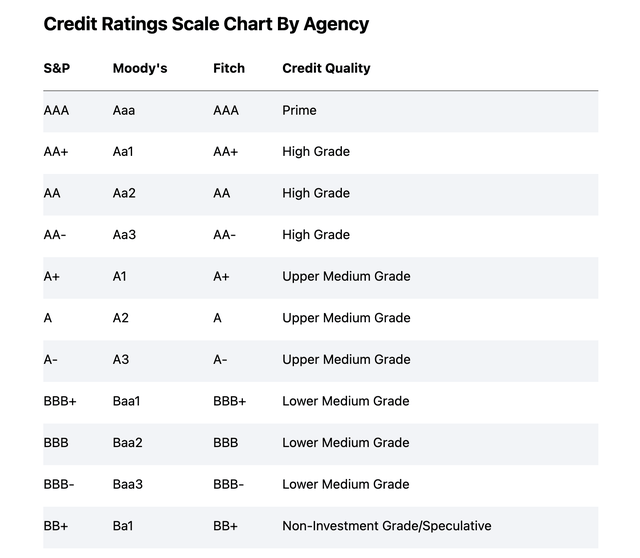
Operating without a strict indexing mandate, IG is actively managed, though its explicit benchmark remains the Bloomberg US Corporate Investment Grade Index, a massive universe comprising approximately 8,800 individual bonds. Regulatory requirements dictate that at least 80% of the fund’s net assets must remain invested in investment-grade corporate bonds and other fixed-income instruments. Investment grade is defined as carrying a rating of BBB- or higher from Standard & Poor’s or Baa3 or higher from Moody’s, with the higher rating taking precedence in the event of conflicting evaluations. Unrated securities are evaluated at the discretion of the management team, which also retains the flexibility to hold U.S. government debt, foreign corporate bonds, and foreign government securities payable in U.S. dollars.
Duration management plays a crucial role in the fund’s operational strategy, serving as a direct gauge of how much a bond’s price will fluctuate in response to shifting interest rates. For instance, a duration of seven years suggests that a one-percentage-point increase in interest rates would result in an approximate 7% decline in bond prices. The parameters governing IG require its duration to stay within a 10% band of its benchmark’s duration in either direction. With the benchmark duration sitting at 6.7 years, the fund’s operational window generally ranges between 6.0 and 7.4 years.

Rather than constantly buying and selling underlying bonds to fine-tune duration, portfolio managers frequently utilize Treasury futures—exchange-traded contracts that correlate directly with Treasury price movements. Additionally, managers employ credit default swaps and credit index futures to dynamically adjust sector exposures or individual corporate risks. Over a recent one-year period, trading activity by the managers equaled more than 80% of the portfolio’s total value, underscoring the dynamic nature of the strategy. Originally launched in April 2018 as the Principal Investment Grade Corporate Active ETF, the fund dropped the word "Active" from its official title while maintaining its active management approach. It carries a net expense ratio of 0.19% and distributes income to shareholders on a monthly basis.
What’s in the Principal Investment Grade Corporate ETF Portfolio?
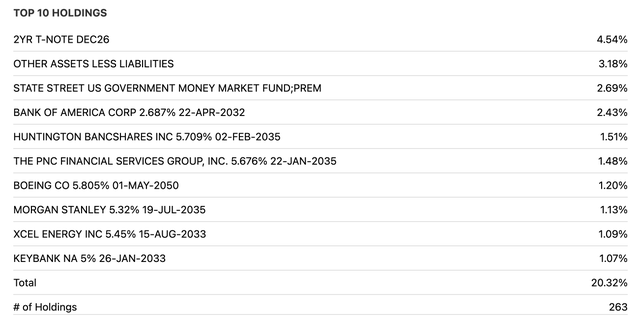
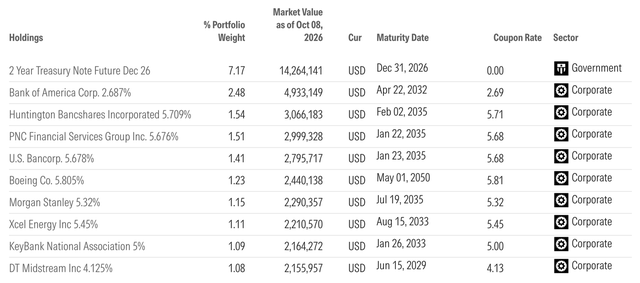
The portfolio maintains a diversified roster of holdings, spanning hundreds of individual issues. The fund’s top exposures include a mix of corporate debt notes alongside derivative and cash management instruments. A notable portion of the top holdings typically features corporate bonds issued by major banking institutions, reflecting a broader portfolio weighting toward the financial sector, which encompasses banks, brokerage firms, and insurance providers. Many of these financial sector notes feature variable-rate structures, paying a fixed coupon for an initial period before transitioning to a floating interest rate.
Credit quality distribution within the fund leans heavily toward the lower tier of investment-grade territory. A substantial majority of the portfolio’s bond holdings are rated BBB, which represents the lowest tier of investment grade, alongside a small allocation to high-yield or lower-rated categories when evaluated across multiple rating agencies like Fitch alongside S&P and Moody’s. While the prospectus strictly relies on S&P and Moody’s metrics using the higher rating, agency comparisons reveal that the fund willingly navigates the riskier end of the investment-grade spectrum to capture higher yields. The average effective maturity of the portfolio extends well beyond a decade, while effective duration hovers around traditional intermediate-to-long-term parameters, though these figures shift dynamically alongside active portfolio rebalancing.
How Might IG Fit in a Portfolio?
Corporate bonds inherently offer higher yields than risk-free U.S. Treasuries to compensate investors for credit risk, including the possibility of issuer downgrade or default. The fund’s recent yield to maturity stands notably above comparable intermediate Treasury notes, generating a positive credit spread that appeals to income-seeking investors.
Integrating IG into an existing asset allocation depends heavily on the investor’s current holdings. Adding the fund to broad market aggregates like the iShares Core US Aggregate Bond ETF or Vanguard Total Bond Market ETF primarily increases exposure to corporate credit while maintaining a relatively similar level of interest rate sensitivity. Conversely, investors heavily weighted in ultra-short cash instruments take on both credit and duration risk by introducing IG, whereas a portfolio concentrated exclusively in long-duration government bonds would see an increase in credit risk coupled with a reduction in overall rate sensitivity.
Tax considerations also play a vital role in portfolio placement. Because corporate bond interest is taxed as ordinary income and—unlike U.S. government debt—is subject to state income taxes, financial planners frequently suggest holding funds like IG within tax-advantaged accounts such as an IRA or 401(k) to maximize net returns.
How Has IG Performed Since Inception?
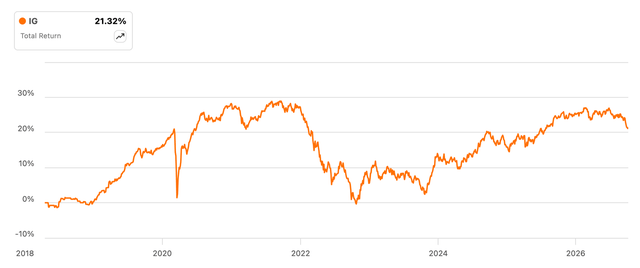
Since its inception, the fund has generated a modest annualized total return, tracking closely alongside its target corporate bond index before accounting for management fees. While broad economic conditions, Federal Reserve monetary policy, and shifting interest rate cycles have triggered significant price volatility over the years, income distributions have served as the primary driver of total return.
Sharp market disruptions, such as the pandemic-induced volatility in early 2000s and the aggressive monetary tightening cycle initiated by central banks to combat inflation, have profoundly impacted share prices. During periods of aggressive interest rate hikes, fixed-income valuations faced substantial downward pressure, leading to notable capital losses that were only partially mitigated by incoming interest payments. Conversely, periods of monetary easing or stabilizing credit spreads have historically provided a tailwind for corporate debt valuations.
On a distribution level, the fund has maintained steady monthly payouts, delivering a consistent dividend yield relative to its share price. However, in taxable brokerage accounts, federal and state income taxes levied on these monthly distributions can significantly erode the real after-tax return, underscoring the importance of tax-efficient placement for long-term holders.
How Might IG Perform in Different Markets?
Market environments characterized by rising interest rates typically pressure fixed-income valuations downward according to duration math, though the higher ongoing income generated by the portfolio helps cushion some of the capital losses. When macroeconomic pressures, such as geopolitical conflicts or persistent inflation, drive yields higher, the expansion of yields results in measurable price declines, which are partially offset by quarterly or monthly interest accruals. Falling interest rates generally produce the inverse effect, driving share prices higher while gradually depressing future distribution yields as maturing bonds are replaced with lower-yielding alternatives.
Because the portfolio maintains a heavier concentration in BBB-rated corporate bonds compared to its benchmark index, it remains sensitive to credit spread movements. BBB-rated spreads are typically wider and more volatile than those of single-A or double-A rated issuers. A widening of credit spreads driven by economic uncertainty or sector-specific distress—such as historical banking sector selloffs—can disproportionately weigh on the fund’s relative performance compared to a higher-quality index.
How Does The Principal Investment Grade Corporate ETF Compare to Peers?
The landscape of actively managed and passive corporate bond funds features a diverse array of competitors. Active peers include quantitative strategies, funds that incorporate modest high-yield allocations to boost income, and strategies segmented rigidly by specific maturity ranges. Passive alternatives, including index-tracking ETFs from major providers, offer broad exposure to the corporate debt market at significantly lower expense ratios, appealing to cost-conscious investors who prefer passive replication over active management. Other specialized funds utilize systematic credit screening models to filter out issuers at high risk of downgrades, while traditional aggregate bond funds mix corporate debt with government-backed mortgages and Treasuries to achieve broader diversification.
Active management within IG allows for tactical positioning through derivatives and disciplined duration targeting, distinguishing the fund from rigid index followers. Ultimately, the choice between IG and its extensive peer group depends on an investor’s preference for active oversight, tolerance for credit risk within the BBB tier, and sensitivity to expense ratios in a competitive fixed-income ETF marketplace.