


The foundational rule of retirement planning may need a serious update when applied to the modern wave of early retirees. According to a recent collaborative study by personal finance figures Nick Maggiulli, author of Just Keep Buying, and the financial blogger known as the Mad Fientist, the traditional 4% rule fails to adequately capture the unique financial realities and spending flexibility of individuals who leave the workforce in their 30s or 40s.
For decades, the 4% rule has served as a cornerstone of retirement mathematics. Developed by financial advisor William Bengen, the rule suggests that a retiree can safely withdraw 4% of their portfolio value in the first year of retirement, then adjust that dollar amount upward for inflation in every subsequent year, ensuring the nest egg lasts for a standard 30-year timeline. However, financial researchers and early retirement advocates have increasingly scrutinized whether this rigid framework suits individuals charting a path toward Financial Independence (FI) decades earlier than traditional retirement age.
The core critique of applying the 4% rule to early retirement centers on a lack of contextual flexibility. Traditional retirees in their 70s or 80s typically face rigid lifestyle structures, fixed health care expenses, and limited avenues for altering their consumption or generating supplemental income. Conversely, someone who retires in their 30s or 40s possesses significantly higher lifestyle and spending flexibility. They often maintain stronger earning potential, a greater capacity to re-enter the workforce if necessary, and a budget containing a substantial proportion of discretionary expenses that can be scaled back during economic downturns.
Furthermore, recent economic analyses suggest that the standard 4% calculation is inherently conservative in how it treats inflation. During a recent episode of the media series Money with Katie, William Bengen discussed how the 4% rule assumes that every single expense item inflates annually at the consumer price index rate. In reality, major household costs—such as a 30-year fixed-rate mortgage—remain entirely insulated from inflation, meaning the actual purchasing power required over time may be lower than traditional projections assume.
Despite these conservative buffers, early retirees face a longer timeline, often stretching 40, 50, or 60 years. Conventional wisdom dictates that a longer retirement horizon necessitates a significantly lower initial withdrawal rate. Yet, historical data analyzed by retirement experts like Michael Kitces suggests that the adjustment is less drastic than commonly assumed. Research indicates that extending a retirement timeline by 10 years requires lowering the initial withdrawal rate by roughly 0.6%. More importantly, historical simulations show that a portfolio designed to survive 40 years possesses a remarkably high probability of lasting indefinitely due to the mechanics of sequence of returns risk.
Combining these insights creates a compelling financial puzzle. If the baseline 4% rule is arguably closer to 4.8% due to conservative inflation assumptions, and must be lowered by roughly 0.6% to accommodate a 40-year timeline, the resulting figure lands right back near the traditional 4% benchmark. However, this calculation still omits the defining characteristic of early retirement: discretionary spending flexibility.
To address this gap, Maggiulli and his collaborator developed a dynamic withdrawal strategy that explicitly incorporates discretionary spending into portfolio math. The methodology begins by categorizing household expenditures into essential costs—those required for basic survival and stability—and discretionary expenses, which represent lifestyle choices that can be trimmed during lean market periods.
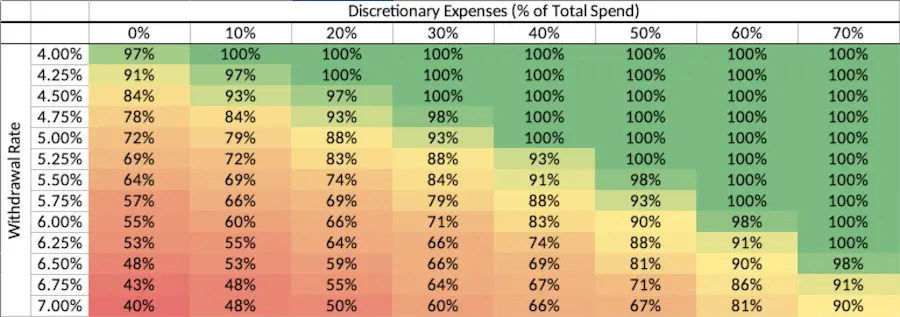
By analyzing historical stock and bond market performance across 40-year rolling periods from 1926 through 2022, the researchers modeled how portfolios perform when retirees adjust their discretionary spending downward following poor market years. The resulting data demonstrates that retirees who are willing to flex their lifestyle spending can safely utilize a higher initial withdrawal rate without sacrificing their overall probability of portfolio survival.
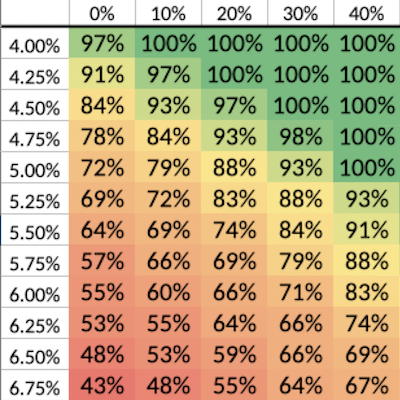
For example, a retiree managing a $1 million portfolio split 80/20 between stocks and bonds would traditionally be limited to a 40,000-dollar initial withdrawal under the 4% rule, yielding a roughly 96.5% historical success rate over 40-year periods. However, if that same retiree classifies 50% of their spending as discretionary and agrees to scale back those non-essential outlays following market declines, they can increase their initial withdrawal rate to 5.5% while maintaining an even higher statistical probability of success.
Under this dynamic framework, the retiree’s essential spending continues to adjust upward with inflation each year to protect core purchasing power. Meanwhile, the discretionary portion of the budget adjusts based on the previous year’s market performance. In years following major market downturns, discretionary spending is reduced or temporarily suspended, shielding the core portfolio from the destructive impacts of sequence of returns risk while preserving long-term financial viability.
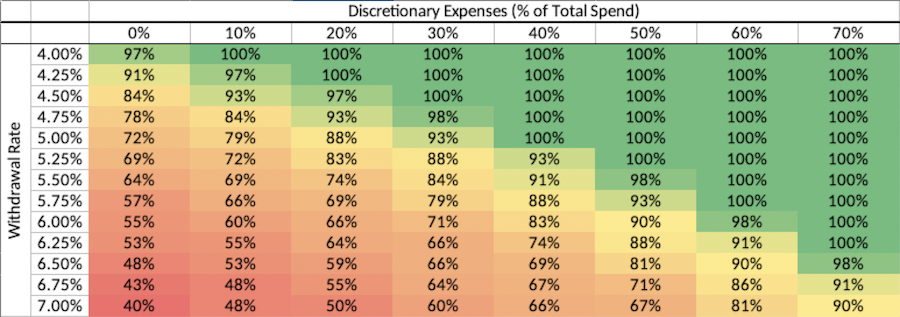
This approach offers a dual advantage for the early retirement community. Retirees can either choose to spend more annually while maintaining a standard retirement target, or they can leverage the higher initial withdrawal rate to reach their financial independence number years earlier. For a household requiring $40,000 in annual spending, utilizing a 5.5% withdrawal rate reduces the required nest egg from $1 million down to approximately $727,000, significantly shortening the accumulation phase.
Beyond the raw mathematics, financial researchers point out that flexible withdrawal strategies may help mitigate the psychological hurdles often experienced by early retirees. Many individuals who successfully reach financial independence report feeling disoriented once money ceases to be a primary motivating factor in their daily lives. Implementing a structured, active management strategy for discretionary funds introduces a sense of agency and purposeful financial stewardship that aligns with long-term portfolio preservation.
While tying spending adjustments to overall market performance rather than individual portfolio metrics introduces a broad macroeconomic barometer, proponents argue it has practical advantages. Broader market downturns typically coincide with tighter labor markets and economic uncertainty, signaling an appropriate time for financial caution even if an individual’s specific asset allocation fluctuates differently. Furthermore, because the model is fully customizable, retirees can fine-tune their essential-to-discretionary ratios to match their personal risk tolerance, ensuring they maintain a comfortable baseline of lifestyle spending regardless of external market conditions.