



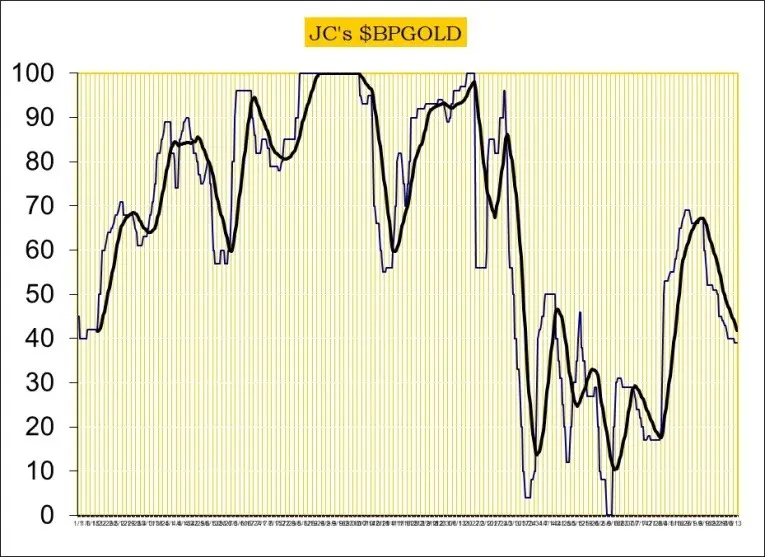
The latest technical analysis of the precious metals market points toward a shifting landscape, as proprietary market cycle indicators turn decisively downward for the broader gold sector. While underlying multi-week trends for both bullion and gold equities remain technically upward, recent market action reveals a failed recovery rally that has collided with formidable overhead resistance. This clash between intermediate trends and short-term cyclical pressure suggests that a correction is currently underway, prompting cautious positioning among market participants.

For traders and investors monitoring the precious metals complex, the proprietary cycle indicator serves as a primary timing mechanism. Although market volatility can occasionally produce short-term whipsaws, the indicator has historically provided a reliable framework for gauging market direction and determining speculative posture. The latest reading indicates that the cycle has shifted to a downward phase across the sector, signaling a period where defensive positioning may be warranted.

Strategic adjustments depend heavily on individual market participation styles. Investors navigating the current environment are generally advised to remain in cash or maintain hedged positions to protect capital against ongoing downward pressure. Meanwhile, active traders who rely on cyclical fluctuations look to capitalize on shorter-term price swings by entering positions strictly at cycle bottoms and exiting when the market reaches cycle tops, though the prevailing downward bias requires heightened vigilance.

The underlying weakness is reflected across several major gold-backed instruments and equity benchmarks. Key indicators tracking physical gold, such as GLD, have flashed short-term sell signals, aligning with similar technical warnings issued across major mining sector benchmarks. This includes the VanEck Gold Miners ETF (GDX), the S&P/TSX Global Gold Index (XGD.to), and the Junior Gold Miners ETF (GDXJ). The synchronized nature of these sell signals underscores the breadth of the current short-term pullback affecting both the metal and the companies that mine it.

A deeper dive into the technical analysis reveals the competing forces currently at play within the macroeconomic environment. Overall market speculation points toward lower gold prices in the near term, a projection reinforced by recent price action. Yet, a closer examination of the broader charts shows that the primary trend for gold remains pointed upward, though prices are currently retreating to test crucial support levels. A similar resilient primary trend is visible in gold stocks, which have maintained their upward trajectory despite recent turbulence.

At the same time, the US Dollar (USD) continues to display an upward trend, creating a persistent headwind for dollar-denominated commodities like gold. This strengthening currency dynamic has contributed heavily to recent market friction. Furthermore, ratio analysis of the sector has generated a fresh sell signal, while attempts by gold stocks to break higher have been firmly rejected at established resistance levels. Amid this consolidation, technical observers are also monitoring the potential formation of an inverted head and shoulders pattern, which could hint at longer-term structural developments once the current corrective phase runs its course.

In summary, the gold sector cycle has turned down, aligning with a short-term correction that follows the rejection of a recent recovery rally at major resistance levels. While the longer-term structural trends for gold, gold stocks, and the US Dollar retain an upward bias, the immediate technical environment favors caution.

Market analysts emphasize that these observations do not constitute forward-looking predictions or price forecasts. Rather, the insights reflect the outputs of a systematic trading model designed to generate objective signals, establishing whether market participants should hold long exposure, short exposure, or remain in cash at any given moment. Because real-time entry points and stop-loss levels are continuously managed and communicated directly to subscribers, retrospective market updates may not fully capture live positioning. Market participants are ultimately encouraged to exercise their own discretion and trade according to their individual risk parameters.