




In a major development for the corporate carbon removal market, San Francisco-based carbon removal company Working Trees has announced that it has signed a series of long-term offtake agreements with technology giant Google and global management consulting firm McKinsey & Company. The landmark deal will result in the generation of 320,000 carbon removal credits through innovative "silvopasture" projects designed to support nature restoration and sustainable farming practices in Brazil.
The high-impact agreements were facilitated through the Symbiosis Coalition, an advance market commitment (AMC) collaboration that was originally launched in 2024. The coalition operates with a collective, ambitious commitment to contract up to 20 million tons of nature-based carbon removal credits by the year 2030. By pooling corporate demand, the coalition aims to send a strong, reliable market signal that helps enable the development of high-impact, science-based restoration projects capable of advancing meaningful progress on global climate goals.
At the heart of this new initiative is silvopasture, a specialized type of agroforestry that thoughtfully integrates trees directly into active grazing land. This agricultural technique serves multiple vital purposes, including reducing deforestation pressure, restoring depleted soil health, and improving overall agricultural productivity while simultaneously drawing down and removing carbon dioxide from the atmosphere. According to data cited by the Symbiosis Coalition, scientific estimates suggest that widespread adoption of silvopasture could successfully remove between 300 million and 1 billion metric tons of carbon dioxide annually on a global scale.
Julia Strong, Executive Director of the Symbiosis Coalition, underscored the unique potential of the agricultural method in light of the new agreements. "Silvopasture is one of the most underused tools we have for nature-based carbon removal, and what excites us about the Working Trees project is how much room there is to scale it," Strong said. "Working Trees’ project is sequestering carbon while also improving the land that communities rely on."
Founded in 2021, Working Trees specializes in developing nature-based carbon removal projects focused on restoring degraded pastureland by seamlessly integrating trees into existing cattle grazing operations. The company actively partners with local landowners to implement practical silvopasture systems. These systems are carefully designed to remove carbon dioxide from the atmosphere, improve soil health, restore local biodiversity, and enhance overall agricultural productivity, all while allowing for the uninterrupted continuation of livestock grazing.
Under the newly finalized terms of the agreements, Google and McKinsey will purchase a combined total of 320,000 metric tonnes of high-integrity carbon removal credits from Working Trees over a dedicated 10-year period. In exchange, Working Trees will direct the crucial funding secured through these long-term contracts toward the ambitious restoration of 8,700 hectares of degraded and semi-degraded pasture. This effort forms a key component of a larger, sweeping 50,000-hectare project spanning the southeastern Amazon and the ecologically vital Cerrado region situated in central Brazil.
Randy Spock, Head of Carbon Removal at Google, emphasized the innovative nature of the partnership and its alignment with global environmental needs. "This partnership represents a significant leap forward for high-integrity, natural climate solutions," Spock stated. "Cattle grazing is one of the most dominant land uses globally; by integrating trees directly onto active pastures, Working Trees demonstrates that we don’t have to choose between food production and ecological restoration. It’s a scalable, tech-driven approach that benefits both global carbon removal and local farming livelihoods."

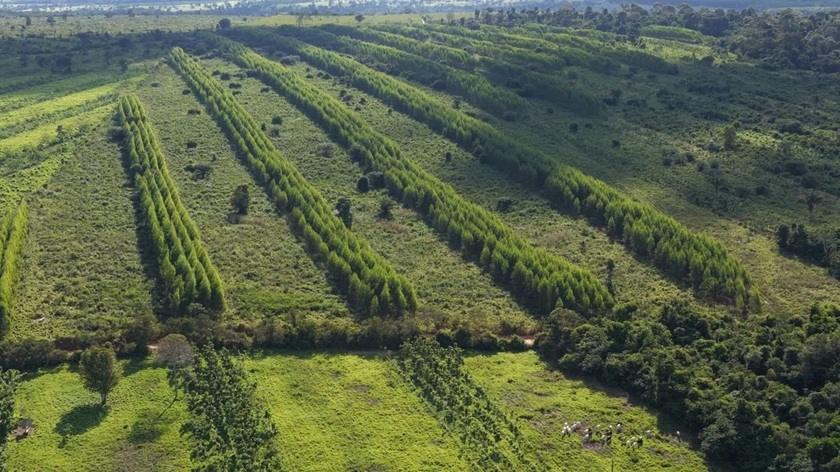
To achieve these environmental and agricultural goals, the project aims to restore the land by strategically planting rows of native and commercial timber trees directly onto existing cattle pastures. This thoughtful layout allows traditional livestock grazing to continue uninterrupted while the growing canopy removes carbon dioxide from the ambient air. The newly introduced trees are anticipated to deliver a wide array of localized ecological and economic benefits, including providing essential shade for cattle during peak temperatures, improving soil health and water retention capabilities, enhancing local biodiversity, and increasing overall resilience to extreme weather events such as drought and disease.
Furthermore, the project will carefully combine native species—which are chosen specifically to provide critical ecological benefits and offer additional resources for both cattle and local landowners—with high-value commercial timber species. The commercial species selected for the initiative include African Mahogany and Teak. These valuable timber trees are expected to generate steady, long-term revenue streams for participating farmers, providing a powerful financial incentive to maintain the trees over time and thereby supporting the long-term economic and environmental viability of the entire project.
Isabelle Schuhmann, Global Director of Environmental Sustainability at McKinsey, highlighted the importance of the initiative within the context of corporate climate action. "Scaling high-integrity nature-based carbon removal is an essential part of our sustainability strategy," Schuhmann noted. "By supporting Working Trees’ silvopasture model, we are backing a replicable approach to sustainable land use, unlocking large carbon sinks while strengthening the resilience of local economies."